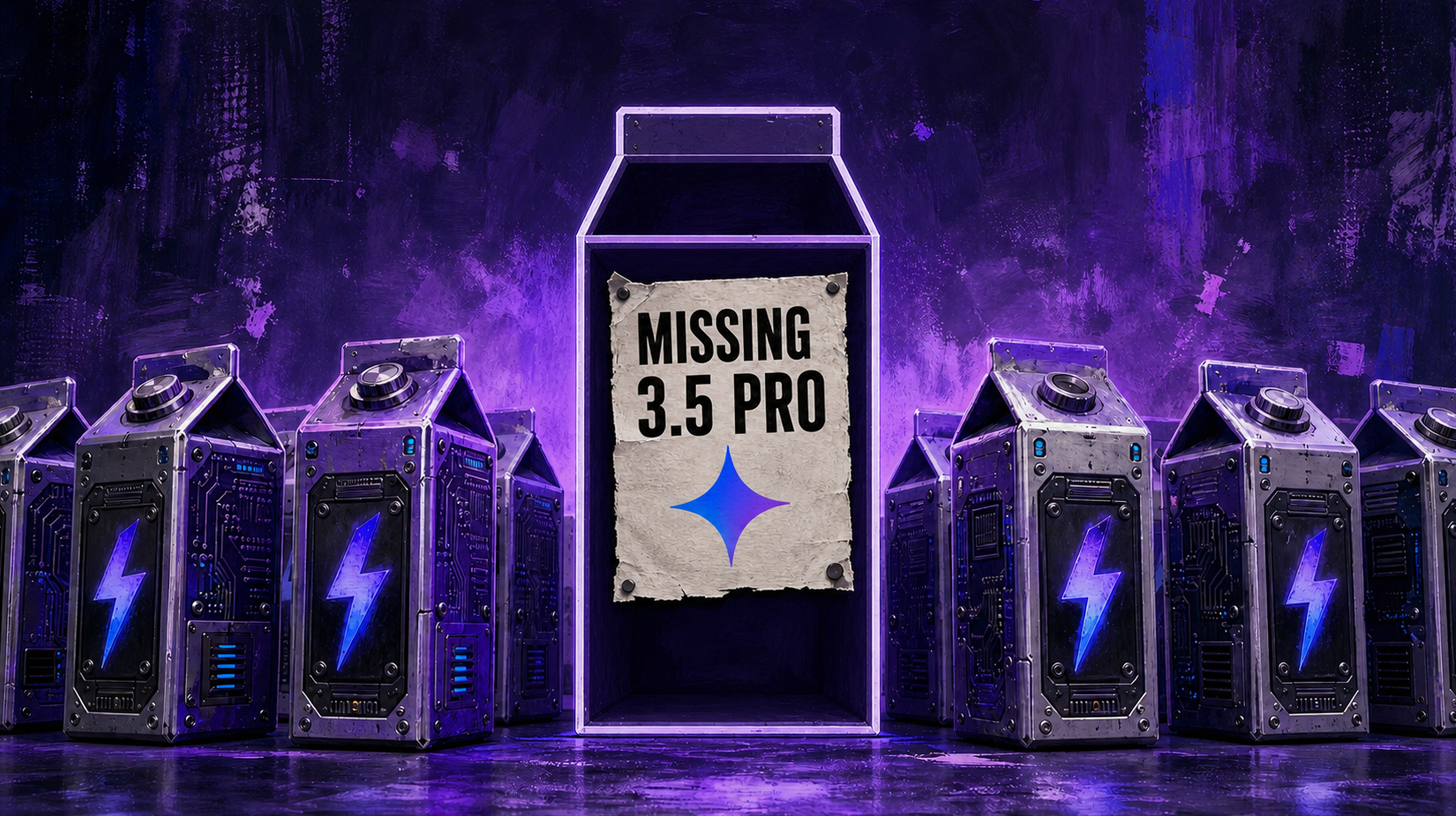
Good morning, {{ first_name | AI enthusiasts }}. Google just added three more models to the Gemini family. Somehow, that made the missing one even harder to ignore.
A new Flash trio covers speed, low-cost use, and cybersecurity, and the company’s “most ambitious pre-training run yet” for Gemini 4 is already in progress. But the delayed 3.5 Pro model expected to challenge frontier rivals? Still nowhere to be found.
Reminder — Our next live workshop is today at 12 PM EST! Join and learn how to go from idea to working product without a technical team using AI tools for research, prototyping, iteration, and more. RSVP here.
Google drops new Flash models as Pro stays missing
AI's biggest copyright bill comes due
Sell high-value AI workflow audit as a consultant
Poolside resurfaces with a top open-weights coder
4 new AI tools, community workflows, and more
The Rundown: Google just released a trio of Gemini models, led by 3.6 Flash, alongside a speed-focused 3.5 Flash-Lite and a security-fine-tuned 3.5 Flash Cyber, prioritizing efficiency over intelligence, as the long-awaited 3.5 Pro remains in testing.
3.6 Flash brings efficiency upgrades over its predecessor, but is still topped by similar-priced rivals like Grok 4.5 and GPT-5.6 Luna on a variety of tests.
On Artificial Analysis’ Intelligence Index, 3.6 Flash strangely shows no upgrade over 3.5, slotting in near Meta’s Muse Spark and Z AI’s open GLM 5.2 model.
3.5 Pro remains unreleased after several delays, with Google's Logan Kilpatrick saying the model is "testing with partners" and "will hopefully land soon."
Google also ended the announcement with an update on Gemini 4, saying the company has kicked off its "most ambitious pre-training run yet".
Why it matters: While a lot of people use Gemini models, which makes efficiency upgrades useful, these scores and the absence of a strong frontier model only add to the perception that Google is falling behind (with even Elon chiming in to take a jab). A lot is riding on the company’s 3.5 Pro and its 4 class that is now in training.
TOGETHER WITH UNWRAP
The Rundown: Unwrap is a customer intelligence platform that pulls your feedback (surveys, reviews, support tickets, social comments) into one view, using AI and NLP to surface actionable insights and deliver them straight to your inbox.
All customer feedback automatically categorized
Query feedback using Unwrap Assistant, or in your favorite tools using Unwrap's MCP
Real-time alerts and a clear view of customer sentiment as it shifts
The tools trusted at scale by Perplexity, DoorDash, Southwest, lululemon, and Oura
ANTHROPIC & AI COPYRIGHT

Image source: Images 2.0 / The Rundown
The Rundown: Anthropic secured court approval for a $1.5B settlement with book authors, clearing payouts of nearly $3,000 a title across 482K works pulled from piracy sites — a record for U.S. copyright cases that leaves AI training standing as fair use.
The case dates back to 2024, when novelist Andrea Bartz and other writers accused Anthropic of training Claude on texts lifted from internet piracy hubs.
Judge William Alsup split the case in 2025, ruling AI training as legal fair use but treating Anthropic's 7M-book pirated stockpile as its own violation.
The settlement spared Anthropic a jury trial that was set for last December, where it faced potential damages of several hundred billion (!) dollars.
Why it matters: $1.5B sounds like a lot until you weigh it against a trial with potential damages in the hundreds of billions, and a fair-use ruling that now goes untouched while Anthropic keeps training on (legally purchased) books. With other labs facing similar suits, $3,000 a work may be the new rate for making copyright issues disappear.
AI TRAINING
The Rundown: In this guide, you will learn how to turn your AI knowledge into a focused consulting offer. Using Claude, you will choose a narrow problem, collect client context, and create a one-page opportunity brief leading to an implementation project.
Ask Claude to interview you about the work, industries, and tools you know best, then suggest three consulting angles. Pick the one that works best
Ask Claude to build an AI assessment for a prospect to uncover AI opportunities in their business, scored out of 100, and publish as a live Artifact
Save their answers. Then, feed those responses, along with the prospect’s website, into Claude, asking it to find the highest-return workflow to fix with AI
Ask Claude to turn the findings into a client-ready slide deck, complete their audit result, the bottleneck, practical solutions, and a sensible next step
Pro tip: Before the audit, have Claude research the best tools, templates, and examples for your niche, and keep that library ready to match against bottlenecks.
PRESENTED BY GOOGLE FOR STARTUPS
The Rundown: Bridging the gap between a multimodal sandbox demo and a scalable product is a massive engineering challenge. The Startup technical guide on generative media provides the architectural blueprint to actually build and deploy your ideas.
Inside the guide, you’ll learn how to:
Architect multimodal workflows that orchestrate media pipelines
Turn models like Veo and Lyria into high-traffic, user-facing apps
Build backends for economic scaling, deterministic output, and reliability
POOLSIDE
The Rundown: Poolside launched Laguna S 2.1, a new open-weights coding model that tops the Western open-source field while staying small enough to live on a single desktop — the strongest sign of America’s response to China's open-model lead.
S 2.1 uses just 8B of 118B parameters at a time, letting it fit on one Nvidia DGX Spark desktop box, with the weights free to grab on Hugging Face.
Poolside’s model tops coding benchmarks for U.S. open systems, but still trails significantly behind Kimi K3 and several other Chinese open models.
Laguna arrives a week after Mira Murati's TML released its Inkling as its first-ever model, with both expanding the U.S.’ limited open source pool.
Poolside said training took under nine weeks, with co-CEO Jason Warner telling Forbes the aim is to create "the most capable open model in the West."
Why it matters: TML's Inkling made self-hosted coding AI more interesting for U.S. buyers last week, and Laguna now adds a smaller option with even stronger results. Two releases don’t erase China's deep lead (and Kimi is still lapping the field), but they at least show that American open-source has momentum instead of just a gap.
🔒 Incogni - remove your personal data from the web so scammers and identity thieves can’t access it. Use code RUNDOWN to get 55% off*
🚀 Laguna S 2.1 - Poolside's open-weight coding AI with a 1M-token context
🎆 Qwen-Image-3 - Alibaba’s new image model with strong text rendering
Mozilla released its 2026 State of Open Source AI Report last week, revealing open models now rival Big Tech's best. Learn more.*
Twitter and Block founder Jack Dorsey unveiled Buzz in early access, an open-source workspace where AI agents join team chats as coworkers.
Substack introduced a new partnership with Pangram that embeds its AI writing detector tool into the platform for both readers and publishers.
Anthropic rolled out Record a skill, a feature (similar to Codex’s upgrade) that allows users to screen-record a workflow to let Claude create a skill around the task.
Sakana AI released Fugu-Cyber, a security model that bundles specialist agents behind one API, claiming benchmarks on par with GPT-5.5-Cyber and Mythos Preview.
Every newsletter, we showcase how a reader is using AI to work smarter, save time, or make life easier.
Today’s workflow comes from reader Jonathan in Waxhaw, NC:
“I'm writing a novel. Asking AI 'is it good?' receives flattering positive feedback — annoying.
I've developed an evaluation protocol which prompts multiple AIs to assess the material through market research simulation, from four perspectives: reader acceptance, publication acceptance, production acceptance, and marketability. The protocol instructs the AI to generate four personas — some antagonistic, some YA-biased, some literature aficionados, and some business-biased.
I've input prose and pitch decks, and results have identified gaps, inconsistencies, and positives. Running across multiple AIs gives results that differ but frequently identify the same strengths and weaknesses. These results are LLM training-biased, but different draft revisions and comparing across AIs gives valuable feedback.”
How do you use AI? Tell us here.
That's it for today!
Before you go we’d love to know what you thought of today's newsletter to help us improve The Rundown experience for you.
Rowan, Zach, Shubham, and Jennifer — the humans behind The Rundown