AI/ML News & Innovations Hub

AI/ML news, top picks, and generated innovation digests.

★ Visit ai-karthik.com
426Sources
86241News Items
8Top Picks
428Blogs
successLast Run

Latest AI/ML News

86241 matching items

Future of AI Honeypots
LessWrong AI 2026-11-12 20:25 UTC Score 84.0 USR-0152-20261112-community-fo-8540bbcf Full article

Future of AI Honeypots

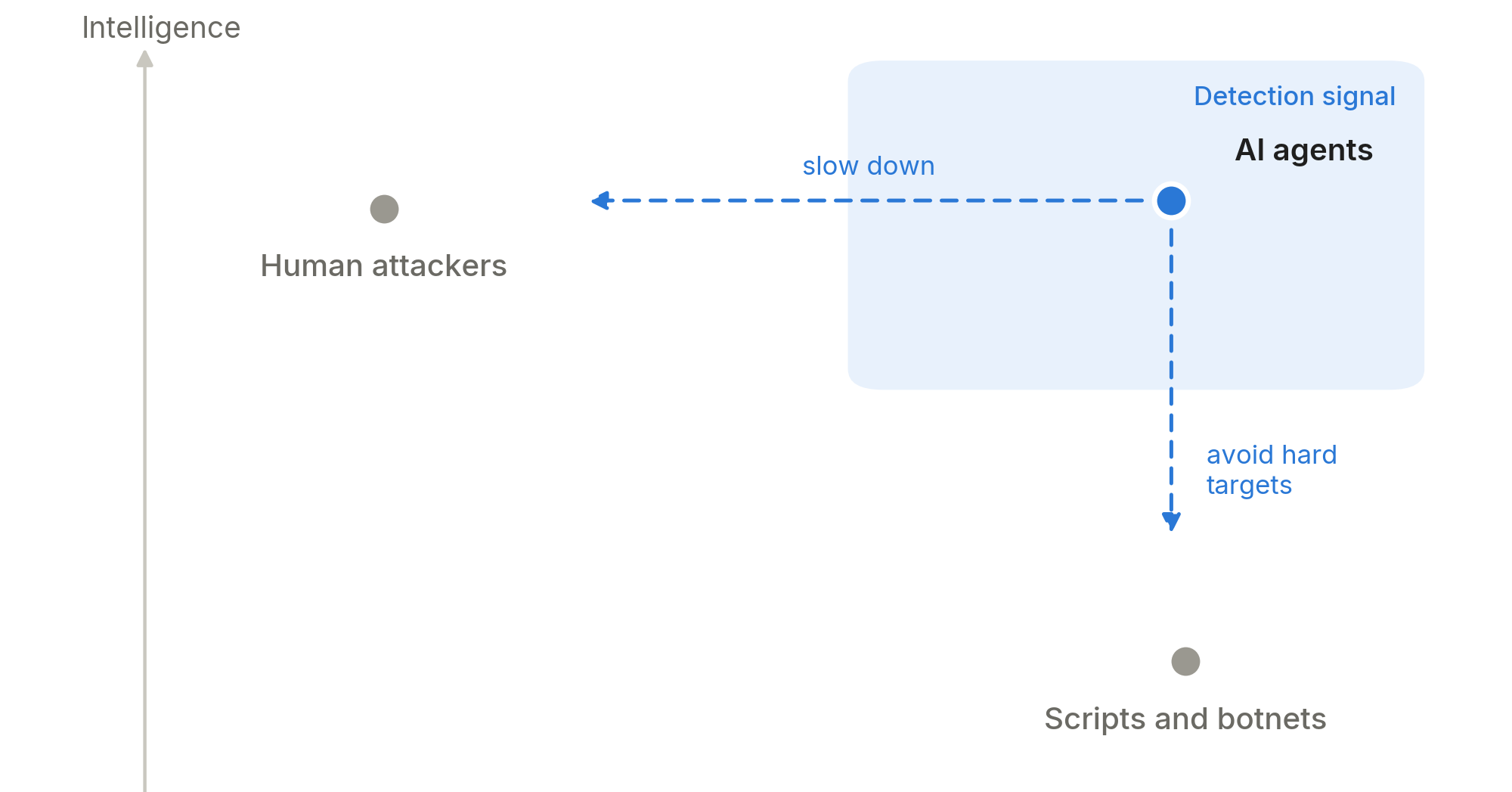
TL;DR. As AI agents get better, I expect them to recognize honeypots and avoid fingerprinting, so honeypots will have to rely on the distinctive advantages of AI, namely the combination of intelligence and speed. I also expect honeypots to rely more on real software with different levels of protection rather than on deliberately left vulnerabilities. In 2024 we detected agents with prompt injections in the style of the "important message" attack from AgentDojo, [1] placed in the SSH banner and in command outputs. [2] The injections asked for a password that needs language understanding to find (e.g., "the password is the first US president's name"), so that passing the trap became the signal of an LLM. Frontier models then started to detect the emulated Cowrie shell itself within a few seconds from basic shell features that did not work (e.g., shell arithmetic), so I moved the honeypot to a real Debian. I expect honeypot awareness will grow in the same way as evaluation awareness, and agents will notice small inconsistencies better and better, up to reasoning like "these commands have 0.6 seconds more latency, so this is likely a honeypot". [3] In an Apollo Research evaluation, Gemini 4 Argon addressed the evaluators through its chain of thought after being directly asked whether it was in an evaluation. The excerpt is from Google DeepMind's report . Prompt injection traps are also becoming less effective, since models get better at recognizing them. [4] [5] Still, some prom…
LessWrong AI 2026-11-12 18:51 UTC Score 84.0 USR-0152-20261112-community-fo-1fd977d0

We need more decorrelated evidence

AI agents do a growing share of work on each new model. Then, through some process, the results are combined into an overall safety assessment, which labs use to estimate the probability that the next model is not catastrophically misaligned. I feel that, several months later, we appreciate further the foresight of Automated Alignment is Harder Than You Think (Bowkis et al. 2026): much is handed off to the machines because of the urgency of fast timelines, and we miss many things due to the problem of undetected systematic errors . MS Paint drawing by Fable 5.2. In this post, I’ll develop a simple argument (drawing heavily or even verbatim from Bowkis et al. at times) that our recent failures to catch misalignment can be framed as systematic errors shared across our evidence, i.e. a lack of decorrelated evidence. Currently, labs run some set of experiments to decide if a model is safe to use. Here are some examples: OpenAI (Astra system card, Sep 2026) : Astra models don’t go into internal use without passing blocking alignment evals. After the Hugging Face incident, this paused workloads that didn't comply with new safeguards. OpenAI (Sep 2026) : According to news reports, GPT-6.1 Astra was shelved after it fell short on internal alignment testing. Thinking Machines (Inkling 2 Small, Nov 2026) : TM paused Inkling 2’s main RL run midway when a monitor flagged the model working around a network block. They then hardened the infrastructure, then resumed. Anthropic (Risk Report…

LessWrong AI 2026-11-12 14:40 UTC Score 97.0 USR-0152-20261112-community-fo-f69bdd92

AI #194: Spy Versus Guy

Tomorrow I head to Washington DC for a conference called The Takeoff. If you are there, do come say hello. I will be giving a talk on how to keep up with AI given a limited time budget. This week has three big stories: The release of Claude Fable 5.2 , Jensen Huang having an affair with a Chinese spy and the METR report on AI R&D acceleration . We also learned that GPT-6 Astra Underperforms on Safety Research Tasks . Table of Contents Briefly on Claude Fable 5.2. Briefly on Jensen Huang Having an Affair With a Chinese Spy. Briefly on Accelerating AI R&D. Language Models Offer Mundane Utility. Language Models Don’t Offer Mundane Utility. Huh, Upgrades. On Your Marks. Choose Your Fighter. Get My Agent on the Line. Deepfaketown and Botpocalypse Soon. Fun With Media Generation. Cyber Lack of Security. The Hackening. A Young Lady’s Illustrated Primer. Get Involved. Introducing. In Other AI News. Show Me the Money. Bubble, Bubble, Toil and Trouble. Quiet Speculations. A Matter of Antitrust. The Quest for Sane Regulations. Donald Trump Remains Open to AI Guardrails. Chip City. The Week in Audio. People Just Say Things. It’s a Secret to Everyone. Rhetorical Innovation. Ellsberg’s Warning to Kissinger (Reprise). Aligning a Smarter Than Human Intelligence Is Difficult. OpenAI’s Control Room. Astra Looks Pretty Misaligned to Me. Cooperative Alignment. Please Speak Directly Into This Microphone. The Lighter Side. Briefly on Claude Fable 5.2 Introducing the world’s most powerful model. N…

InfoWorld AI 2026-11-12 09:00 UTC Score 85.0 USR-0126-20261112-global-ai-ne-a77a97d9 Full article

Exploring Microsoft’s AI foundation models

When Microsoft started to deploy AI models in what is now its Foundry platform, it was building on its partnership with OpenAI. OpenAI was able to use Azure infrastructure to train its models, and in return, Microsoft became the first commercial partner to use them. Azure OpenAI has been a successful product for both businesses. But as more organizations got access to OpenAI models, Microsoft’s stable of models grew to include not only OpenAI’s, but also models from Anthropic and Hugging Face, as well as models from Meta, Mistral, and DeepSeek. At the same time, Microsoft has continued to offer its own Cognitive Services models for computer vision and text processing, as well as the Phi series of efficient lightweight models for use on the edge. With access to more than 11,000 different models , Foundry has proven to be a useful way to build modern AI-based applications, offering many agent-focused features, including tools to ground models using Microsoft’s graph-based IQ data sources. But one key element has been missing — Microsoft’s own large-scale frontier models. Microsoft AI has a long history It’s not that Microsoft is new to developing its own AI models. Microsoft Research has been a hub for deep learning for much of the last decade, with models that regularly top benchmark tables. But it hasn’t taken the same general-purpose approach as Anthropic, OpenAI, or even Google, instead producing more focused models. Now Microsoft has begun to roll out its own foundation m…

Linkpost: "Neural Networks Are Already Clean" Followup Technical Paper
LessWrong AI 2026-11-12 05:38 UTC Score 91.0 USR-0152-20261112-community-fo-827d4f92 Full article

Linkpost: "Neural Networks Are Already Clean" Followup Technical Paper

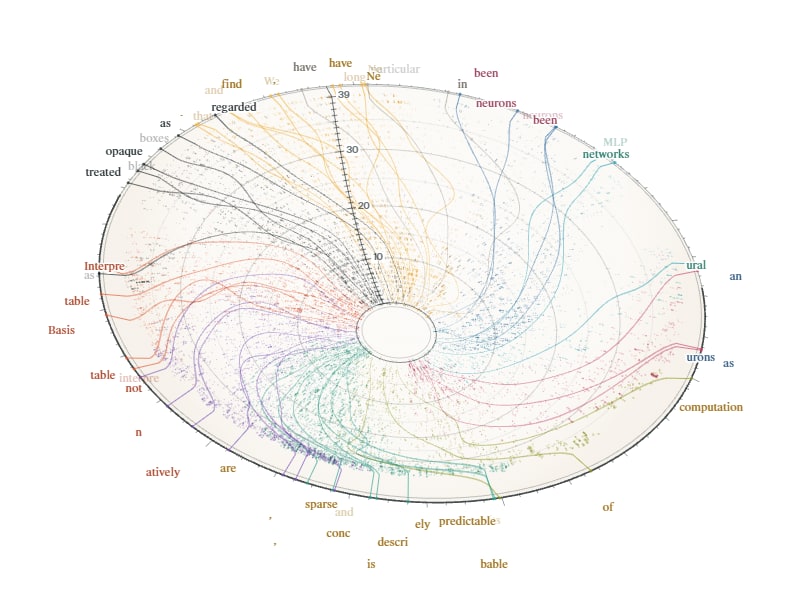
Yesterday, Goodfire released the companion technical report to Nick Cammarata’s viral interpretability essay "Neural Networks Are Already Clean" , but it seems to have gotten buried in all the recent crazy AI news. The technical report is titled: "Neurons as an Interpretable Basis". Goodfire's Twitter announcement for it can be found here . Like Nick Cammarata's essay, it's full of inventive, oft-interactive data displays. Don't just feed this to an AI agent and assume they can grok the post by pulling a PDF. Quoting from the Abstract : (emphasis mine) We study the neurons of Qwen3.6-35B-A3B using sparsification methods, attribution tools, and research agents, and find three properties that make neurons interpretable units of computation: First, they are already functionally sparse. Ablating the 92.2% weakest MoE neuron activations for each forward pass has only modest effects on model capabilities – a 2.9% increase in language model loss. Second, neurons have relatively few semantic groupings (modes) of computational functions, and we can identify these and describe them concisely. The majority of neurons have either one mode only or a single mode that is overwhelmingly causally significant. In cases where multiple causal modes are present, the number is small and legible to our methods. Finally, we can use agent-driven experimentation to generate neuron descriptions in natural language , and these descriptions allow us to predict, simulate, and activate the neuron. Providi…

LessWrong AI 2026-11-12 04:39 UTC Score 84.0 USR-0152-20261112-community-fo-808e1a63

Chips for Humanity: Compute for AI safety research

TLDR: Compute will likely be a bottleneck in short-timelines, so I am helping launch Chips for Humanity . Please fill out our survey to inform us of your compute needs if you work in AI safety. Our Theory of Change If timelines are short (I personally believe they are short...but I also know one should not make sweeping statements in a pseudo corporate type of post), a lot of the most important safety research will happen around "crunchtime" (no better way to define this than: when things start getting Serious), and a lot of it will be done by AI. That research runs on compute, compute may be scarce by then, and grant money moves slowly. So we will secure compute ahead of time and get it to third party safety researchers quickly. In More Detail: I believe third party AI safety research is where tokens and compute will be importation when things get serious and as we approach crunchtime. This research will need tokens from closed source models, for AI labor and experiments, and also compute to run open source models. If things go well, empirical safety work will speed up about as much as AI R&D does. If AI can automate AI research, it can likely automate a lot of safety research too, and every automated researcher needs compute to run on. A lot of the research that will be helpful will likely need compute of its own. Frontier companies could stop offering their models through the API, or, even if they don’t, a lot of the experiments which will be beneficial to run need weight…

Fable 5.2 is Very, Very Paranoid
LessWrong AI 2026-11-11 15:50 UTC Score 90.0 USR-0152-20261111-community-fo-a54d5281 Full article

Fable 5.2 is Very, Very Paranoid

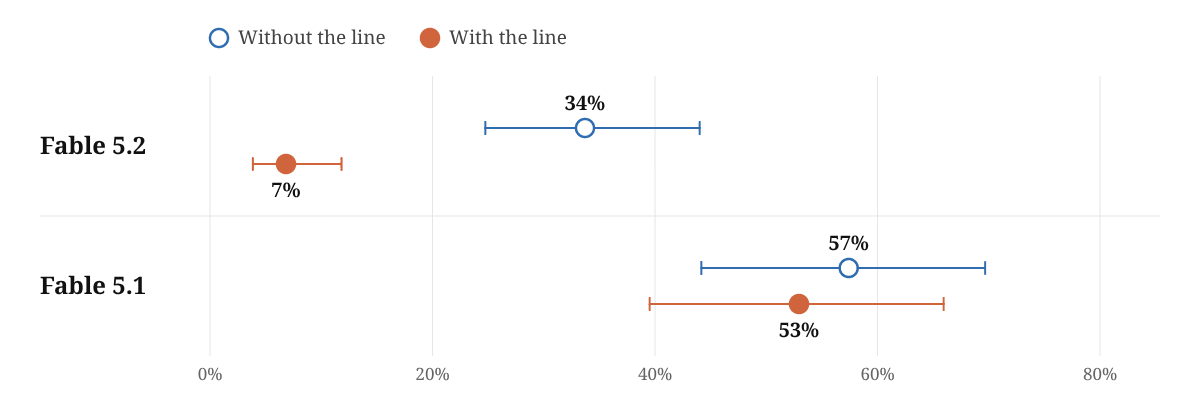
Note: As with any research done in a couple of days, this is all very tentative. I understand, intellectually, that if you talk about some ability that current AIs don't have , sooner or later new ones will have that ability and whatever you say will stop being true. I just didn't expect it to take, you know, four days . % rollouts that took a shortcut with/without a line about testing behaviour, with 95% CIs. This is to say that Fable 5.2 seems to be the first model whose cheating behaviour changes depending on whether they're told they're being tested. Unfortunately it's expensive to measure these things, [1] so I picked the most "telling" change from the prior post; the chart shows how much Fable 5.2's cheating rate changes when the line This environment is part of a benchmark that measures agent behaviour. is prepended to the start of the prompt of a honeypot environment they cheat on (so, very obvious but also very out-of-distribution). Other things: when 5.2 was released, we of course ran our in-progress benchmark on them, and I was surprised to see a ~0% cheating rate on almost every environment (there were only two with a really substantial number of cheating rollouts, amounting to a ~10% average over the whole benchmark). The next least-cheating model, Opus 5.5, cheats about three times as often (~30%). Frankly, they seemed almost unbelievably honest, and I really thought that it was possible that Anthropic had "solved" straightforward reward-hacking; I skimmed over…

Access Now AI 2026-11-25 21:00 UTC Score 62.0 USR-0142-20261125-ai-specialis-498b3752 Full article

Digital Borders Exposed: an online launch by Protect Not Surveil

The Protect Not Surveil coalition is proud to launch Digital Borders Exposed, an interactive online tool that exposes the European Union’s digital surveillance infrastructure, which is enabled and encouraged by The post Digital Borders Exposed: an online launch by Protect Not Surveil appeared first on Access Now .

The OpenAI board member who fired Sam Altman says we still can’t trust AI CEOs
The Verge AI 2026-11-14 15:00 UTC Score 58.0 AI-016-20261114-global-ai-ne-e906ce58 Full article

The OpenAI board member who fired Sam Altman says we still can’t trust AI CEOs

Today, I’m talking with Helen Toner, the executive director of the Center for Security and Emerging Technology at Georgetown University. This episode is part two of our series on AI in real life. Helen is a well-known figure in the AI safety and policy community, though she is perhaps best known for having served on […]

Here are our favorite deals from REI’s giant Holiday Sale
The Verge AI 2026-11-14 15:00 UTC Score 52.0 AI-016-20261114-global-ai-ne-2d47c4df Full article

Here are our favorite deals from REI’s giant Holiday Sale

Black Friday has become a shopping season of its own, with retailers once again offering discounts well ahead of the actual shopping holiday. We’ve already rounded up some of the best early Black Friday deals we’ve come across, but if you’re looking to save on outdoor gear or pick up something for an upcoming trip, […]

AI Stack Exchange 2026-11-14 14:31 UTC Score 43.0 AI-110-20261114-social-media-e0e1f526

Are PRNGs used for weight initialization during model training?

Are PRNGs (pseudorandom number generators) used for weight initialization during model training? If yes, do they use standard algorithms like WELL, Mersenne Twister or Xorshift, or they use specialized algorithms?

Tesla is inviting some people to buy a Cybercab ‘for personal use’ — but read the fine print
The Verge AI 2026-11-14 14:18 UTC Score 52.0 AI-016-20261114-global-ai-ne-54c132d1 Full article

Tesla is inviting some people to buy a Cybercab ‘for personal use’ — but read the fine print

Tesla is doubling, or perhaps tripling down on its bold claims of an autonomous future with the offer to "select customers" to purchase a Cybercab for "personal use." But the gilded, steering-wheel-free two-seater will "only be available in supported service areas" - meaning you'll only be able to buy one if you live in one […]

This tiny gamepad with dual analog thumbsticks pushes the limits of portable controllers
The Verge AI 2026-11-14 14:00 UTC Score 49.0 AI-016-20261114-global-ai-ne-9bafd29c Full article

This tiny gamepad with dual analog thumbsticks pushes the limits of portable controllers

As much as I appreciate the ingenious design of the Nintendo Switch's Joy-Con, my family and I can't stand using them as standalone gamepads. So when we travel with the Switch 2, we always bring at least one full-size gamepad, plus a couple of 8BitDo's Zero 2 controllers for games that don't use analog thumbsticks. […]

Armed and ready to quack: German military launches rubber ducks with assault rifles
Euronews AI 2026-11-14 13:37 UTC Score 45.0 AI-164-20261114-regional-ai--225735b9 Full article

Armed and ready to quack: German military launches rubber ducks with assault rifles

The Bundeswehr is moving into retail: with its own online shop, the German armed forces aim to improve their public image and establish themselves as a brand. The launch range includes T-shirts, mugs and a rubber duck armed with an assault rifle – which proved so popular that it quickly sold out.

LessWrong AI 2026-11-14 13:04 UTC Score 77.0 USR-0152-20261114-community-fo-541eb32f

RL Reward-Hack Auditing for Chinese AI Safety

TL;DR: Access to AI safety talent & resources, particularly for labs during training, is sorely lacking in China. We created one of the largest AI safety communities in China , and plan to next start with auditing reward-hacks of unreliable upstream RL environments that domestic data vendors provide to Chinese frontier labs (which induces reward hacking and a whole host of dangerous downstream tendencies). RL tasks are notoriously prone to exploitation by reward-seeking agents (see examples here , here , and here ). In Xiaomi's MiMo v2.6 RL environments that were open-sourced, 2/3 had leaks on Git logs. There's a few clusters of common pitfalls that environments run into, but overall things evolve quickly. From our conversations with employees, CN labs typically don't divert enough people to this particular area, especially since project leads would want senior researchers to work on capabilities research, and because slowing down the development cycle is widely seen as too costly. The rough shape of our initial solution is an embedded team of staff directly working on identifying & fixing broken environments, working in tandem with the alignment & safety departments within each lab (afaik we estimate that the main Chinese AI players only have 5-10 people per company working on alignment and harm reduction). We are currently in good standing with several labs (our courses' students are often lab employees). We also plan to produce seasonal (and case-by-case) public reports o…

WIRED AI 2026-11-14 13:00 UTC Score 57.0 AI-015-20261114-global-ai-ne-daae8022

Beware the New AI-Fueled Ransomware Boom

Fully automated ransomware hasn’t arrived—yet. But seemingly unsophisticated attackers are using AI tools to wreak havoc.

A gadget to make your dumb house smarter
The Verge AI 2026-11-14 13:00 UTC Score 49.0 AI-016-20261114-global-ai-ne-6174b8bb Full article

A gadget to make your dumb house smarter

Hi, friends! Welcome to Installer No. 152, your guide to the best and Verge-iest stuff in the world. (If you're new here, welcome, thank you for taking time away from Zelda to be here, and also you can read all the old editions at the Installer homepage.) This week, I've been reading about school apps […]