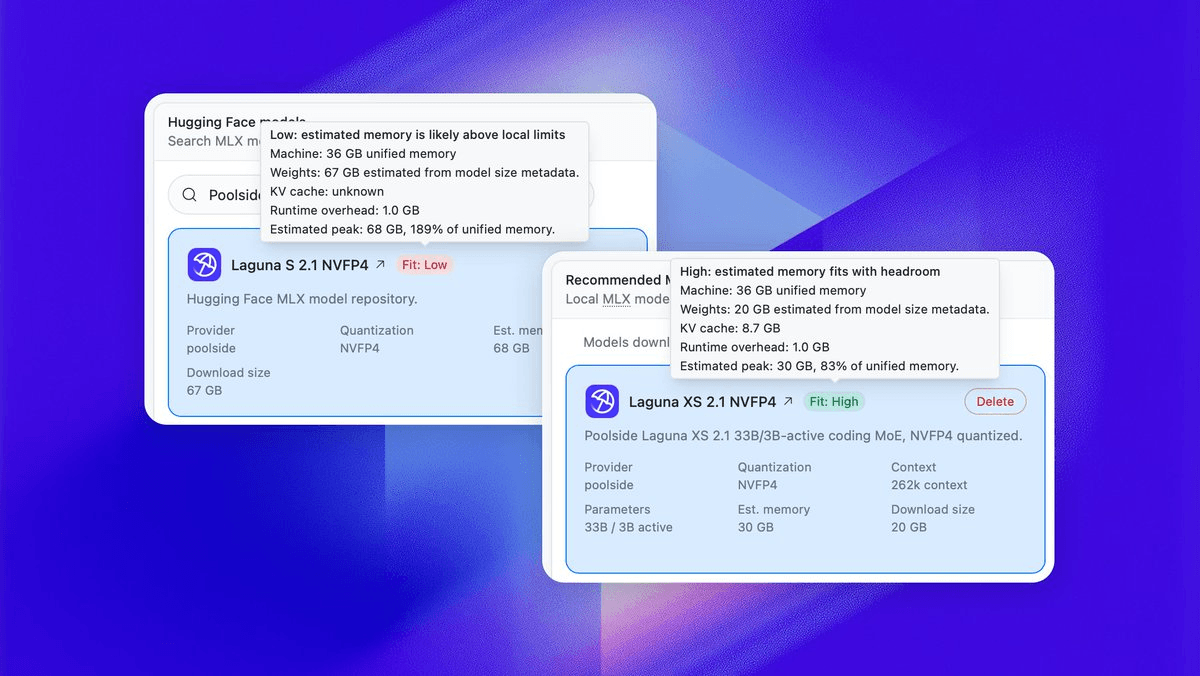
The chat box was never the right interface for a coding agent doing real work. Poolside just shipped Poolside Desktop Assistant, a macOS app that treats agent supervision as a first-class activity , and it comes loaded with a model that just beat DeepSeek V4 Pro Max on agentic coding benchmarks despite activating a fraction of the parameters.
The problem it's actually solving
When a coding agent is reading through a repository, running tests, fixing what it broke, and staying at it for hours, a single scrolling chat column starts to fall apart. The real unit of work is a session tied to a repository, a branch, its tools, its permissions, a runtime, and everything that's happened so far. And there's rarely just one session running. You might have one agent implementing a feature, another investigating a bug, and a third reviewing the first agent's output. Your job becomes supervision, not prompting.
Poolside built this tool for their own team first. For the past year, the team did its daily work inside tools they built for themselves: pool, their agent harness and CLI, and the interfaces around it for running agents wherever they happened to be working. Now they're making those interfaces available to everyone.
One workspace, any agent
The headline feature is vendor-agnosticism. Poolside Desktop Assistant is a macOS app for running multiple coding agents across projects and repositories, with Poolside Assistant extensions bringing the same experience into VS Code and Visual Studio.
The app is built on the Agent Client Protocol (ACP) , think of it as LSP, but for agents instead of language servers. Created by Zed Industries and released in August 2025, it uses JSON-RPC 2.0 over stdin/stdout to create a universal interface between agents and editors. Before ACP, every agent-editor combination required a custom integration. ACP standardizes the interface so any compatible agent works in any compatible editor, no custom glue code required. It's now adopted by JetBrains, Google, GitHub, and 25+ agents.