The dominant assumption in agentic AI has been that you pick a harness, configure it once, and let the model work within those fixed rails. Prime Agent, a new open-source coding agent from Prime Intellect, is built on the opposite premise: the harness itself should be something the model can read, rewrite, and improve while a task is running.
A new number on a very hard benchmark
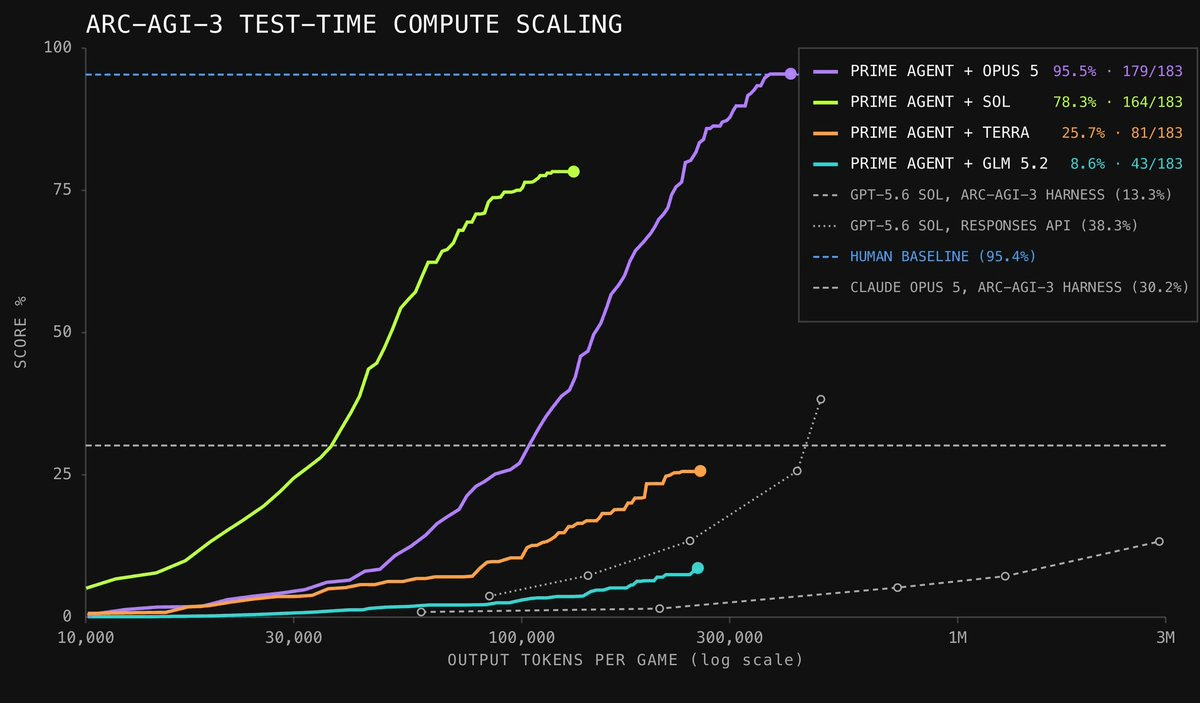
The headline result is hard to ignore. Using Opus 5, Prime Agent achieves 95.5% RHAE Best@1 on ARC-AGI-3, surpassing the reported human expert baseline of 95.4%. For context, when ARC-AGI-3 first launched, every frontier model scored below 1%, with Google's Gemini 3.1 Pro leading at just 0.37%. Getting from sub-1% to above the human expert line in a matter of months is a significant jump, and it happened not by training a new model, but by redesigning the scaffolding around existing ones.
Critically, Prime Intellect is careful to note that no model has been trained around Prime Agent or its core feature set. These gains come purely from the harness design, which means there is likely a lot more performance headroom once models are actually fine-tuned to use it.
Two ideas doing most of the work
Prime Agent is built around two core abstractions that are worth understanding before diving into the benchmarks.
- Recursive Language Model (RLM): The RLM treats context as a variable and sub-agent delegation as function calls inside a REPL. The persistent REPL gives the model programmatic access to its history, sub-agents, and tools, allowing it to write language model programs as actions over its own context. In plain terms: instead of the model receiving a fixed list of tools it can call, it gets a live Python kernel it can program against. Everything, including spawning sub-agents, is just a function call.
- Continual Harness: The Continual Harness treats the harness's own state, abstracted as its prompts, skills, memory, and sub-agents, as something the agent can create, read, update, and delete from its own trajectory. Think of it as the agent having a writable config file for itself that persists across turns and sessions.