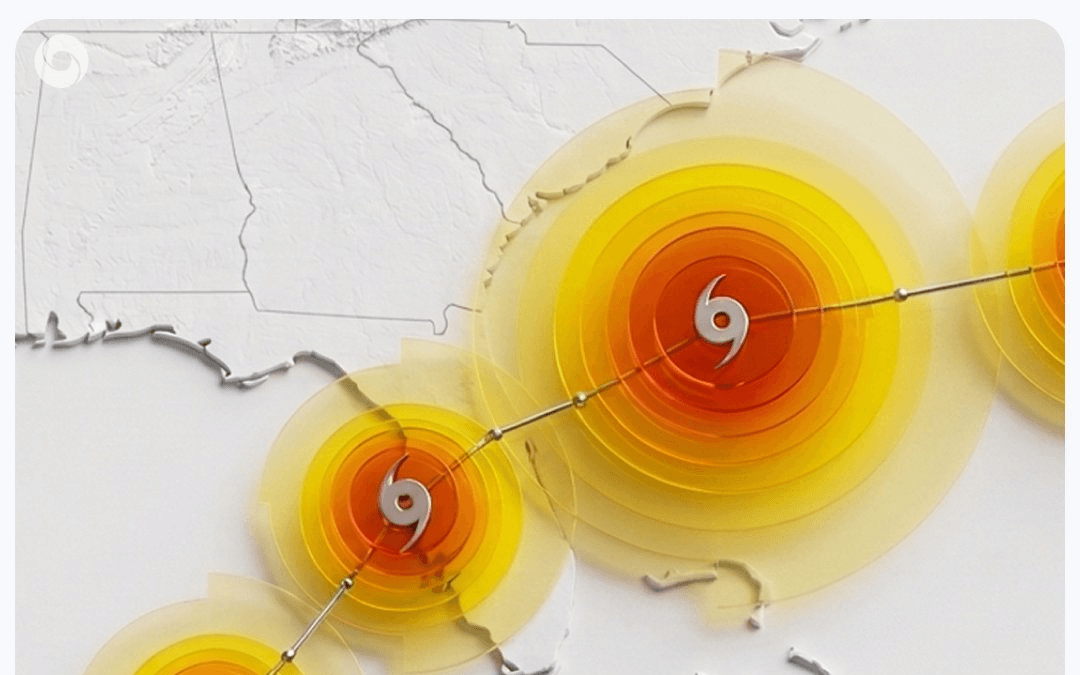
Tropical cyclones have killed more than 700,000 people and caused $1.4 trillion in economic losses over the past 50 years. The core problem for forecasters has always been time: every hour of additional warning translates directly into lives saved. Google DeepMind has published a paper in Nature showing that its WeatherNext Cyclones model achieves state-of-the-art accuracy in predicting a storm's track, intensity, and wind structure, and is now open-sourcing the code and model weights for anyone to build on.
A decade of progress in one model
On average, WeatherNext gives forecasters an extra day of predictive accuracy: three-day forecasts are as accurate as what prior models could produce for only the next two days. That improvement corresponds roughly to a decade of meteorological progress, the kind of leap that changes how emergency managers plan evacuations.
The benchmark numbers back this up. The FGN ensemble mean track position error is significantly lower than GenCast's, offering approximately a 24-hour accuracy advantage at 3–5.5 day lead times. That advantage holds across all three dimensions of a cyclone forecast:
- Track: where the storm goes
- Intensity: how strong it gets, measured in knots
- Wind structure: the spatial extent of damaging winds
The National Hurricane Center's annual verification report confirmed WeatherNext as the top-performing individual model for both track and intensity throughout the 2025 hurricane season.
The trade-off it eliminates
For decades, cyclone forecasting forced a painful choice. Models consistently excelled at predicting a storm's path or its intensity, but rarely both at once. Large global models tracked storms well yet lacked the granular detail to capture the small-scale atmospheric processes behind rapid intensification. High-resolution local models could catch intensity changes but often lost broader contextual accuracy.
WeatherNext handles both in a single model, predicting global atmospheric patterns and fine-scale cyclone behavior end-to-end through a combination of its training data, architecture, and approach to low-resolution inputs.