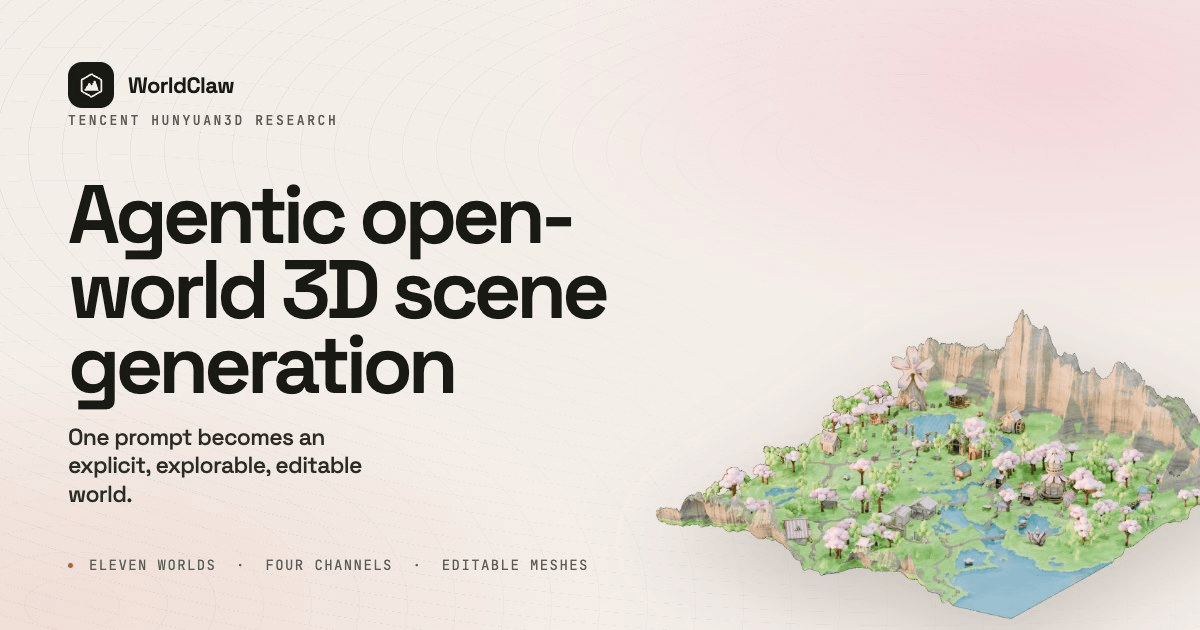
WorldClaw is Tencent Hunyuan's latest push into AI-generated 3D content, and it takes a fundamentally different approach from everything that came before it. The team introduces WorldClaw as an agentic framework for generating large-scale, explicit, and editable 3D open-worlds from open-ended text prompts. The key word here is explicit: every tree, rock, and building is a real, independently editable mesh , not a baked video, not a cloud of Gaussian splats (a popular but hard-to-edit 3D representation technique), and not a panoramic illusion.
Generating large-scale, freely explorable 3D worlds from open-ended text remains challenging because a system must jointly maintain global spatial coherence, rich local content, and explicit assets suitable for downstream editing and reuse. WorldClaw's answer to that challenge is an agentic workflow , a chain of AI agents that each handle a different layer of the problem, from high-level planning down to per-object geometry refinement.
One prompt, three stages
WorldClaw employs a coarse-to-fine, global-to-regional agentic framework with three stages: Intent Analysis and Planning, Global Terrain Generation, and Regional Object Generation and Placement. Think of it as a tiny automated game studio: one agent reads the brief, another builds the landscape, and a third populates it with props.
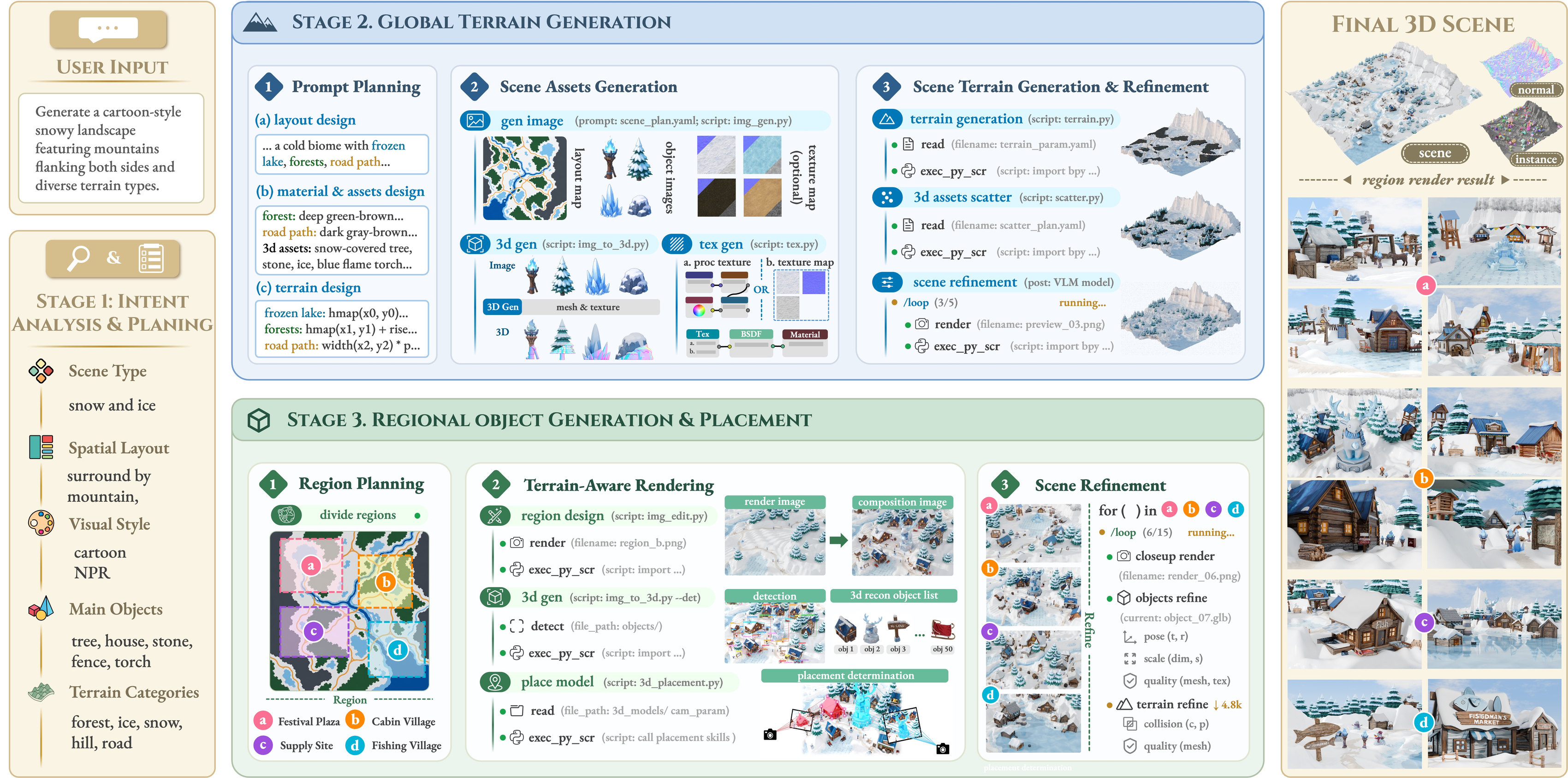
- Stage 1 , Intent Analysis: Planning agents translate a text prompt into a structured specification of regions, terrain, assets, materials, and spatial relations.
- Stage 2 , Global Terrain: A semantic-layout-guided procedural terrain generator creates controllable landforms and asset scattering based on region-aware plans.
- Stage 3 , Regional Detail: For detail-demanding regions, it generates terrain-conditioned compositions, reconstructs editable textured meshes, and recovers their placement on the terrain; render-based agents further refine terrain, objects, appearance, and contacts.