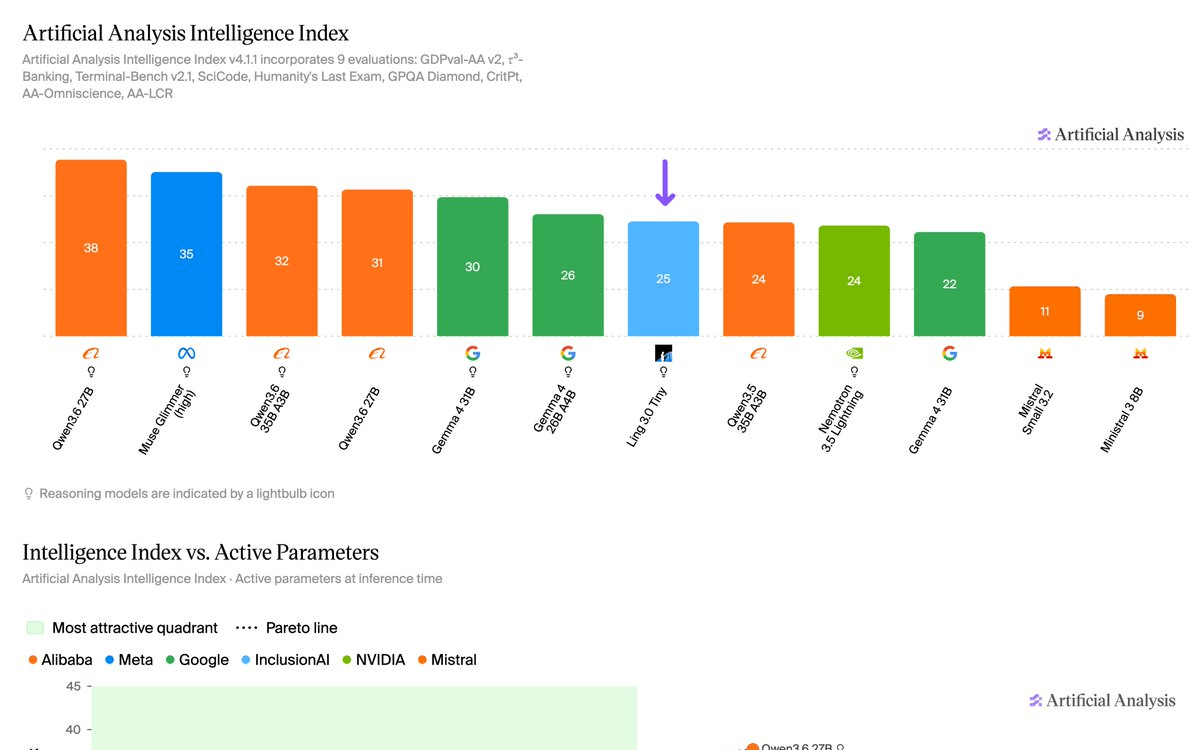
Ling 3.0 Tiny is the latest model from InclusionAI, the AI research arm of Ant Group (the fintech giant behind Alipay). It is a small but surprisingly capable reasoning model that punches well above its weight class, and it is available right now under an MIT license with free API access.
Tiny name, real numbers
Ling 3.0 Tiny is a lightweight hybrid reasoning MoE model with 7.9B total parameters and only 1.3B activated parameters per token. That distinction matters: in a Mixture-of-Experts (MoE) architecture, the model has many specialized sub-networks ("experts"), but only a small subset are activated for any given input. This means the compute cost at inference time is much closer to a dense 1.3B model than a 7.9B one.
Independent evaluator Artificial Analysis scores it 25 on its Intelligence Index, ranking 6th of 56 models in its size class against a class median of 8. For context, that score is comparable to gpt-oss-120b (high, 24) , a model with 15x more total parameters and 4x more active parameters.
The architecture doing the heavy lifting
The Ling 3.0 family is built on a hybrid-linear attention design that combines two types of attention layers in alternation. Ling 3.0 Tiny integrates a 3:1 alternating stacking of KDA and MLA (3 Kimi Delta Attention layers followed by 1 Multi-Head Latent Attention layer per 4-layer block) with a sparse MoE FFN comprising 128 routed experts, where each token activates only 8 routed experts and 1 shared expert.
To unpack that: KDA (Kimi Delta Attention) is a linear attention mechanism , it processes long sequences in O(n) time rather than the O(n²) cost of standard attention, keeping memory and compute from exploding at long context lengths. MLA (Multi-Head Latent Attention) is a periodic full-attention layer with a compressed key-value cache. Linear attention keeps long inputs cheap, while periodic full-attention layers maintain the exact token-to-token recall needed for complex reasoning.