Cerebras Systems just posted its second quarterly earnings report as a public company, and the numbers are hard to ignore. Cloud and other services revenue hit a record $126 million on a GAAP basis, up 281% year-over-year, while core cloud revenue reached $127.7 million, up 287%. The cloud business has nearly quadrupled in a single year. The market shrugged, at least initially.
Following the earnings release, CBRS declined roughly 15% in after-hours trading, even as the company beat on EPS, reporting an adjusted loss of 5 cents versus 17 cents expected. The culprit was GAAP revenue of $180 million, below the $194 million analysts had penciled in, with the gap driven largely by how Cerebras accounts for its non-standard revenue structure.
The numbers behind the headline
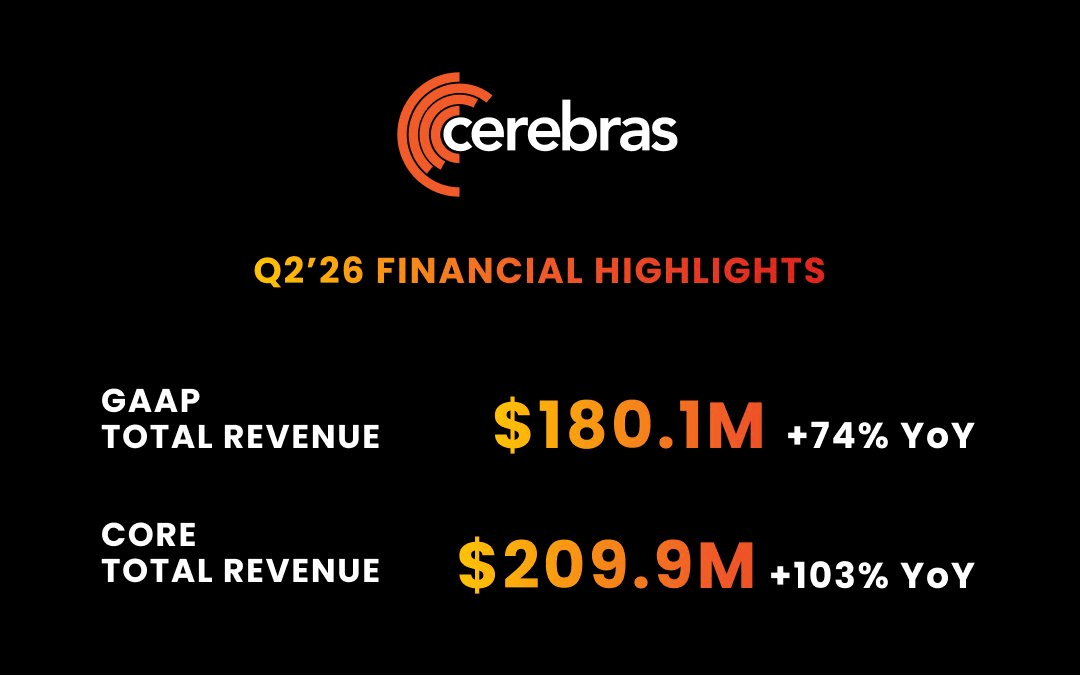
To parse Cerebras's financials, you need to know the difference between its GAAP and "core" (non-GAAP) numbers. GAAP total revenue came in at $180.1 million, up 74% year-over-year, while core total revenue, which strips out pass-through data center costs and adds back non-cash customer warrant amortization, reached $209.9 million, up 103%. The company's guidance and analyst expectations were set against the core number, which is why the beat/miss picture confuses at first glance.
- Record GAAP cloud revenue: $126.0M (+281% YoY); core cloud revenue: $127.7M (+287% YoY)
- Core gross margin: 41%, an improvement of roughly 940 basis points from Q2 2025
- Core EPS beat: reported loss of $0.04 per share vs. estimates of -$0.17
- Remaining performance obligations (RPO): $25.4 billion as of June 30, 2026
- Data center capacity under contract: over 600 MW; manufacturing capacity scaling more than 10x in 2026
- Full-year 2026 core revenue guidance raised to $880–$890 million, from a prior range of $855–$865 million
CEO Andrew Feldman summarized it simply: "Core revenue more than doubled to $210 million, and our cloud business nearly quadrupled year-over-year." CFO Bob Komin added that the company plans to more than triple revenue in 2027. That target is aggressive, but it is backstopped by $25.4 billion in already-contracted future revenue.
Why speed is the product
Cerebras's core thesis is that inference latency doubles as a product differentiator, unlocking use cases that slower hardware cannot serve. The company's