
Physical AI systems generate more data than teams can reasonably inspect by hand. A robotics dataset may contain millions of camera frames alongside LiDAR, depth, joint states, trajectories, actions, annotations, and model outputs. An autonomous vehicle dataset can contain thousands of hours of driving. Even a conventional computer vision dataset can contain millions of images and objects.
The problem is not simply storing this data. It’s understanding what is in it.
Embeddings transform large datasets into searchable numerical representations that capture meaningful similarities between samples. Once those representations exist, teams can search a dataset semantically, find related examples, identify redundant data, measure coverage, discover unusual samples, and investigate model failure modes across millions of samples.
For physical AI in particular, embeddings can turn large collections of multimodal time-series data from something that must be inspected recording by recording into something that can be queried and organized by behavior.
Key takeaways
- Multimodal embeddings turn physical AI datasets from something inspected recording by recording into something that can be queried and organized by behavior.
- The embedding level determines what you can retrieve: episode-level embeddings summarize a whole recording, while segment-level embeddings make the moments within it searchable.
- Research shows dataset composition beats dataset size: DataComp curation beat OpenAI's CLIP by 3.7 points, SemDeDup removed 50% of a LAION subset without losing performance, and ZCore cut a robotics dataset by 95%.
- Vision-language embedding models like CLIP and SigLIP let teams search unlabeled sensor data with natural language.
- A useful embeddings tool is more than a scatterplot: it needs semantic search, interactive visualization, curation workflows, and production-scale vector search in one place.
What are embeddings?
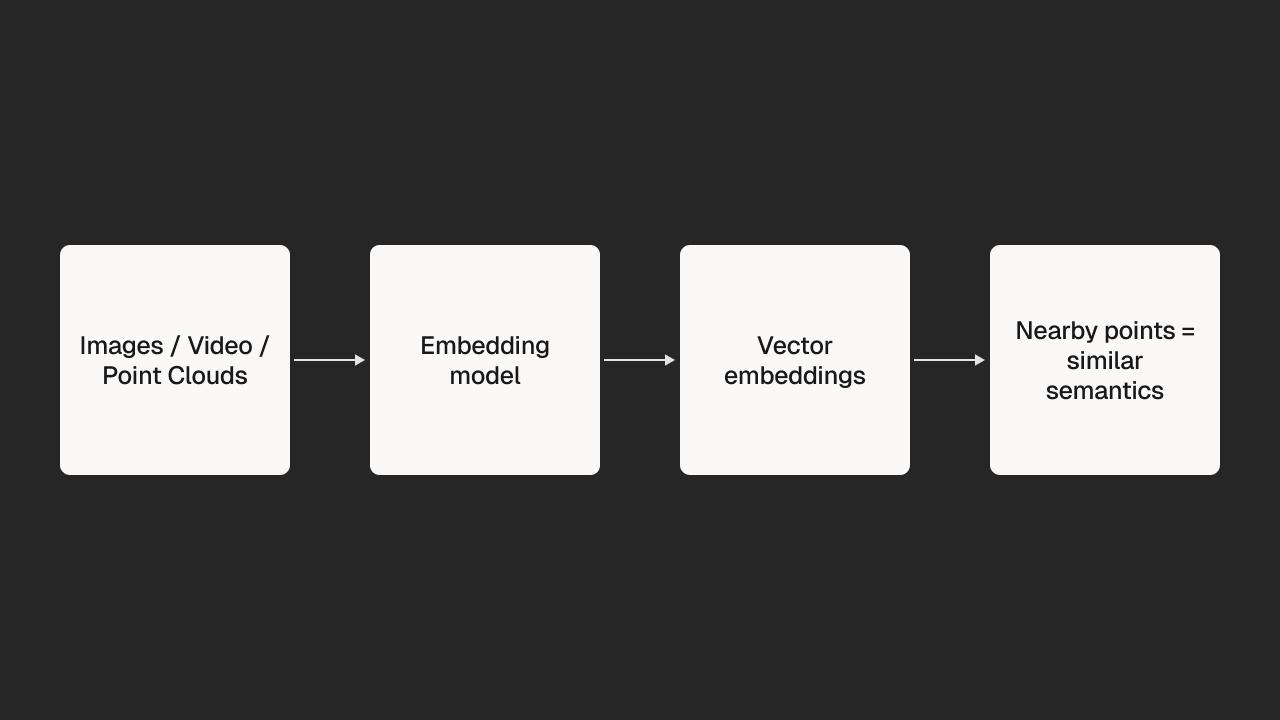
A model takes an input—an image, object crop, video segment, point cloud, text description, robot trajectory, or other signal—and converts it into a vector such as:
[0.18, -0.42, 0.07, ...]
That vector may contain hundreds or thousands of dimensions. Individual dimensions generally do not correspond to interpretable attributes such as "forklift" or "left turn." Instead, the position of the vector within the larger embedding space captures properties the embedding model has learned to consider important.
The useful property is distance.
Inputs that the model considers similar tend to appear near one another in embedding space. Inputs it considers different tend to appear farther apart.
What counts as “similar” depends on the embedding model. A model trained primarily on visual features may organize the same dataset differently from a vision-language model trained to align images with text.
Benchmarks comparing popular embedding modelsshow that these differences can materially affect clustering, retrieval, and downstream model performance.
The embedding therefore provides a machine-readable representation of the sample's content.
Embeddings are not limited to images
In physical AI, the unit being embedded is often an image or object.
| Embedding level | Example |
|---|---|
| Image | One camera frame |
| Object | A detected pedestrian, defect, package, or robot gripper |
| Patch | A region within an image |
| Point cloud | One LiDAR sweep or 3D scene |
| Frame | All information associated with one timestamp |
| Video segment | Five seconds surrounding an interaction |
| Event | A lane change, grasp, collision avoidance maneuver, or failure |
| Episode | One complete robot task or driving scenario |
| Trajectory | Motion or action history across time |
The level at which embeddings are computed determines what teams can retrieve and compare. An embedding of an entire recording represents the episode as a whole, while embeddings computed over shorter segments preserve localized information about what happens within it — down to individual frames or short windows.
Suppose a team wants to understand every moment a vehicle initiated a turn across a 20-minute driving log. An episode-level embedding treats the whole recording as one point, with no way to distinguish the turn from the straightaway before or after it. Segment-level embeddings, by contrast, place each moment in the recording according to what's happening at that instant — so frames captured during a turn cluster together, separate from the rest of the episode.
For physical AI, this turns embeddings into a navigable map of an episode rather than a single summary of it. A team can select a cluster of interest directly and jump straight to the corresponding moment in the recording, moving fluidly between the shape of the data and the specific frames that produced it.
Why multimodal embeddings matter for physical AI
More data does not automatically produce better models. Once a dataset contains enough examples of common scenarios, additional examples of those same scenarios contribute relatively little. Performance increasingly depends on which data a model sees—not simply how much it sees.
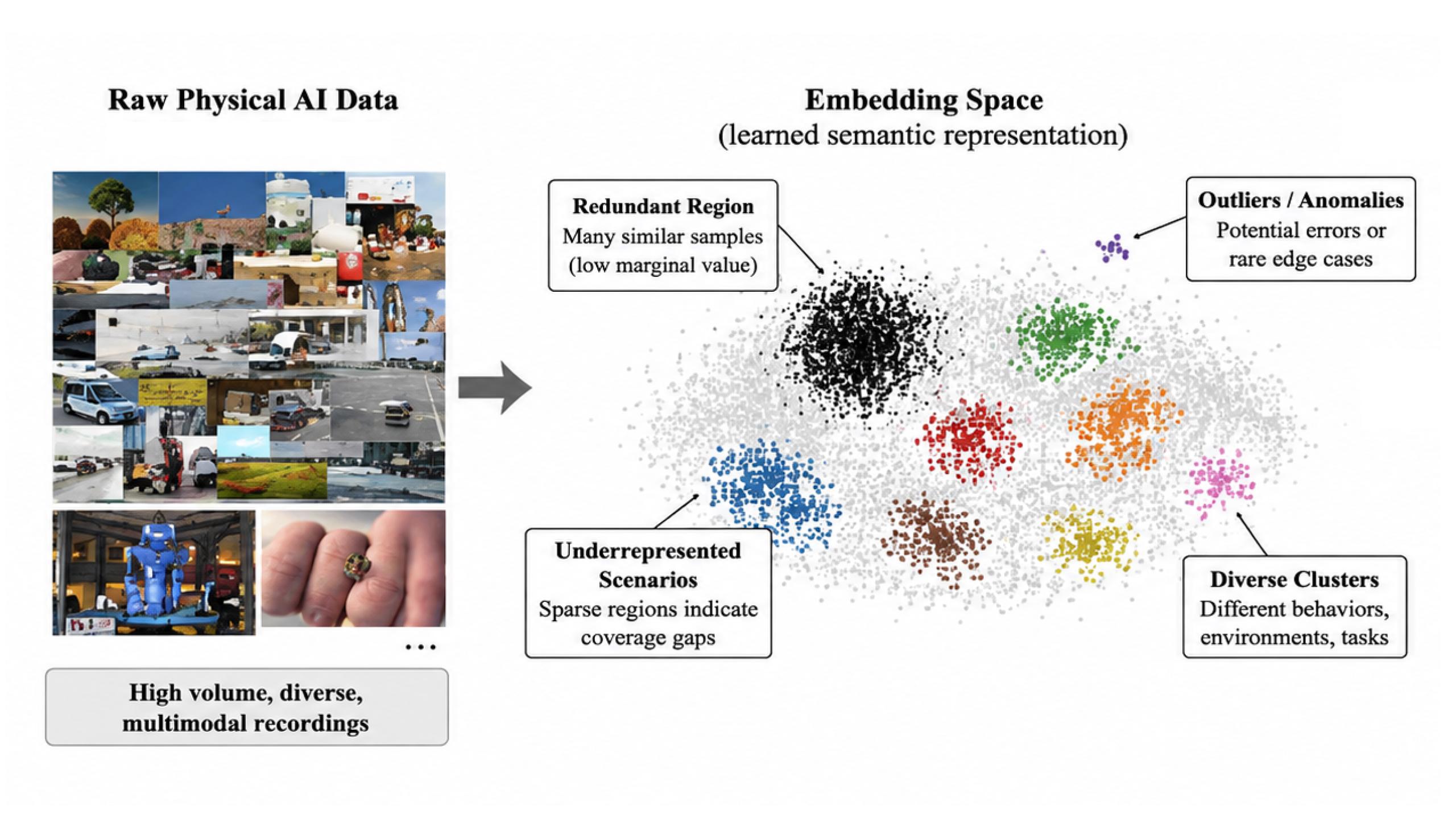
Embeddings have become one of the primary tools for understanding dataset composition at scale. They give teams a way to measure semantic similarity, identify redundant samples, surface underrepresented scenarios, and curate datasets based on content rather than random sampling or manual inspection.
A growing body of research shows that improving dataset composition can produce larger gains than simply adding more data.
- Better data selection improves models without changing the architecture. DataComp (arXiv:2304.14108) found that curating image-text training data produced a CLIP model that outperformed OpenAI's original benchmark by 3.7 percentage points on ImageNet zero-shot classification.
- Semantic embeddings can eliminate redundant training data. SemDeDup (arXiv:2303.09540) removed 50% of a LAION subset using embedding-based deduplication while maintaining performance and improving out-of-distribution robustness.
- Embeddings can help models train on far less data. ZCore, an embedding-based dataset selection method (arXiv:2411.15349), reduced a robotics training dataset by 95% and eliminated annotation requirements for 1.15 million ImageNet images.
- Intelligent data selection can dramatically reduce training compute. JEST (arXiv:2406.17711) reached comparable multimodal performance with up to 13× fewer training iterations and 10× less compute by selecting better training examples.
- Diverse datasets generalize better than narrow ones. Open X-Embodiment (arXiv:2310.08864) combined over 1 million demonstrations from 22 robot embodiments, showing that training on diverse robots, tasks, and environments substantially improves manipulation generalization.
- Data curation alone can significantly improve VLM performance. 20/20 Vision Language Models (arXiv:2605.11405) improved average performance by 11.7 percentage points across 20 benchmarks while holding the model architecture and compute budget constant.
These studies do not argue that embeddings alone improve model performance. Rather, they demonstrate that understanding and organizing data has become a first-order machine learning problem. Embeddings provide the representation that makes many of those workflows practical at modern dataset scale.
What can you do with embeddings?
The most useful way to understand embeddings is through the data problems they solve. At the most basic level, embeddings let teams find similar data: start with an interesting sample and retrieve its nearest neighbors in embedding space.
This changes the unit of investigation from one example to a set of related examples. Instead of inspecting a single failure, behavior, or edge case in isolation, teams can find where else it occurs across the dataset and use those results for debugging, curation, labeling, evaluation, and data selection.
Search within episodes with segment-level embeddings
Physical AI recordings can span minutes or hours, but the behavior an engineer wants to find may last only a few seconds. Episode-level embeddings represent the entire recording as a single vector, making it difficult to locate where a specific object, behavior, or event occurs within the episode. The meaningful unit of data is often not a single frame but a sequence that unfolds over time
Segment-level embeddings make the data within an episode searchable. Instead of embedding an entire recording, teams can compute embeddings over shorter windows within individual sensor streams. A query such as pedestrian crossing can then identify the matching intervals within an episode rather than returning the entire recording as a single match.
For robotics and VLA workflows, this makes it possible to search across large collections of demonstrations and logs for specific behaviors, objects, or conditions, then jump directly to where those matches occur in the underlying recording.
Search with natural language
Vision-language embedding models such as CLIP and SigLIP map images and text into compatible representation spaces.
Instead of relying on predefined labels or metadata, users can search with natural language. The system embeds the query and retrieves visual observations that appear nearby in the shared embedding space.
CLIP (
arXiv:2103.00020) demonstrated the viability of this basic image-text retrieval paradigm at scale. More recent models such as SigLIP 2 (
arXiv:2502.14786) have improved image-text retrieval, localization, multilingual understanding, and dense visual representations.
For physical AI, natural-language search becomes especially powerful when combined with temporal segmentation. Instead of searching only for frames matching "open drawer," teams can retrieve episodes or intervals representing the behavior.
Natural language is not a substitute for structured metadata. It provides an additional way into the dataset when the property of interest was never labeled.
Discover failure modes
Aggregate model metrics can show that a model is underperforming, but not necessarily why. Embeddings can reveal patterns across failures that are difficult to identify through metrics alone.
By embedding failed or low-performing samples, teams can see whether similar cases cluster together based on shared characteristics. A cluster might reveal a particular environment, object type, behavior, viewpoint, or other condition associated with poor performance.
Embeddings do not automatically explain the cause of a failure. They narrow the search space, allowing teams to inspect related samples and identify the common characteristics behind a recurring failure mode.
Find coverage gaps
Embedding spaces provide a useful approximation of dataset coverage.
Dense regions represent patterns that occur frequently according to the embedding model. Sparse regions represent less common observations.
Teams can compare embeddings across training,
simulation, evaluation, production, and newly collected data to identify
distribution shiftsand measure dataset coverage.
If production observations repeatedly fall into regions sparsely represented by the training set, those regions become candidates for additional collection, labeling, simulation, or training.
For robotics, the comparison might expose missing combinations of objects, environments, camera viewpoints, embodiments, or manipulation strategies.
The point is not necessarily to make the embedding distribution uniform. Real-world distributions are rarely uniform. The goal is to understand where the dataset differs from the conditions under which the model must operate.
Reduce redundant data
Large physical AI datasets often contain extreme redundancy.
Adjacent video frames may be nearly identical. Teleoperated demonstrations may contain hundreds of repetitions of the same behavior. Fixed cameras may generate millions of visually similar observations.
Nearest-neighbor distances and embedding clusters make it possible to identify this redundancy semantically rather than relying exclusively on hashes or pixel comparisons.
The SemDeDup result is an extreme example of the potential leverage (
arXiv:2303.09540): semantic deduplication removed half of the evaluated LAION subset while largely preserving performance.
For physical AI, redundancy reduction can lower labeling, storage, training, and review costs while preserving the meaningful diversity of the dataset.
Select diverse data for labeling or collection
Most teams have far more raw data than they can afford to label or train on. Random sampling can spend that budget on redundant examples while missing less common scenarios.
Embeddings let teams measure diversity before deciding what data to keep, label, or collect next.
Coreset methodsuse the structure of embedding space to select smaller subsets that preserve the diversity of the larger dataset.
(ZCore) uses foundation-model embeddings to identify high-value training data based on coverage and redundancy. Without labels or dataset-specific training, ZCore selected 10% of ImageNet for training and outperformed previous data-selection methods using the same amount of data. In a robotics dataset, ZCore also identified a representative subset using 95% less data (
arXiv:2411.15349).
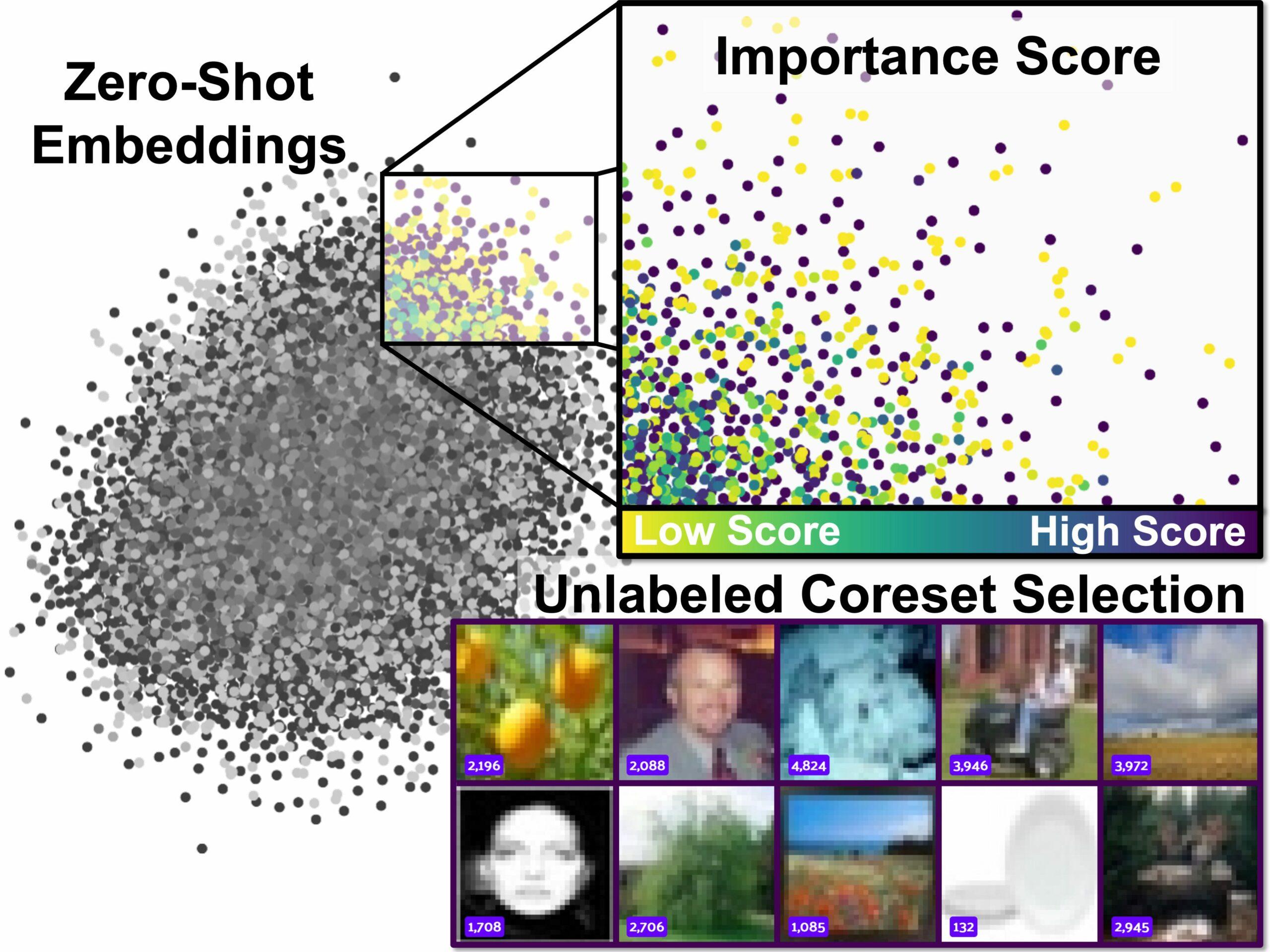
For physical AI, this means teams can prioritize data that adds new information instead of repeatedly labeling or collecting variations of scenarios the dataset already covers.
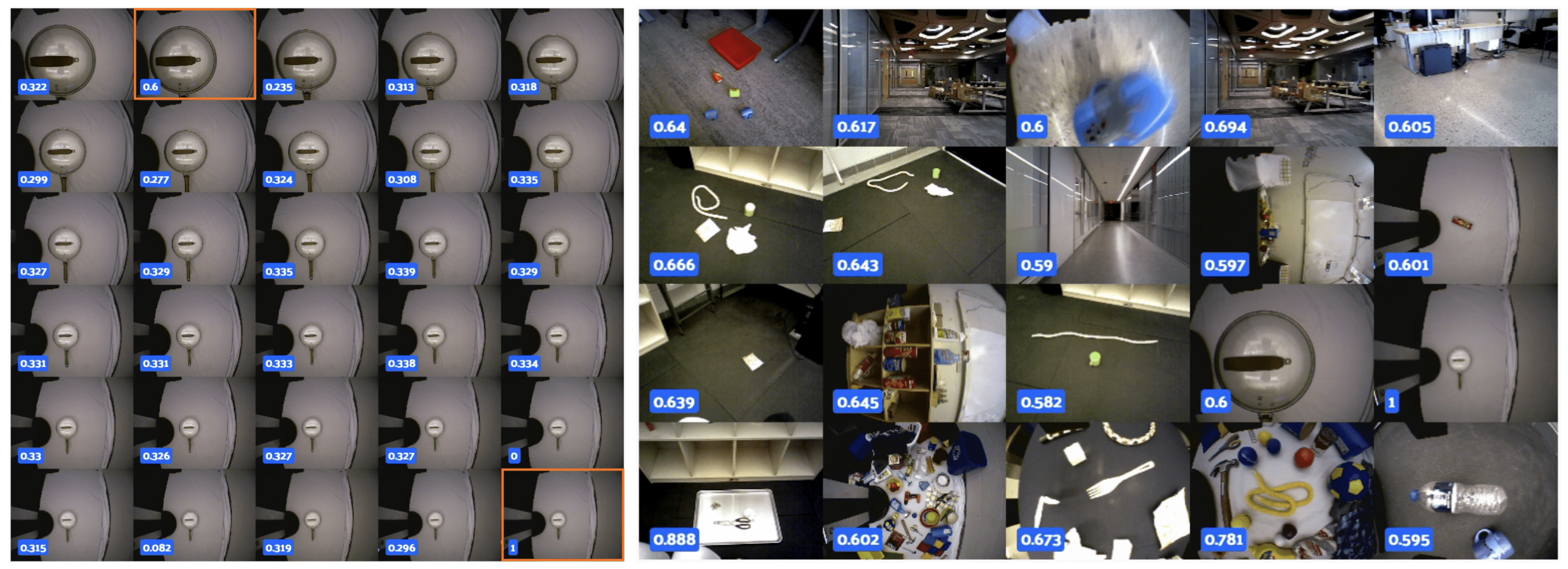
Find label errors and inconsistencies
These disagreements do not necessarily indicate an error—the embedding model is not ground truth—but they provide a practical way to prioritize annotation QA across large datasets.
Detect distribution shift
Embeddings make it possible to compare entire datasets rather than just individual samples.
Training data can be compared against validation data, customer data, production data, data from a new sensor, or data collected after an operating environment changes.
ScenarioNet (
arXiv:2306.12241), for example, used encoded scenario representations and t-SNE visualization to expose distribution differences between Waymo, nuPlan, and synthetic driving scenarios.
The visualization itself is only one tool. Teams can also quantify neighborhood overlap, similarity distributions, density, or other statistics directly in the original embedding space.
Build better evaluation and regression datasets
Random evaluation sets can overrepresent common data while missing the conditions most likely to expose model weaknesses. Embeddings help teams build evaluation datasets that more deliberately represent the range of conditions a model needs to handle.
Teams can select representative samples, preserve important outliers, and retrieve examples related to known failure modes. For physical AI, failures discovered during development or deployment can also become regression sets used to evaluate future model versions.
As new failure modes or operating conditions emerge, embeddings make it easier to find related examples across the dataset and add them to these sets. Future model versions can then be tested against both newly discovered conditions and historical failures, helping teams catch regressions before deployment.
Building custom embedding workflows
Most ML teams start by building internal embedding tools in notebooks. After computing embeddings with models like CLIP, DINO, or SigLIP, engineers project them into two or three dimensions using techniques such as
PCA, t-SNE, or UMAP. The result is usually an interactive scatterplot where each point represents an image, object, or video segment.
For small datasets, this approach works well. Engineers can quickly identify clusters, inspect outliers, compare classes, and validate that an embedding model captures meaningful semantic structure.
As datasets grow, however, the visualization becomes only one small piece of the workflow. Teams quickly find themselves building infrastructure around it:
- Computing and storing embeddings for millions of samples
- Maintaining vector indexes for similarity search
- Rendering large embedding plots interactively
- Linking points back to the underlying images, videos, or sensor data
- Filtering embeddings by metadata, labels, or model predictions
- Supporting multiple embedding models and versions
- Recomputing embeddings as datasets evolve
These challenges become even more pronounced for physical AI.
Instead of visualizing individual images, robotics teams often need to embed video segments, robot trajectories, 3D scenes, or synchronized multimodal recordings. Investigating a single point in embedding space may require synchronized playback across cameras, LiDAR, joint states, sensor streams, annotations, and model outputs.
At that point, the engineering challenge is no longer generating embeddings. It is building a scalable system that makes embeddings useful for dataset exploration, search, curation, and debugging.
What should you look for in an embeddings tool?
Computing embeddings is only the first step. To make them useful at scale, teams need infrastructure for
search, visualization,
dataset curation, and interactive inspection—not just an embedding plot.
Whether you build those capabilities yourself or adopt an existing platform, the requirements are largely the same.
| Capability | Why it matters |
|---|---|
| Support for multiple embedding models | Use the embedding model that fits your workflow and compute embeddings at the object, frame, point-cloud, segment, or episode level. |
| Segment-level embeddings | Embed arbitrary intervals of time—not just entire recordings—to retrieve similar behaviors, events, or failure modes across a dataset. This is particularly important for robotics and other multimodal time-series data. |
| Semantic search & retrieval | Search by natural language or similarity, combine semantic search with metadata filters, and retrieve nearest neighbors across large datasets. |
| Interactive visualization | Explore embedding spaces, inspect clusters and outliers, and jump directly from an embedding to the underlying data. |
| Multimodal data exploration | Connect embeddings to synchronized images, video, point clouds, sensor streams, annotations, and model predictions. |
| Dataset curation workflows | Use embeddings to discover failure modes, identify redundant data, measure dataset coverage, prioritize labeling, and build evaluation datasets. |
| Production readiness | Scale to millions of embeddings with fast vector search, versioning, APIs, and incremental updates. |
Embeddings are not an end in themselves. They're a way to understand your data. Embeddings are most useful when teams can move fluidly between exploration and action.
The right platform turns embedding spaces into practical workflows for search, curation, failure analysis, and continuous dataset improvement.
Embedding workflows in FiftyOne
is an open source tool for building multimodal datasets, with an
enterprise tierfor teams that need shared infrastructure at larger scale. Embeddings are part of the core data model rather than a separate add-on: once an embedding is computed on a dataset, it is available immediately for search, visualization, and curation using the same sample and label objects already stored in that dataset.
Instead of stitching together notebooks, vector databases, visualization libraries, and custom inspection tools, teams can explore embedding spaces and immediately investigate the underlying multimodal data.
Generate embeddings with your own models or foundation models, then visualize them interactively to understand dataset structure,
identify clusters, and surface outliers. Search by natural language, visual similarity, or nearest neighbors, and combine semantic retrieval with metadata filters to isolate specific scenarios, environments, or model behaviors.
For physical AI, embeddings extend beyond individual images. FiftyOne supports embeddings for arbitrary temporal segments, allowing teams to retrieve similar behaviors, failure modes, and events across synchronized multimodal recordings. Selecting an embedding immediately opens the corresponding cameras, point clouds, sensor streams, annotations, and model predictions, making it easy to move from a point in embedding space to the underlying data.
The result is a unified workflow for understanding datasets, discovering failure modes, measuring coverage, curating training data, and building better evaluation sets—all within the same platform.
FAQ
What are embeddings in machine learning?
An embedding is a numerical vector representation of a piece of data, such as an image, point cloud, or trajectory. Inputs the model considers similar sit near each other in embedding space, so distance becomes a measure of semantic similarity.
What are segment-level embeddings?
Embeddings computed over shorter windows within a recording instead of the whole episode. A query like "pedestrian crossing" then returns the matching intervals within an episode rather than the entire recording.
How do embeddings improve dataset curation?
They let teams find redundant data, surface coverage gaps, and select diverse subsets by content rather than random sampling. SemDeDup removed half of a LAION subset this way, and ZCore identified a representative robotics subset using 95% less data.
Can you search robot or driving data with natural language?
Yes. Vision-language models like CLIP and SigLIP map images and text into a shared embedding space, so a text query retrieves the visual observations that appear nearby, even when the property was never labeled.