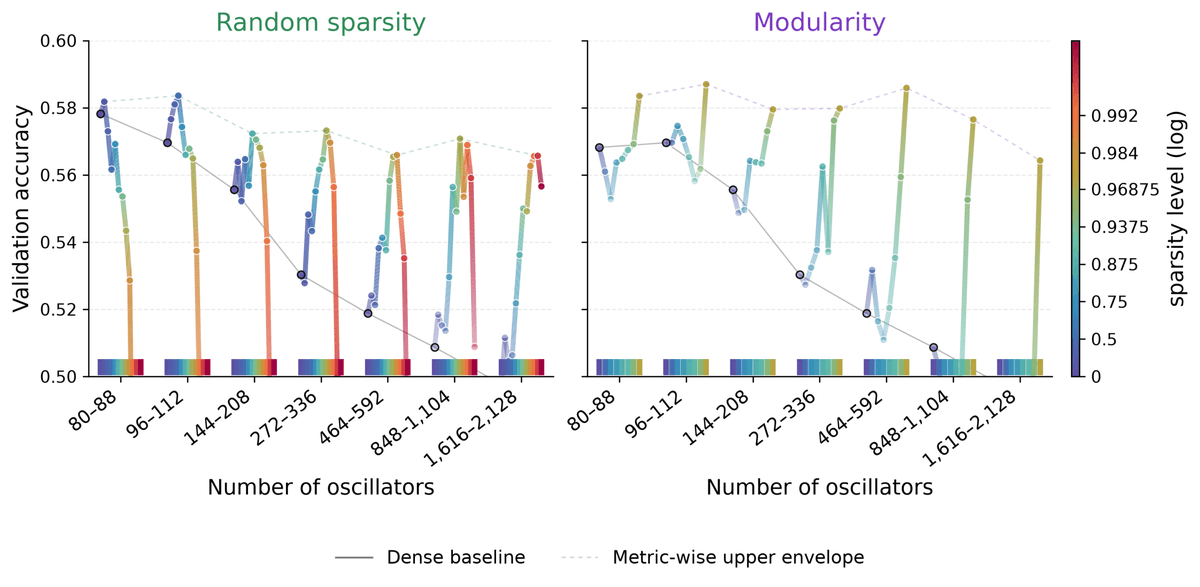
Unconventional AI just published a result that runs counter to almost every instinct in deep learning: they deleted 93.25% of the connections in their Un-0 image generation model and the model got measurably better. On ImageNet 64x64, the sparse version hits an FID of 7.15 , roughly 1.9 points ahead of the dense baseline at matched size. Lower FID is better, so this is a genuine quality improvement, not a rounding error.
A quick primer on what Un-0 actually is
Un-0 is an image-generation model built on Kuramoto dynamics: it generates an image by integrating the phase dynamics of a population of coupled oscillators , no diffusion schedule, no adversary, no iterative denoising. Think of it as thousands of tiny pendulums, each spinning at its own natural frequency, nudging each other through learned coupling weights. The system evolves over time, and a small conventional decoder reads out the final oscillator states and renders them into pixels.
The company is building an oscillator-based computer architecture that abandons the digital logic underpinning virtually all modern computing. Instead of processing data through transistors performing binary operations, Unconventional's approach uses coupled ring oscillators in a fabric network, encoding and processing information through the physics of the oscillators themselves. The long-term bet: Un-0 aims to demonstrate a path toward dramatically reducing AI's energy consumption , potentially by up to 1000x compared to current GPU-based digital systems.
The model is software-only for now (no physical chip yet) but demonstrates that the company's radically different computing approach can produce real AI results. With Naveen Rao (former Databricks AI chief, Nervana founder) leading and $475M raised at a $4.5B seed valuation, Unconventional AI is one of the most consequential AI hardware bets of the current cycle.