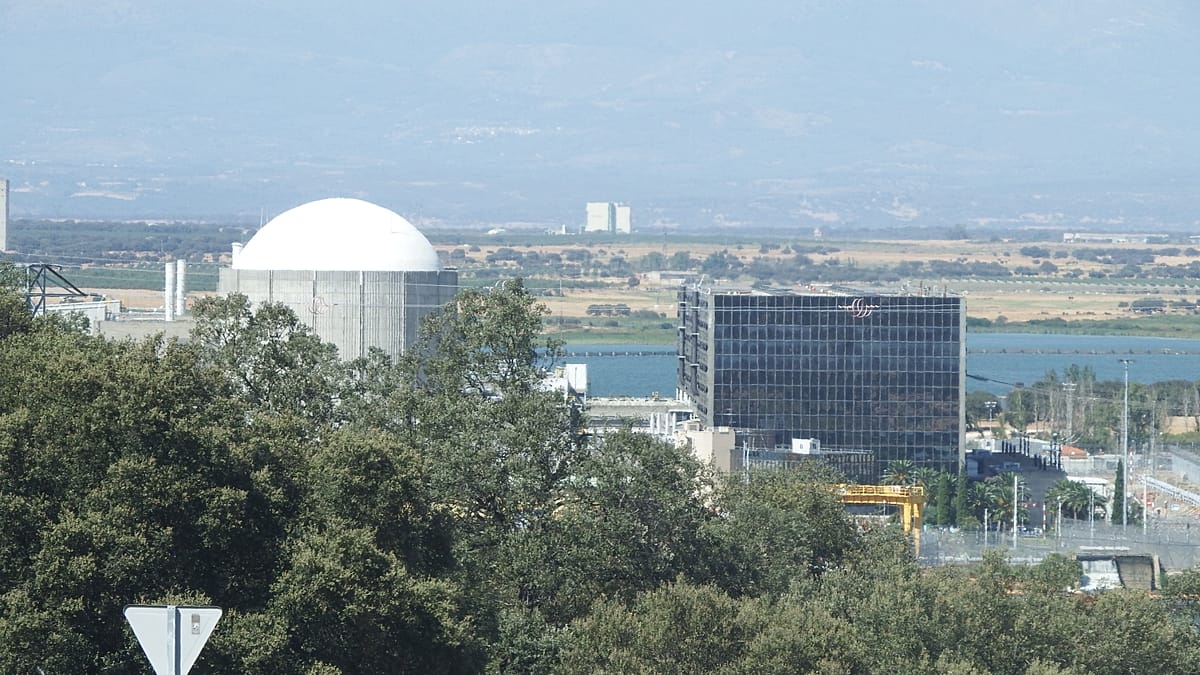
The Spanish Government announced on Friday the extension of the operating life of the Almaraz nuclear power plantuntil 8 June 2030, thereby acceding to the request made last autumn by the companies that own the facility.
 ADVERTISEMENT
ADVERTISEMENT
ADVERTISEMENT
The decision, which means postponing by three years the planned shutdown of the plant's two reactors in the Extremadura region, has been published in the Official State Gazette through a ministerial order from the Ministry for Ecological Transition.
Almaraz is the nuclear power plant that has generated the most electricity in Spain's history and currently provides around 7% of national electricity production.
Its unit 1 was scheduled to close in November 2027 and unit 2 in October 2028, according to the timetable agreed in 2019 between the Government and energy companies.
After the blackout that hit the Iberian Peninsula in April 2025, the role of nuclear power and the need to keep these plants running returned to the heart of the debate.
That agreement was reached in the context of a coalition government with left-wing political parties Podemos and subsequently with Sumar.
It demanded the immediate closure of all nuclear plants, setting out a gradual nuclear phase-out for Spain's seven reactors with the aim that by 2035 none would remain in operation.
The timetable established was as follows: Almaraz I in November 2027, Almaraz II in October 2028, Ascó I and Cofrentes in 2030, Ascó II in 2032, and Vandellós II and Trillo in 2035.
However, the position of the owner companies evolved over time until, last autumn, the firms that own Almaraz formally asked the Government for a three-year extension, until June 2030.
'An ideological issue: pressure from Brussels'
Madrid's decision also comes in a context of growing European pressure. In February 2026, a delegation of ten MEPs led by the chair of the European Parliament's Petitions Committee, the Pole Bogdan Rzońca (ECR), visited the Almaraz site in response to a citizens' petition against its closure, signed by workers, local governments, residents, farmers and associations from across the area.
Rzońca described the closure of the plant as "an ideological issue" for the Spanish Government and pointed out that more than 10,000 local residents opposed shutting it down, warning of a disconnect between local and national governments on this matter.
As a result of that visit, the Petitions Committee approved in May 2026 a report explicitly urging the Spanish Government to reconsider the shutdown timetable, concluding that the decision was based on "purely political and ideological reasons, without sufficient technical basis", and warning of the serious economic, social and energy consequences it would have for the region and for Spain's electricity system as a whole.
MEP Elena Nevado (EPP) argued that "there is no comprehensive impact assessment that properly evaluates its consequences" and stressed that the plant sustains around 4,000 direct and indirect jobs.
The European report also stated that decisions on strategic energy infrastructure must be taken on the basis of rigorous, transparent and technically justified assessments, taking into account energy security, socio-economic impact and decarbonisation objectives.
The European Parliament's position was also in line with that of European Commission president Ursula von der Leyen, who has repeatedly defended the need to keep operating nuclear power plants online.
Nuclear Safety Council clears the way
The Government's decision comes after the Nuclear Safety Council (CSN) issued, on 16 July, a favourable report on the plant's continued operation, confirming that it meets all nuclear safety conditions to operate until 2030.
The facility also complies with the requirements on security of supply and zero cost for consumers set by the Ministry for Ecological Transition.
The regulator's favourable report thus removed the main technical argument that the Government could have used to maintain the original shutdown timetable, leaving the decision entirely in the political sphere.
It is worth remembering that the plant has a 'twin' in Virginia (USA), North Anna, which has already been authorised to operate for up to 80 years.
Big relief and success for a region hit by rural exodus
The news has been welcomed by the citizens' platform Yes to Almaraz, Yes to the Future, set up in January 2025, which has brought together more than a hundred municipalities, business organisations, chambers of commerce, workers, ancillary companies and associations from across the Cáceres area in defence of keeping the plant open.
"At last we can breathe again and see light at the end of the tunnel", said Fernando Sánchez, president of the platform and mayor of Belvís de Monroy, who believes that the decision "restores confidence to thousands of families who for months have lived in suspense, waiting for a ruling that would determine the future of an entire district".
The platform, which defines itself as a civic, plural and cross-cutting movement with representatives of different political persuasions, has also enjoyed the backing of international organisations such as Mothers for Nuclear - which has campaigned for the continued operation of the US nuclear plant Diablo Canyon - and WePlanet, a leading pro-nuclear environmental group in Europe.
Its example also inspired the creation of Women for Almaraz, an association made up of more than a thousand women from Campo Arañuelo that defends the plant as a guarantee of jobs, economic development and decarbonisation.
A reopened debate for energy security
The extension of Almaraz's operating life reignites the debate on the future of nuclear energy in Spain at a time when several economic and technical sectors are also pressing the Government to review the closure dates of other plants.
The wars in Ukraine and Iran are already prompting a rethink in order to guarantee energy independence in the European Union.
Recently, Catalan business leaders called for the shutdown timetable for the Ascó and Vandellós plants to be reconsidered, as industrial engineers and various energy analysts warned of the risks to national electricity supply if the planned pace of the phase-out is maintained.
There are growing worries about this especially after the nationwide blackout that shook Spain last year which reopened the debate on the country's energy security and energy independence.