science
Large Hadron Collider goes offline to make room for its enhanced successor
The High-Luminosity LHC will be mostly the same machine, but it'll deliver 10 times the luminosity and just as little chance of destroying the universe - sorry, conspiracy theorists
The end has come for CERN’s Large Hadron Collider (LHC), but it’s not being turned off for fear of the world being sucked into some sort of cosmic anomaly - it’s getting a major upgrade.
Physicists at CERN are still bidding goodbye to the LHC, per a Monday announcement from the lab, but this is very much a “the king is dead, long live the king” sort of moment, as the four-year shutdown will result in the completion of the High-Luminosity LHC, or HiLumi LHC, not a full-fledged replacement.
In essence, a younger, fitter model with much better eyesight and most of the same genes will be taking the throne as the world's largest particle accelerator, or human-made machine, for that matter, when it comes online in 2030 after what the lab is calling Long Shutdown 3.
HiLumi LHC will feature a number of upgrades. As its name suggests, increased luminosity is the biggest difference between the new model and the old LHC, which was first switched on in 2008.
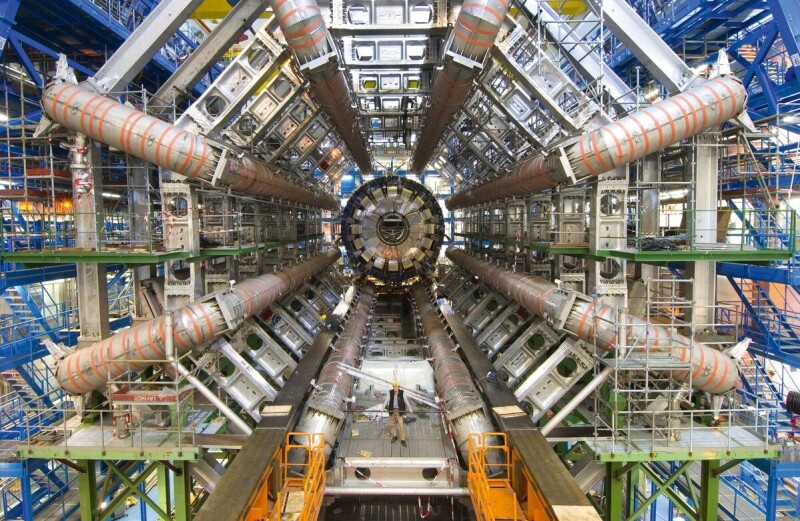
Luminosity, as CERN explains, is proportional to the number of collisions produced in a given time. Those collisions are detected in the ATLAS and CMS detectors at the LHC (the pair were responsible for the world’s first detection of the Higgs boson in 2012), which will be getting some major upgrades that, per CERN, will effectively make them into entirely new detectors.
In their current incarnation, ATLAS and CMS can detect somewhere in the neighborhood of 60 proton-proton collisions per firing cycle, in what’s known as a “bunch crossing” where particles fired in opposite directions come in contact with each other. Once the upgrade to HiLumi LHC is complete, the hope is that they’ll be capable of detecting between 140 and 200 collisions per cycle, a luminosity increase of a factor of 10, the lab said. Those collisions are picked out of a massive amount of data (more than five billion interactions per second), and the more collisions the experiments can detect, the greater potential they have of spotting something of interest to CERN particle physicists - like the Higgs boson.
To turn the LHC into the HiLumi LHC, ATLAS and CMS will have their trigger systems that select events for closer examination completely replaced, new detector technology will be installed, and timing detectors able to measure things at a resolution of “a few tens of picoseconds” will be installed.
The end result of this upgrade, a CERN spokesperson told The Register, is to enable more physics discoveries like the Higgs identification and other firsts the LHC has produced over the years when it wasn’t shut down for repairs or other upgrades.
“Over its lifetime, the HiLumi LHC could produce about 380 million Higgs bosons, compared with roughly 55 million Higgs bosons produced since the start of the LHC,” the CERN spokesperson told us, adding that the hope is to eventually see two Higgs bosons produced together and interacting with each other. “This process is extraordinarily rare and is one of the flagship goals of the HL-LHC. Measuring this self-interaction will teach us about the Higgs field itself and may provide clues about how our Universe evolved shortly after the Big Bang.”
A number of renovations are being conducted in the next four years along with the luminosity upgrades. Per CERN, the Super Proton Synchrotron (SPS), a 7 kilometer circumference ring that accelerates particles and beams them into the LHC, will be consolidated; the CERN Neutrinos to Gran Sasso (CNGS) target area, which shot a beam out of the SPS through the Earth’s surface toward a laboratory in Italy 732 km away, will be dismantled; and new target facilities will be established in Experimental Cavern North 3, along with other safety, electrical, and technical upgrades.
“In the LHC alone, 1.2 km of magnets and components will be removed and replaced with new equipment,” Jean-Philippe Tock, CERN deputy engineering lead and coordinator for the shutdown, said in the lab’s statement.
As for whether the refurbished LHC will increase the chance that humanity ends the world, CERN assured us the new one will be just as safe as the old 27-kilometer machine that’s stirred up controversy and conspiracy theories over the past couple of decades.
“The Universe as a whole produces more than 10 million million LHC-like experiments per second,” the lab spokesperson explained. “If such phenomena were dangerous or destructive, it would contradict what we see: stars, galaxies and the Earth still exist.” ®