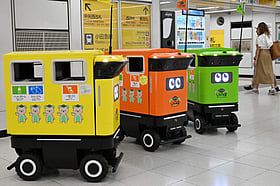
Robots move through busy station
The robots stand just over one metre tall and travel at a cautious speed of about 20 centimetres per second.
Their slow pace has been deliberate, allowing passengers to approach them and throw away rubbish while enabling the machines to stop quickly if needed.
“We wanted to test how well something like this can operate automatically and safely in an environment like Shinjuku Station,” said JR East research official Shinya Kawamichi.
“We want to see how much of a difference mobile trash bins that collect garbage make, and whether people are actually willing to throw their trash into them.”
Fewer bins in the station
Despite the enormous size of Shinjuku Station, the JR East section has only seven sets of rubbish bins and recycling boxes.
The number of wastebaskets has been reduced in recent years because of cleanliness and security concerns.
Some Japanese passengers have shared that stations can remain clean because people often take their rubbish home with them.
Meanwhile, others have welcomed the robot bins as a convenient option for disposing of waste while travelling.
Robots become tourist attraction
The bulky machines, which feature large googly eyes, have also attracted attention from visitors. Many tourists have stopped to photograph the unusual devices as they move through the busy station.
For JR East, however, the trial has been focused on whether the robots can safely operate among large crowds and whether the technology could have wider applications in the future.
The robot-bin trial has been scheduled to run until late November. JR East will assess how effectively the machines collect rubbish, move through crowded areas and interact with passengers.