Roboflow's Outsourced Labeling service lets you outsource image annotation to trusted labeling partners, helping you create accurate, production-ready datasets without the overhead of managing an in-house labeling team.
A model is only as good as the quality of the data it is trained on. To help you build high quality datasets for large-scale annotation projects, Roboflow enables customers to work with vetted labeling partners to outsource image annotation through its Outsourced Labeling service.
This allows organizations to create high quality datasets faster without the overhead of managing an in-house labeling team.
In this guide, you will learn about Roboflow's outsourced data labeling service, the challenges of labeling images in-house, and how to provide clear, detailed instructions to outsourced annotators.
💡
Get started with
Outsourced Labelingtoday and have your first 1000 images labeled for free. We prioritize delivering high quality, accurate annotations with fast turnaround times, helping you build large-scale, production-ready datasets with confidence.
The Importance of Image Labeling in Computer Vision
Image labeling is the foundation of every successful computer vision model. By assigning labels or annotations to images, you create the training data that enables models to recognize objects, identify patterns, and understand visual information.
High quality annotations are essential for training accurate models across a wide range of computer vision tasks, including image classification, object detection, semantic segmentation, and keypoint detection. Consistent, well-labeled data directly impacts model performance and helps reduce errors during inference.
Although many public datasets are available, they rarely match the specific requirements of your application. Whether you're identifying manufacturing defects, detecting specialized equipment, or recognizing custom objects, large-scale, domain-specific annotated datasets are essential for building high-performing models.
With Roboflow's outsourced labeling service, you can work with experienced annotators to produce accurate, high quality annotations tailored to your project, allowing your team to focus on developing and deploying computer vision models rather than managing large-scale labeling operations.
Challenges Faced When You Label Your Own Images
Managing image annotation projects in-house requires significant time, personnel, and operational overhead. Common challenges include:
- High resource requirements: Building an in-house labeling team requires hiring, training, and managing contributors.
- Project management overhead: Dedicated team members are needed to oversee labeling quality, answer questions, and coordinate workflows.
- Limited scalability: As datasets grow, expanding internal labeling capacity can be slow and expensive.
- Longer project timelines: Annotation can become a bottleneck that delays model development and deployment.
- Inconsistent annotations: Without clear processes and quality control, labeling consistency can vary across contributors.
- Potential labeling bias: Internal teams may introduce biases that reduce dataset diversity and impact model performance.
- Higher operational costs: Maintaining an internal annotation team often costs more than outsourcing large-scale projects.
- Reduced engineering focus: Engineers and domain experts may spend time managing annotation instead of building and improving computer vision models.
Why Outsource Image Labeling with Roboflow?
To overcome the challenges above, Roboflow's Outsourced Labeling service connects you with trusted annotation partners who can label images on your behalf.
Instead of building and managing an in-house annotation team, you can work with experienced annotators who produce high-quality training data while your team focuses on developing and deploying computer vision models.
Every project is completed using the instructions and quality standards you define, ensuring annotations are accurate, consistent, and tailored to your application.
By outsourcing image labeling through Roboflow, you can achieve:
- Scalability: Label datasets of any size without hiring, training, or managing an in-house annotation team. Roboflow's trusted labeling partners can quickly scale to meet your project's needs, whether you're labeling as few as 50 images or scaling to millions.
- Cost-effectiveness: Pay only for the annotations you need instead of hiring, training, and managing an in-house labeling team. Pricing starts at just $0.10 per bounding box, $0.20 per polygon, and $0.05 per classification or keypoint annotation, with discounted prepaid plans available for larger projects.
- High-quality annotations: Work with experienced annotators who have expertise across diverse datasets and domains. They follow your labeling guidelines and quality assurance processes to produce accurate, consistent, and production-ready training data.
- Faster development cycles: Generate labeled datasets more quickly, reducing the time between data collection, model training, and deployment.
- Bias mitigation: Third-party annotation teams can provide a more objective perspective by reducing the influence of internal assumptions and labeling habits. This helps reduce the risk of systematic bias in your training data.
Get Started With Outsourced Data Labeling Today
Getting started with Roboflow's Outsourced Labeling service only takes a few simple steps.
First, log in to Roboflow and create a new project by clicking + New Project in your workspace.
During project creation, select the computer vision task you want to label for, such as object detection, instance segmentation, semantic segmentation, image classification, or keypoint detection.
Once your project has been created, upload the images you want to have labeled.
After your images have been uploaded, navigate to the Annotate tab. Here, you'll see all unannotated images in your dataset. Click Annotate Images to open the annotation options.
Select Hire Outsourced Labelers to submit your images for annotation to Roboflow's team of professionally vetted labelers.
If you have any questions about the process, contact us, and a member of our team will get back to you as soon as possible.
How to Provide Detailed Labeling Instructions to Outsourced Labelers
When working with Roboflow's Outsourced Labeling team, clear instructions help labelers understand your requirements and produce accurate, consistent, high quality annotations.
Follow the best practices below to create labeling instructions that labelers can reference throughout the annotation process, helping ensure annotations remain consistent and aligned with your project's requirements.
You can use Roboflow Annotate to create the example images included in your instructions.
Tip #1: Provide Positive Examples
Positive examples are correctly annotated images that demonstrate exactly how your dataset should be labeled.
They serve as the ground truth for labelers, showing what a high quality annotation looks like and how your labeling instructions should be applied in practice.
Examples of well annotated images are one of the most effective ways to communicate annotation requirements. By providing reference images that demonstrate the expected outcome, labeling teams have a clear source of truth they can consult throughout the project.
As a general rule, the more comprehensive your set of positive examples is, the less ambiguity and back-and-forth communication will be needed during the labeling process.
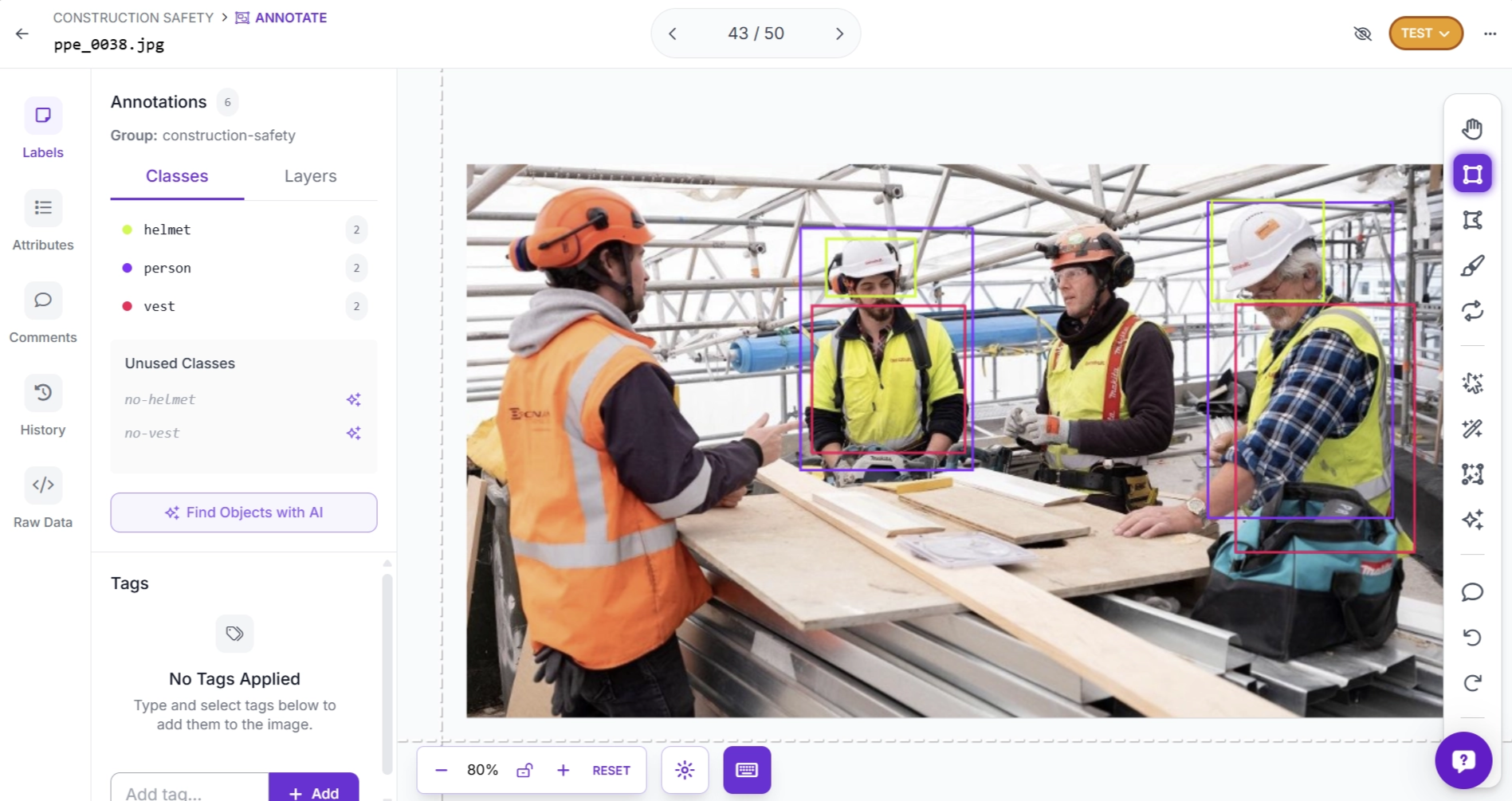
Positive Example 1: Label All Required Classes Correctly
The example below demonstrates a correctly annotated image that follows the expected labeling conventions for the dataset.
All three required classes, Person, Helmet, and Vest, have been annotated.
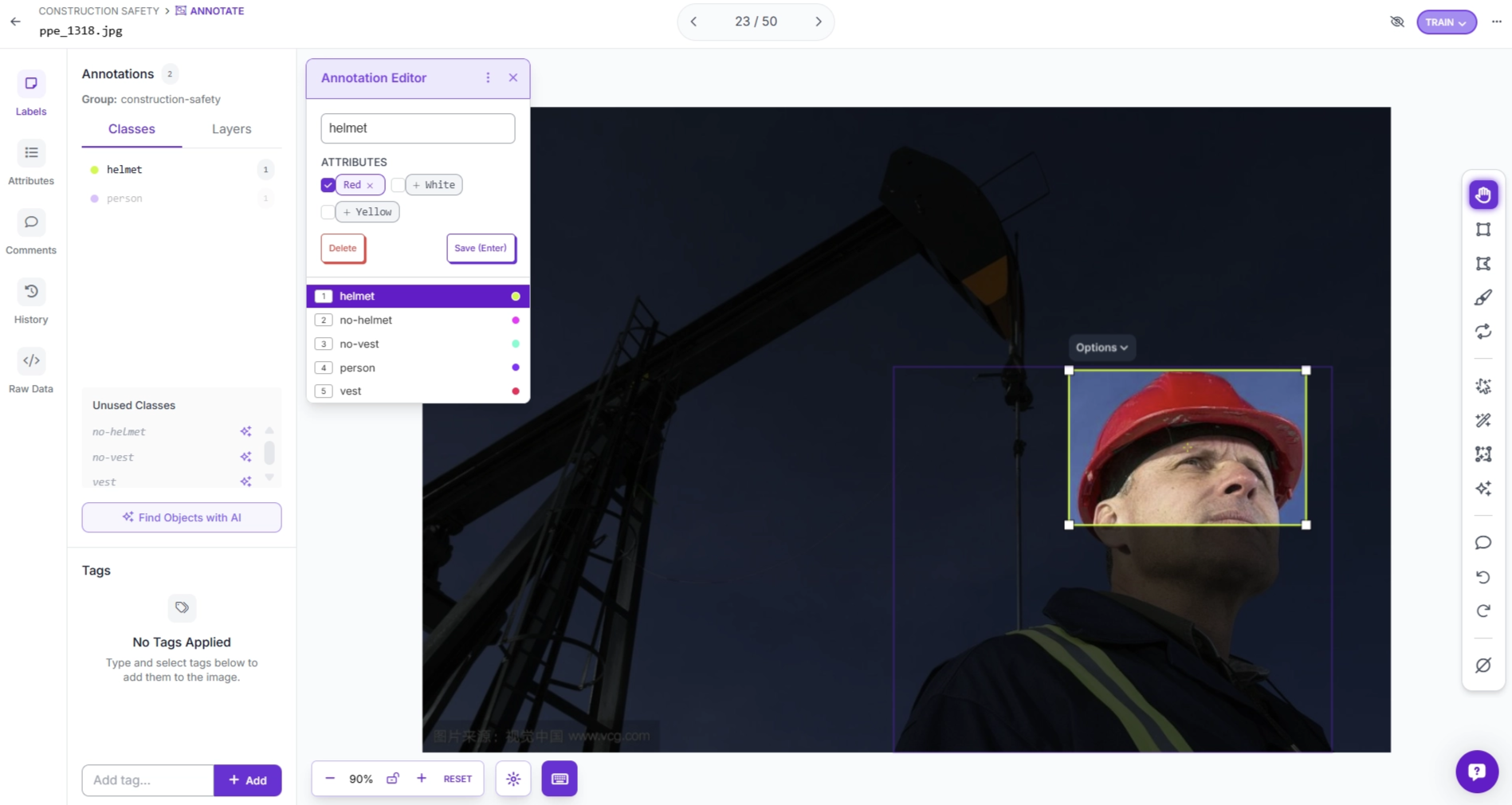
Positive Example 2: Use Annotation Attributes to Capture Additional Information
The example below demonstrates how Annotation Attributes can be used to capture additional information.
In addition to labeling all required classes, it applies the Red attribute to the Helmet class, increasing annotation granularity and improving the quality of the dataset.
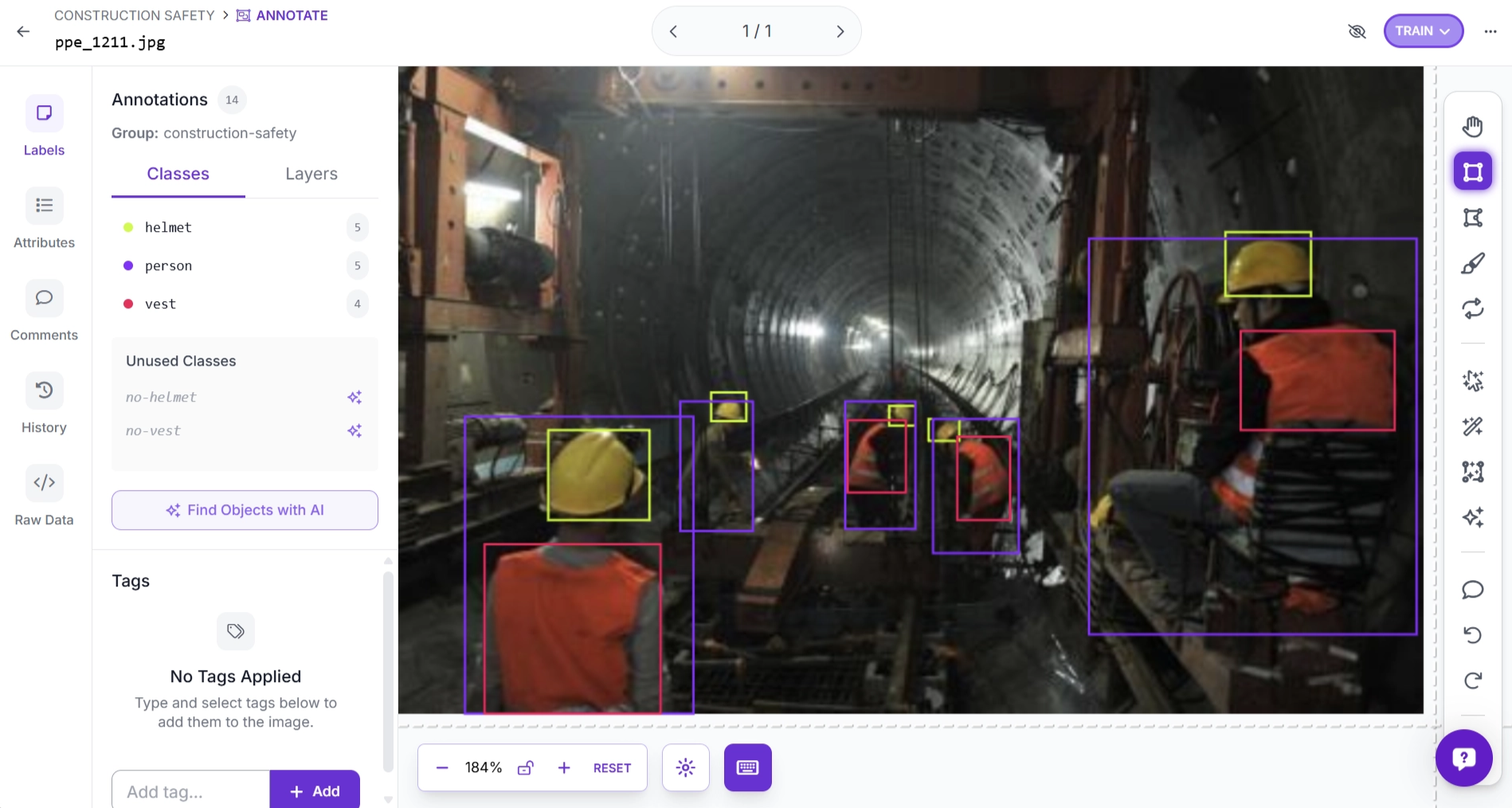
Positive Example 3: Annotate Objects Even When They Are Small or Partially Occluded
The example below demonstrates that objects should still be annotated whenever they are identifiable, even if they are small or partially occluded.
Further, you can also include positive examples for crowded scenes, visually similar classes, challenging lighting conditions, and other edge cases specific to your dataset.
Tip #2: Provide Negative Examples
Negative examples are incorrectly annotated images that demonstrate common labeling mistakes. They help labelers understand edge cases, reduce ambiguity, and avoid recurring errors.
These examples are particularly valuable when annotation decisions involve subjectivity or when certain classes are commonly mislabeled. They can also highlight frequent quality issues, such as missing annotations, incorrect class assignments, or inconsistent labeling.
Negative Example 1: Don't Leave Visible Objects Unlabeled
The example below demonstrates an incomplete annotation where several clearly visible objects have been left unlabeled.
Every identifiable object that matches the labeling instructions should be annotated to ensure the dataset is complete and consistent.
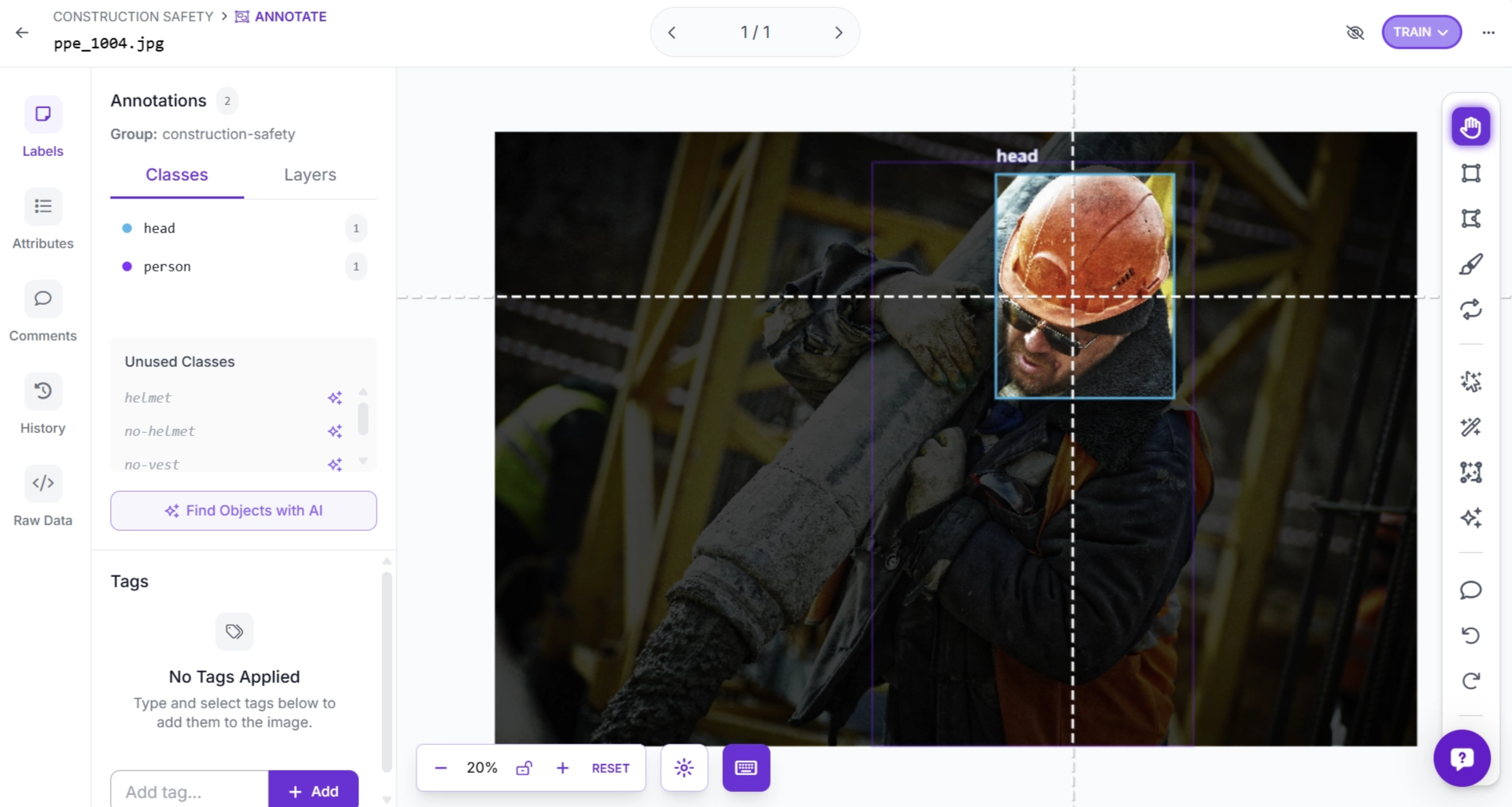
Negative Example 2: Don't Assign a New Class to an Object
The example below demonstrates an incorrect class assignment where a person's helmet has been labeled as Head, even though Helmet is the correct class defined in the dataset.
Only use the classes defined in the project's labeling instructions, and never create or substitute new classes.
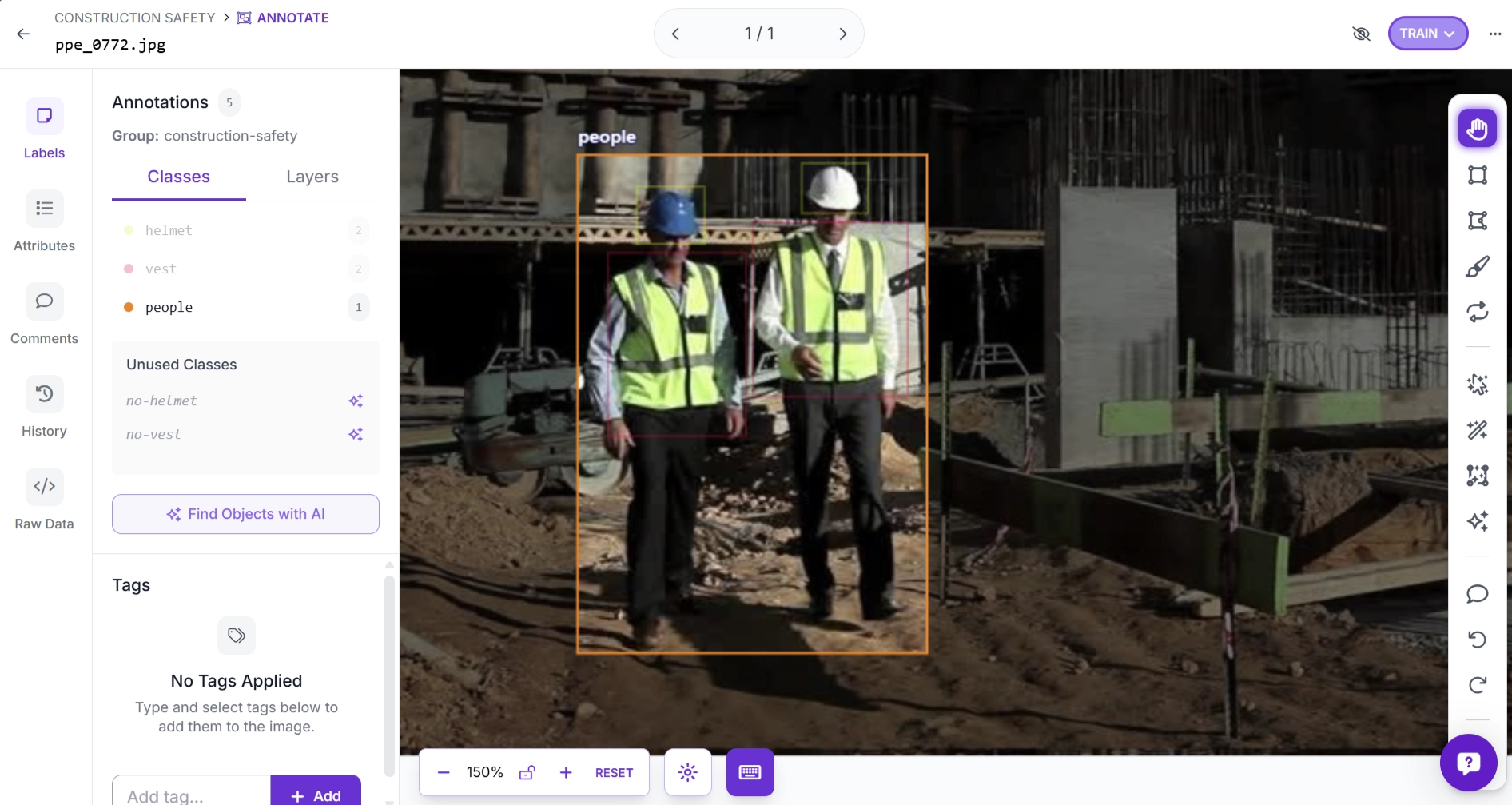
Negative Example 3: Don't Create New Variations of Existing Classes
The example below demonstrates an incorrect annotation where two people have been labeled using a new class, People, instead of the existing Person class defined in the dataset.
Each bounding box should represent a single object and use the exact class name defined in the project's labeling instructions. Do not create plural forms, abbreviations, or other variations of existing class names.
Further, you can also include negative examples for incorrect class assignments, duplicate annotations, inaccurate bounding boxes, and merged or split objects.
Tip #3: Include Unannotated Images
After providing positive and negative examples, include a small set of unannotated images in your labeling instructions. These images allow labelers to apply what they have learned without being shown the expected annotations.
Unannotated images act as a simple test of your instructions. If labelers can consistently annotate them correctly using only the guidance you've provided, your instructions are likely clear. If they frequently ask questions or produce inconsistent annotations, it is a strong indication that your instructions need additional examples or clarification.
This approach helps identify ambiguous cases before a large labeling project begins. Rather than discovering gaps in your instructions after hundreds or thousands of images have been labeled, you can refine them early and establish a stronger source of truth.
After labelers complete the exercise, review their annotations and provide feedback explaining any mistakes. You can then add the corrected annotations and explanations to your labeling instructions as additional positive or negative examples, further improving the quality and consistency of future annotations.
Leaving a feedback on an Annotation using Roboflow Annotate
Tip #4: Provide Context About Your Project
While your labeling instructions explain how images should be annotated, providing project context helps labelers understand why those annotations matter.
Knowing the purpose of your computer vision application helps annotators make informed decisions when they encounter situations that were not explicitly addressed in your labeling instructions or examples.
You don't need to provide a lengthy explanation. A few sentences describing what your model is being built to do and which details are most important is often enough.
For example:
“We are building a computer vision model to monitor construction site safety by detecting whether workers are wearing helmets and safety vests.”
Giving labelers this additional context helps them better understand your annotation requirements, leading to more accurate and consistent labels across your dataset.
Outsourced Image Annotation Services by Roboflow
Building high quality computer vision models starts with high quality training data. However, producing accurate, consistent annotations at scale can be time consuming and resource intensive.
Roboflow's Outsourced Labeling service solves this challenge by easily connecting you with trusted labeling partners who produce high quality, production-ready datasets without the overhead of hiring, training, and managing an in-house annotation team.
By providing clear labeling instructions, positive and negative examples, unannotated validation images, and project context, you can help ensure outsourced annotations remain accurate, consistent, and aligned with your project's requirements. This results in more consistent datasets, fewer revisions, and better model performance.
Get started with Roboflow for free today, or contact us to learn more about our Outsourced Data Labeling service.