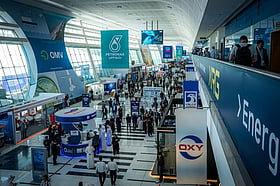
“When you look at the UAE, you have a state-of-the-art infrastructure- airports, ports, rail system that is working and growing and soon to be expanded to the neighbouring countries,” said Al Kaabi as he spoke of the same vision cascading down also into the energy system, oil and gas in the UAE and in Abu Dhabi.
He described ADNOC’s approach during recent disruption as resting on three principles: protecting people, maintaining commitments to customers and continuing to invest.
He said Abu Dhabi’s infrastructure and preparation helped support that resilience, while the emirate’s resources and ability to execute projects remain part of its investment appeal.
Turning to ADNOC’s latest upgrades, Al Kaabi highlighted efforts to reduce operational shutdowns, saying “minimising shutdown means value.”
He said ADNOC had deployed Neuron 5, a tool that has reduced unplanned shutdowns. According to the company’s operational reporting and pilot results, it has reduced unplanned shut down by 50 per cent.
AI in energy operations
Al Kaabi described AI as a way to accelerate subsurface modelling and field development planning, optimise well production, and reduce shutdowns. He said traditional subsurface workflows take two to three years and that AI could collapse sequential processes.
He framed ADNOC’s goal in applying AI is to produce the lowest-cost energy molecules while reducing carbon intensity and cited the OpenAI partnership and Energy in AI as examples of expanding collaboration beyond traditional oil and gas partnerships.
Building resilience across the supply chain
Abu Dhabi’s partnership principles are built on three pillars- shared vision, mutual benefit, and shared commitment.
Al Kaabi said resilience should be designed into energy projects, alongside safety, customer commitments, and investment. He cited an initial production milestone of 345 million standard cubic feet per day from Abu Dhabi’s unconventional resources.
Emma Delaney, Chairwoman & CEO of OMV, highlighted the importance of emergency response, business continuity, physical disruption, and cyber preparedness.
Also speaking on the panel, Takayuki Ueda, president & CEO of INPEX, said resilience must account for the full supply chain, including shipping routes, duration, and insurance costs. He described Abu Dhabi as a trusted, long-term partner for Japan.
He cited Abu Dhabi’s stable and transparent policy environment, competitive production, low-carbon-intensity crude and strong infrastructure as reasons to continue investing there.
He argued that diversification should mean reducing exposure to the Strait of Hormuz, not moving away from Abu Dhabi or the Middle East, while retaining competitive, low-carbon resources and stable policy conditions.