The African National Congress is on course to lose control of most of South Africa’s major cities in Wednesday’s local elections, according to polling data, potentially disrupting power dynamics in the national coalition government.
Several polls suggest the party’s remaining support is increasingly concentrated in smaller towns and rural provinces as opposition parties make deeper inroads in the biggest cities that drive Africa’s largest economy. The local government vote will decide who runs 250-plus municipalities responsible for basic service provision including water, sanitation, and refuse collection. It is the ANC’s first nationwide test since falling support forced it to share power in 2024 after losing its parliamentary majority — unprecedented in the democratic era.
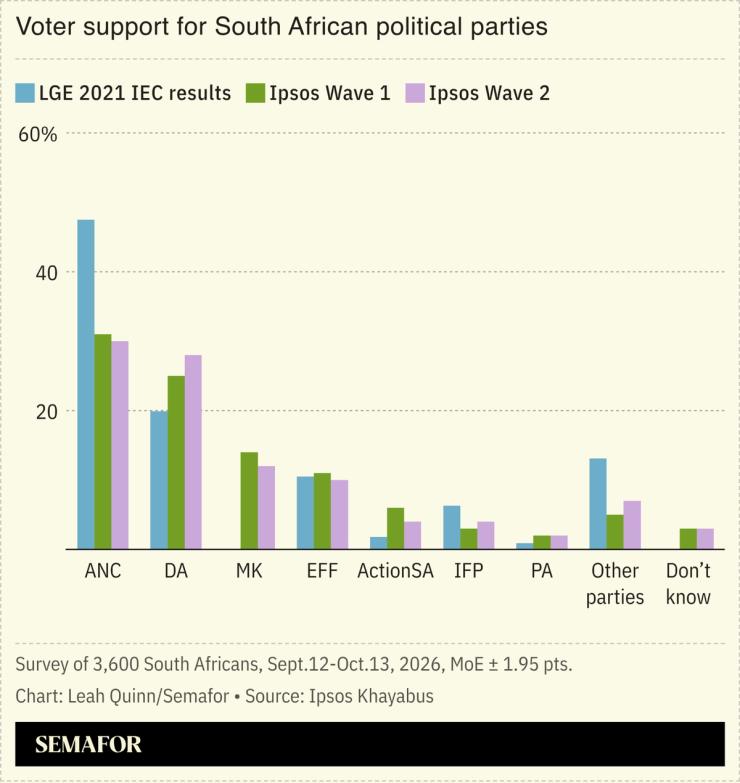
The latest Ipsos poll, conducted between Sept. 12 and Oct. 13, put the ANC’s national support at an “all-time low” of 30%, reflecting just how far its backing in urban areas has fallen. Roughly 30% of respondents in Johannesburg, the nation’s commercial hub, and Tshwane, home of the capital Pretoria, said they would vote for the ANC. And that figure fell to just 10% in the port city of Durban, where the populist uMkhonto weSizwe Party (or MK), which is pressing for sweeping state control of the economy and built around former president Jacob Zuma, is comfortably ahead in polls.
Support for the ANC, the party once led by Nelson Mandela, remains near 60% in Limpopo and the Eastern Cape, vast provinces of villages, small towns, and dispersed settlements that remain far less urbanized than Gauteng or the Western Cape, an earlier Ipsos poll showed. “After 30 years of democracy, voting patterns are changing and we are moving into a completely new reconfiguration of the political spectrum,” said Andre Duvenhage, a political analyst at South Africa’s North-West University.
The Ipsos survey and several other polls — if replicated on voting day — indicate that most metropolitan municipalities would require coalition governments after the local elections. This broadly matches the assessment of think tank Oxford Economics, which has predicted that voting in six of the eight metros would fail to produce an outright winner, creating the need for coalition negotiations.
A poor ANC showing would “upend the power dynamics” inside the national coalition government, said William Gumede, a political analyst and governance professor at the Johannesburg-based University of Witwatersrand. He argued that if the ANC’s share of the vote was close to or fell below the Democratic Alliance, it would force the former liberation movement to treat its junior partner “as an equal power” in policy-making and government decisions.
The two parties became governing partners after the 2024 general election for the first time, bringing ideological rivals into the same government where the ANC remains committed to state-led economic transformation policies while the DA has pushed for bigger private investment.