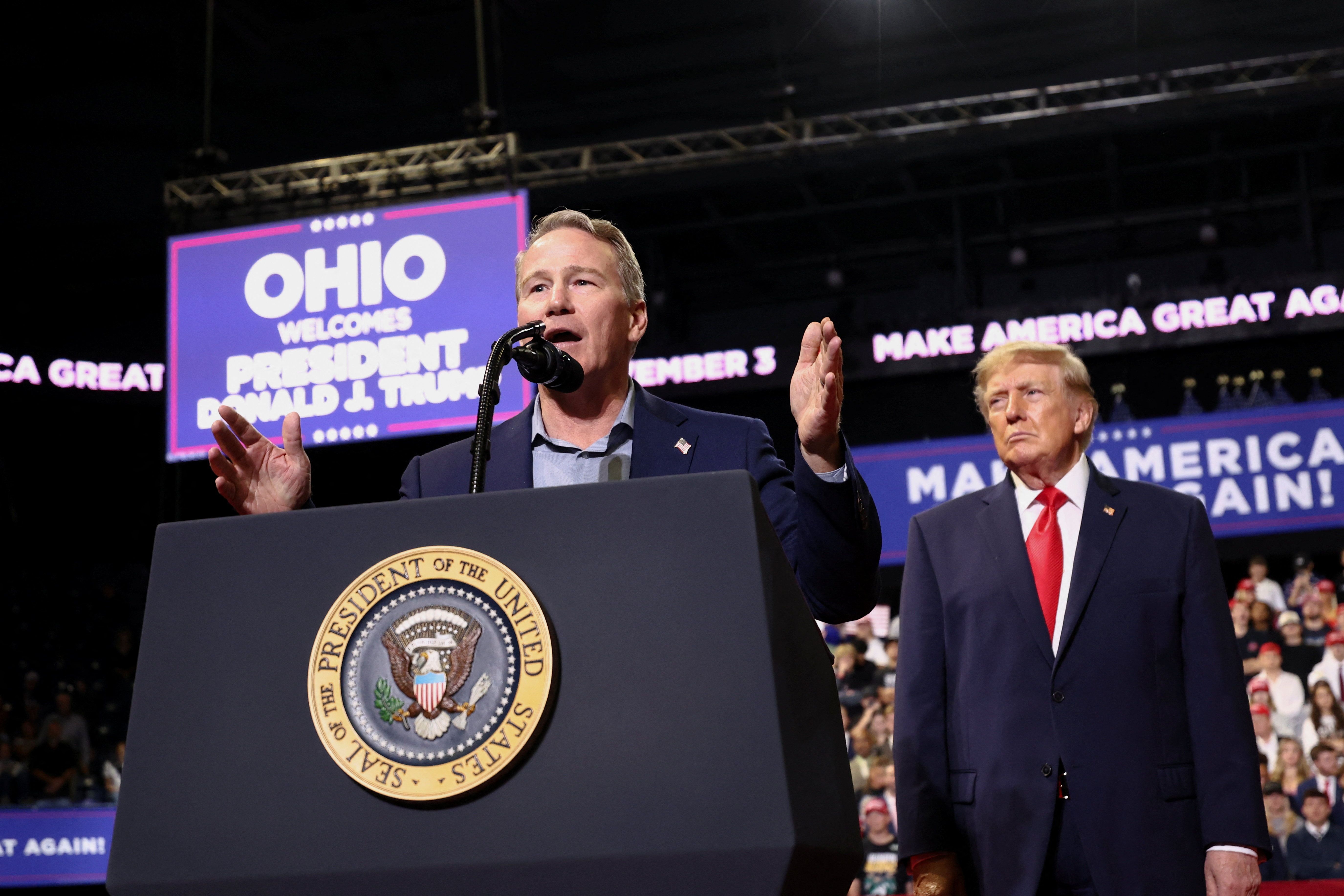
Americans are angry about war and prices, and a president’s second midterm is always difficult — but a series of decisions by President Donald Trump has made Republicans’ Senate majority ever-more vulnerable.
The mark Trump made on the midterms began in the summer of 2024, when he selected former Ohio Sen. JD Vance as his running mate. Since then, the president’s personnel and political decisions have reshaped the Senate battleground from what looked like an impenetrable red wall into a toss-up.
His decision to pick Vance opened up a special election in Ohio that will by the end of this week cost the GOP hundreds of millions of dollars and potentially a Senate seat. Trump’s party-boss mentality in North Carolina, Texas, and South Carolina has further contributed to the yawning battleground.
He endorsed Rep. Mike Collins in Georgia’s Senate race against Democratic Sen. Jon Ossoff — a contest that never really got off the ground after Georgia Gov. Brian Kemp, whom Trump tried to take down in a primary in 2022, passed on the race. Ossoff is favored to win.
And party insiders blame Trump’s tariffs and war with Iran for creating a volatile Senate map that has left seats in red states like Nebraska and Kansas vulnerable. Republicans could hold the chamber — or lose as many as a half-dozen seats on Tuesday.
“Every negative for the GOP this cycle is a downstream effect of Iran,” said a person close to the White House. Republicans can lose up to three seats and still keep Senate control.
Trump’s zeal on the campaign trail is undeniable and he helped direct huge sums of money into the midterms, albeit later than many Republicans would have liked. He spent the last weekend capping off a breakneck fall campaign schedule stumping in Iowa and Kansas, two places where the GOP was strongly favored to win a few months ago but now is struggling.
“President Trump has a 97% endorsement record and he remains the best turnout machine for our base voters,” said Republican National Committee press secretary Natalie Baldassarre.
Trump is hosting nearly 20 tele-rallies in the last days of the campaign, in addition to his almost-daily travel for rallies over the past month. The White House has sought to emphasize the administration’s accomplishments on issues like the border, crime, and US investment and manufacturing, as they look to encourage low-propensity voters to turn out for Republicans.
“President Trump is the unequivocal leader, best messenger, and unmatched motivator for the Republican Party, and he is committed to maintaining Republican majorities in Congress,” White House spokesman Davis Ingle said.
But his moves to reshape the party in his image over the past two years also often showed little regard for conventional political risk assessment.
Trump created two special elections with decisions to put Vance as his vice president and Marco Rubio, a popular former Florida senator, as his secretary of state.
On Tuesday, Democrats are underdogs in Florida after nominating democratic socialist Angie Nixon to face appointed GOP Sen. Ashley Moody. The race is more competitive than expected but not a five-alarm fire like Ohio, where Vance’s replacement, Sen. Jon Husted, R-Ohio, is in a precarious position.
The longtime preference of Husted, a former lieutenant governor, was to run for governor, according to multiple people familiar with internal party deliberations. He was instead appointed to the Senate and Vivek Ramaswamy ran for governor; Ramaswamy now trails Democrat Amy Action. A campaign spokesperson for Husted said that he “is completely focused on retiring Sherrod Brown once and for all this Tuesday.”
“Public polls in the national media have gotten Ohio wrong every election cycle since 2016,” one Ohio GOP operative argued.