Ideally the user would never have to think about it: the battery would say "100%" to mean "as charged as makes sense given battery age".
Have you considered that this might already be true?
The title of this post made me think the post was gonna be a rational analysis of whether or not limiting charging to 80% is actually worth it, but it wasn't, so I did a partial analysis of my own.
ChatGPT says phones get replaced in average every 3.5 years, and current iPhones and Pixels are rated to retain 80% battery life after 1000 charge cycles, which is 2.5 to 3.5 years roughly, depending how often you charge.
In the 3.5 case, capping your charging at 80% doesn't seem rational, since you're making a sacrifice as large as the maximum possible benefit you could get from that sacrifice.
That's just to demonstrate one case where capping might not be rational. I think a full analysis would need to take things into account like total battery life. If 80% gets you through your day no worries, then there's no sacrifice. If not, then it's different. If you charge a lot, then your battery would degrade more quickly. If you replace your phone every 2 years, it's pure sacrifice and will never pay off, etc.
I'm glad manufacturers aren't forcing this on all of us by changing what 100% means, because I doubt it's rational for everyone, maybe even most people.
In an ideal world the incentives on phone manufacturers would be to optimize useful lifetime, but instead people buy phones based on their as-new performance.
This statement was a red flag to me. It assumes customers aren't making any kind of rational trade-off and are just being stupid en-masse. But as-new performance is part of the overall lifetime of the phone and also worth prioritizing!
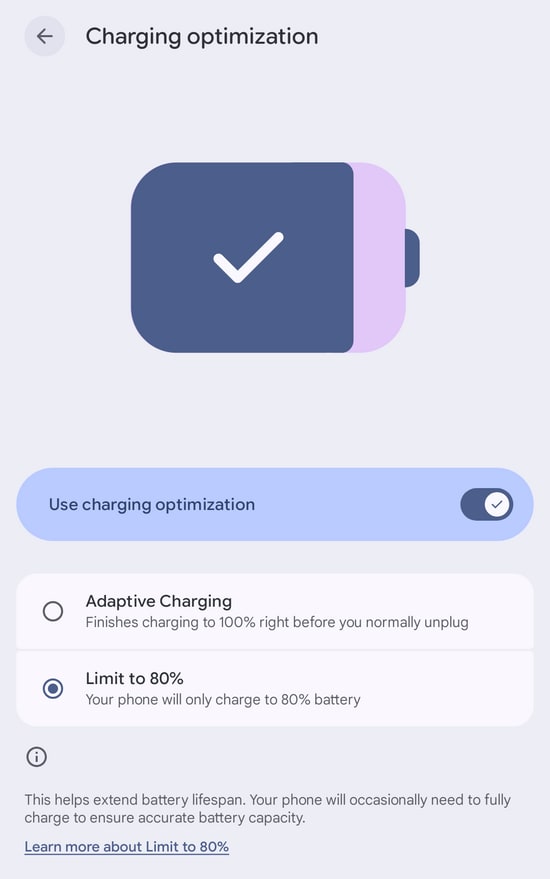
Have you considered that this might already be true?
The title of this post made me think the post was gonna be a rational analysis of whether or not limiting charging to 80% is actually worth it, but it wasn't, so I did a partial analysis of my own.
ChatGPT says phones get replaced in average every 3.5 years, and current iPhones and Pixels are rated to retain 80% battery life after 1000 charge cycles, which is 2.5 to 3.5 years roughly, depending how often you charge.
In the 3.5 case, capping your charging at 80% doesn't seem rational, since you're making a sacrifice as large as the maximum possible benefit you could get from that sacrifice.
That's just to demonstrate one case where capping might not be rational. I think a full analysis would need to take things into account like total battery life. If 80% gets you through your day no worries, then there's no sacrifice. If not, then it's different. If you charge a lot, then your battery would degrade more quickly. If you replace your phone every 2 years, it's pure sacrifice and will never pay off, etc.
I'm glad manufacturers aren't forcing this on all of us by changing what 100% means, because I doubt it's rational for everyone, maybe even most people.
This statement was a red flag to me. It assumes customers aren't making any kind of rational trade-off and are just being stupid en-masse. But as-new performance is part of the overall lifetime of the phone and also worth prioritizing!