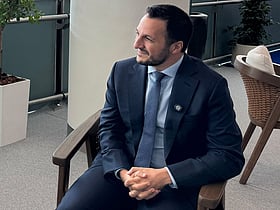
Abu Dhabi: Nearly 80% of UAE residents aged 18 to 34 use ChatGPT weekly, Rod Solaimani, Policy & Partnerships Lead for MENA and Central Asia said. People across MENA are optimistic about AI and its potential to create new job opportunities as the region continues to grow.
In an interview at ADIPEC 2026, Solaimani described the UAE and wider MENA region as distinctive for combining optimism about AI with major investment in infrastructure, energy, computing capacity and talent.
Solaimani said OpenAI had been working with regional partners toward this vision for more than three years, naming ADNOC, the Department of Government Enablement (DGE), Mubadala and Inception.
He said access to AI tools must be accompanied by training that helps people apply them in their work. The DGE, Solaimani said, is piloting an AI upskilling program for 20,000 government employees. At ADNOC, ChatGPT and Codex have been made available to 40,000 people, with Solaimani citing 97% utilization.
“Folks tend to fall into a false binary, and by that, I mean, ‘I have to make a choice. A choice between on-prem or cloud, open source or closed source,’ this lab or that,”
Solaimani also cautioned against treating AI decisions as a choice between strict alternatives. Instead, leaders should focus on what combination of tools best serves people.
He stated that the question asked by leadership is, “How do we best serve our people? What is the holistic solution that supports them and their day-to-day lives?”
Where should AI be used?
On AI sovereignty, Solaimani emphasized local processing, saying the UAE became the third region globally, after the United States and Europe, where OpenAI models were available for in-country inference.
He also pointed to investment in localized Arabic-language models in 2023 as a way to attract talent and build a lasting technology ecosystem.
“The researchers and engineers who worked on them were now moving on to larger projects, founding startups or joining enterprises, and that the investment would, only see dividends for decades to come,” he added.
He said the UAE’s investment in AI could open opportunities for researchers and engineers, particularly through startups and enterprise projects. He also highlighted its practical applications, from helping students prepare study materials to supporting entrepreneurs in developing business ideas.
Partnerships beyond business
At ADNOC, the partnership with OpenAI focuses on applying AI across key operations, including field development planning, drilling decisions and reserve estimation.
It is also exploring ways to optimize downstream trading and improve workforce productivity, Solaimani said.
“Access is not enough. You have to enable and empower your people,” he said, while addressing the ‘elephant in the room’.
He added, “I'd say this part of the world is taking that ambition and that vision and putting it into action, and they're doing it across a number of pilots, industries and government, uplifting their people at the same time.”
Another part of the collaboration is an “intelligence layer” intended to help employees work with ADNOC’s internal data by checking that queries, labels and terminology align with the relevant information. Solaimani said future work could extend to robotics and offshore operations.