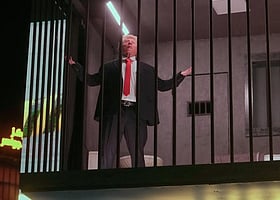
What is a lame-duck president?
A lame-duck president is a leader approaching the end of their term whose political influence may be declining, particularly when they cannot seek re-election.
In Trump’s case, the midterm defeat has strengthened Democratic control of Congress, potentially limiting his ability to push through legislation.
However, Trump remains president until January 2029 and retains significant executive powers, including authority over foreign policy and military operations.
Will Iran see an opportunity?
For Tehran, Trump’s domestic troubles could appear to offer fresh diplomatic leverage.
The president acknowledged that the Iran conflict contributed to Republican losses, although he defended his military campaign and blamed other factors for the defeat.
Iranian negotiators may calculate that Washington now has greater incentives to secure an agreement that reopens the Strait of Hormuz, stabilises energy markets and reduces American fuel prices.
But such calculations carry risks.
Reuters reported in September that senior Trump aides had sought to prevent major escalation before the elections, partly because of the war’s political unpopularity. Officials were also considering renewed military pressure after voting.
With the elections over, that immediate constraint has disappeared.
The latest American strikes near the Strait of Hormuz underline how quickly diplomacy and military confrontation can collide.
A difficult calculation for Gulf states
For Gulf governments, Trump’s political setback presents a different challenge.
The UAE, Saudi Arabia and other regional countries have repeatedly advocated diplomacy, warning that renewed fighting could threaten energy infrastructure, international shipping and regional stability.
At the recent Manama Dialogue, UAE presidential diplomatic adviser Anwar Gargash said the country hoped for a diplomatic breakthrough but remained prepared for the worst.
A weakened president might become more receptive to diplomatic arguments, particularly if a settlement delivers economic benefits.
Alternatively, Washington could continue using military pressure to extract concessions from Tehran.
For Gulf capitals, the practical question is whether American policy will become more predictable or more difficult to navigate during Trump’s final two years.
Will world leaders begin looking beyond Trump?
Perhaps the most consequential change is the approaching end of Trump’s presidency.
Constitutionally barred from seeking another elected term, Trump will leave office in January 2029.
His political influence could remain substantial, but foreign governments must increasingly consider the possibility that a future administration will pursue different priorities.
That creates a delicate diplomatic balance: Maintaining relations with a president who still commands extraordinary power while preparing for an uncertain political transition.
Trump has repeatedly recovered from setbacks that appeared capable of ending his career. His allies argue that his influence over the Republican Party remains formidable.
And the president has already signalled that he is willing to work with Democrats, even while threatening to veto legislation he opposes.
The real test lies ahead
The midterms have changed Trump’s political standing, but they have not settled the future of American policy in the Middle East.
Iran must decide whether to compromise or maintain its demands. Israel faces questions about the durability of American support. Gulf governments continue seeking regional stability while preparing for renewed confrontation.
Trump may be entering the final chapter of his presidency, but the Middle East could still be profoundly shaped by the decisions he makes before leaving the White House.
The question is no longer simply how much political power Trump has lost at home — but how he will exercise the considerable power he still holds abroad.