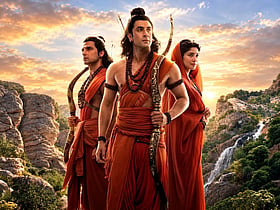
“But if I'm able to make you understand Ravana a little better, I think it will help you understand Prabhushri Ram [Lord Ram] in a better way.”
That's quite a proposition: understand the villain, and perhaps you'll understand the hero more deeply.
As for the possibility of international awards attention like whipping up an Oscar buzz, Kapoor was quick to bring the conversation back to the film's intentions.
“I don't think that was our intention. You know, the intention was just to tell the most authentic version of Ramayan. Try and do it with sincerity, with passion.”
At the time of the interview, they had just hosted a screening in Los Angeles and peddled the movie to mostly non-Indian press.
He believes cinema should entertain audiences while making them think, rather than handing them easy answers. Awards, he suggested, would simply be an added bonus.
But beyond the scale, technology and casting, the conversation also revealed a rather nostalgic side of the trio.
Yash's childhood favourite was Hanuman, whom he remembers as his first superhero. “You could change shapes, you could fly, and I love character of Anjunaya, we call it Anjanaya in South,” he recalled.
Pallavi, meanwhile, was curious about Janaka Maharaj, Sita's father. Kapoor's earliest memories came from watching Ramanand Sagar's Ramayan every Sunday morning, particularly its spectacular flying arrows and the dramatic depiction of Surpanakha.
For a generation raised on that television classic, those images clearly left an impression.
And perhaps that's the real balancing act for this new Ramayana: keeping the nostalgia alive while making an ancient epic feel cinematic, accessible and relevant to a global audience.
With Kapoor embracing Rama, Pallavi bringing her interpretation of Sita and Yash promising a Ravana who might just leave viewers conflicted, the familiar story could have a few new talking points.