Saudi flight suspensions extended — check before travelling
The most important change for passengers is that Etihad’s Riyadh and Dammam suspensions now extend beyond the previously reported Nov. 5 deadline.
Gulf News aviation update reports:
Abu Dhabi–Riyadh and Abu Dhabi–Dammam: All passenger and cargo flights remain cancelled through Nov. 19.
Abu Dhabi–Jeddah: Selected services—EY601, EY602, EY603 and EY604—are scheduled to resume Nov. 6. Other Jeddah services are reported to operate as scheduled. These remain plans, subject to operational changes.
Iranian airlines: Services to and from the UAE, including Iran Airtour flights serving Dubai, remain suspended until further notice.
Tel Aviv: Emirates–flydubai codeshare services remain suspended. This should not be read as a blanket suspension of every UAE–Tel Aviv service.
For residents: Check the airline’s app or official flight-status page before leaving home, confirm connecting flights separately, and ask about rebooking or refund options if affected. Schedules can change at short notice.
Security: UAE favours diplomacy while preparing for escalation
For residents: Follow official UAE announcements rather than circulating unverified attack footage or social-media warnings. Keep passports, booking details and emergency contacts readily accessible. There is no new UAE-wide evacuation instruction or blanket airport closure for Nov. 5.
Economy and oil: Brent below $94, disruption persists
The decline has been attributed to hopes that Trump would pursue diplomacy after Republican election losses, alongside Qatar’s mediation efforts.
It shows markets are reducing the extra premium charged for feared future disruption, but physical restrictions around Hormuz remain. Prices remain above pre-war levels despite the sell-off.
For residents and businesses: Falling crude is an encouraging signal, not proof that freight costs or imported-goods prices have normalised. War-risk insurance and shipping expenses can still affect imports. Businesses should review delivery schedules, insurance cover and supply-chain exposure.
Shipping: Tanker incident underscores Hormuz risk
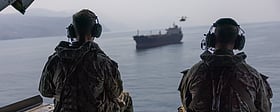
Gulf News’ Nov. 4 briefing, citing the UK Maritime Trade Operations agency, reported that a tanker was struck by two unidentified projectiles approximately 14 nautical miles northeast of Oman, on Tuesday (Nov. 3).
The engine room was hit, but no casualties or environmental damage were reported. The notice did not identify the attackers.
The report also cited tracking data showing only five commodity vessels passing through Hormuz on Saturday and none on Sunday, compared with more than 130 daily transits pre-war.
For UAE importers, exporters and seafarers, the practical issue remains whether vessels can transit reliably and obtain insurance, rather than whether oil futures have fallen for a few sessions.
Trump’s choice: Renewed strikes, a deal or continued economic pressure
Axios reported that Trump is weighing three broad options after Republican midterm losses: resume military strikes, negotiate an agreement, or maintain the naval blockade and economic pressure campaign, according to Iran International’s account. No final choice was reported, per Iran International.
The report describes competing approaches within the administration:
Vice President JD Vance favours reaching an agreement with Tehran rather than restarting major operations.
CIA Director John Ratcliffe, Treasury Secretary Scott Bessent and other advisers favour maintaining economic and naval pressure.
US military officials said preparations for possible major combat operations were being completed, while Qatari mediators pursued a draft agreement intended to prevent renewed fighting and potentially restart direct talks.
Axios also reported that Israeli Prime Minister Benjamin Netanyahu had urged strikes before the midterms. Preparations and advocacy, however, are not the same as a presidential order to attack.
For UAE residents, this explains why diplomatic optimism and military risk coexist: talks can advance while forces remain positioned for escalation.
South Korea proposes a larger naval mission near Oman—not inside Hormuz
South Korea plans to expand its Cheonghae anti-piracy mission from the Gulf of Aden into waters south of Oman, according to Yonhap reporting carried by Iran International. Proposed additions include a P-8A maritime patrol aircraft, an explosive ordnance disposal team, unmanned mine-clearing systems and 75 personnel, bringing the unit to 395.
Officials described the proposed mission as non-combat and independent of allied forces. The aircraft would be barred from monitoring or targeting Iranian territory, territorial waters or the interior of the Strait of Hormuz.
Cabinet endorsement is expected to be sought next week before parliamentary approval.
Hegseth faces political pressure
For Gulf residents, these developments are relevant to Washington’s decision-making, but do not themselves establish a change in military policy.
Vance blames the war; Fleischer blames the ceasefire
US VP Vance attributed Republican losses to the conflict, writing: “The reason we lost is the war.” Former George W. Bush press secretary Ari Fleischer argued the opposite: “The problem was not the Iran War. It was the ceasefire.”
Fleischer advocated continuing the campaign until Iran’s leadership fell. The disagreement shows that election pressure is producing competing demands for negotiations and escalation — not a single agreed path out of the conflict.