I've seen a bunch of people claiming "well, we need to make sure whatever our AI policy is doesn't hurt the economy because people will feel that in their wallets and hate it (and hurting the economy is bad."
This might hypothetically be true, but I've never seen anyone argue for it in any detail.
Meanwhile, I'd naively expect if shut down AI anytime soon, it'd dampen growth, and maybe it'd be a minor economic dip, but I wouldn't expect it to be a major recession. (It makes sense that it'd become a bigger deal as AI takes over more of the economy. But it feels like the people saying "it'd hurt the economy" are often the people implying that means we should do less of a pause and do it later).
I don't know much about economic recessions.
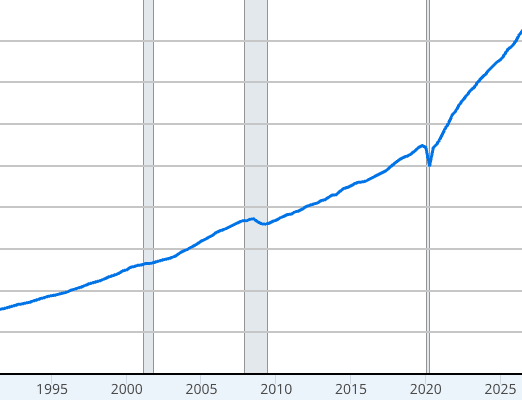
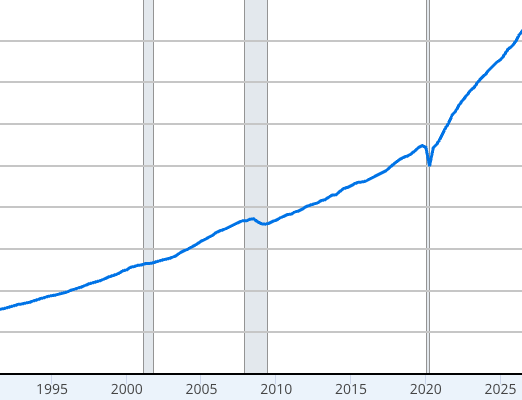
But, like, for reference, here's the 2007-2009 recession and the Covid blip.
GDP
Unemployment
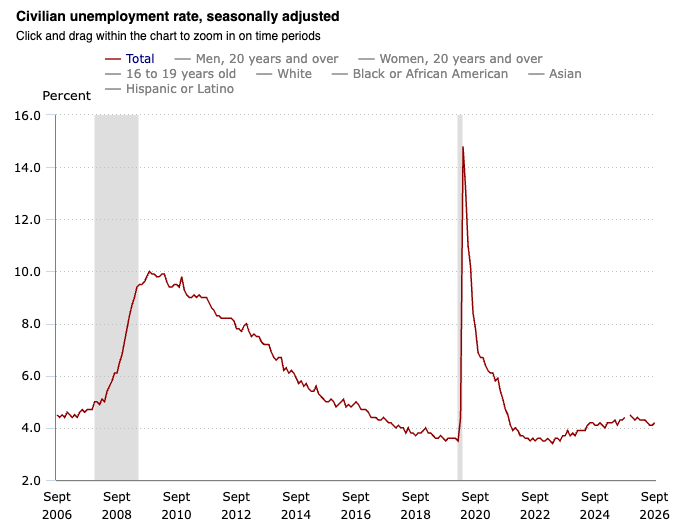
https://www.bls.gov/charts/employment-situation/civilian-unemployment-rate.htm
I asked Claude
If the frontier AI industry and datacenter build out completely halted, what do you predict would happen to US unemployment and GDP?
Claude said:
My central estimate: a sudden, complete halt would likely cause a US recession. Unemployment would probably peak around 5.5–6.5%, up from roughly 4.2–4.4% today. Real GDP would end up about 2–4% below where it would otherwise be within 12–18 months. That would be worse than the 2001 dot-com bust but well short of 2008.
Full response
Starting point
- Labor market: September’s report showed unemployment at 4.2%, and the rate has stayed in a narrow 4.1%–4.3% band since March 2026. Hiring is already weak, with payroll gains in the tens of thousands. The October report comes out tomorrow. insiderfinance
- Growth: Real GDP grew at a 3.4% annualized rate in Q3 2026. Information processing equipment and software contributed 1.09 points of that, about 32%. Private investment in data-center structures rose roughly 69% year over year, to an $83 billion annual rate. fourweekmbafourweekmba
- Scale of spending: Amazon, Alphabet, Meta, Microsoft and SpaceX are on pace to spend $803–828 billion on capex in 2026, and executives say they will spend more in 2027. Estimates of AI’s share of growth vary by method. ING’s James Knightley puts AI investment at roughly a third of US growth this year. Bridgewater estimates AI capex adds about 1.4 points to full-year 2026 growth. AI hyperscalers are expected to finish the year spending a whopping $828 billion on capex +2
Channels of the shock
1. Direct investment loss, worth about 1.5–2.5% of GDP. Gross AI capex is over $1 trillion when you add Oracle, the neoclouds and the labs’ own builds, against a GDP of roughly $31 trillion. But much of that money never counted as US output. Chips come from TSMC, servers are assembled in Mexico and Taiwan, and memory comes from Korea. Accounting studies find the net effect on US GDP is substantially smaller than the raw investment figures suggest once imports are subtracted. That leakage is the biggest cushion: Taiwan and Korea would absorb a large share of the hit. emergentmind
2. Wealth effect, worth about 1–1.5% of GDP. AI-linked firms make up a large part of US equity market value. A halt would likely cut stock prices by 25–40%, erasing perhaps $10–15 trillion of household wealth. At the usual estimate of 2–4 cents of lost spending per dollar of lost wealth, consumption would fall about 1–1.5% of GDP. High-income households, who own most of the stock, now drive a large share of consumer spending.
3. Credit stress. Bank of America expects hyperscaler debt issuance to reach $175 billion in 2026, more than six times the prior five-year average. Data-center debt, private credit and GPU-backed loans would see losses. Neoclouds and developers would default first, and lending to other borrowers could tighten. officechai
4. Jobs. The direct job loss is modest relative to the GDP hit, because the AI build-out is capital-intensive rather than labor-intensive. I’d estimate 0.5–1 million jobs in data-center construction, electrical trades, power generation, chip and equipment manufacturing, and AI firms themselves. The second-round effects would be larger: lower consumer spending, tighter credit and weaker business confidence. By the usual rule of thumb (Okun’s law), a 2–4% output gap implies unemployment roughly 1–2 points higher.
Offsets
- The Fed has room to cut, and lower rates would help housing and other rate-sensitive sectors, though only after a lag.
- Skilled trades would find other work. Electricians and grid workers are in short supply elsewhere, so they would be absorbed faster than, say, 2009’s construction workers.
- Energy prices would ease. Electricity and natural-gas demand would drop, which helps households and manufacturers.
- Some AI-related layoffs might stop. If AI is currently displacing white-collar workers, a halt would remove that drag. I think this effect is small relative to the demand shock.
- Fiscal policy would probably respond.
Scenarios
Peak unemployment | GDP vs. baseline (12–18 mo) | |
|---|---|---|
Benign (fast Fed cuts, orderly market, high import leakage) | ~5% | −1 to −2% |
Central | ~5.5–6.5% | −2 to −4% |
Severe (credit spiral, 40%+ equity crash, weak policy response) | 7%+ | −4 to −6% |
The closest historical comparison is 2001, when an IT-investment bust pushed unemployment from about 4% to 6.3% even though GDP barely fell. Two differences make today’s case worse: the halt you describe is abrupt rather than gradual, and AI investment is a larger share of growth now than telecom and IT were then. On the other hand, more of the spending leaks abroad.
Caveats
These are judgment calls, not model output. The biggest uncertainty is how far equity prices fall and whether credit losses spread beyond AI firms. The scenario also assumes nothing replaces the spending. In reality, some of the capital would go into other investments over time, so the long-run loss is mostly the forgone productivity gains from AI rather than permanently lost demand.
Sources:
I asked DeepSeek, who I go to for more decorrelated answers. (I added the second paragraph because it answers very quickly and vaguely the first time)
If the frontier AI industry and datacenter build out completely halted, what do you predict would happen to US unemployment and GDP?
Think through all the considerations you can think of, and then give quantitative answer with an upper and lower bound of percentage points for both
Deepseek said:
If frontier AI and datacenter buildout halted completely, the most defensible quantitative estimate is: GDP growth would fall by roughly 0.4 to 1.0 percentage point, and the unemployment rate would rise by roughly 0.2 to 0.6 percentage points, relative to a baseline where the buildout continues.
Full response
If frontier AI and datacenter buildout halted completely, the most defensible quantitative estimate is: GDP growth would fall by roughly 0.4 to 1.0 percentage point, and the unemployment rate would rise by roughly 0.2 to 0.6 percentage points, relative to a baseline where the buildout continues.
These ranges are not symmetrical in confidence. The GDP impact is better grounded in available estimates; the unemployment impact is more uncertain because data-center construction employment is diffuse and hard to isolate from broader construction and tech hiring.
GDP Impact: 0.4 to 1.0 Percentage Point Hit to Growth
The key distinction is between gross AI-related spending and its net contribution to GDP after imports. Much of the hardware—chips, servers, networking equipment—is imported, so a halt would also reduce imports, partially offsetting the GDP drag.
- Net contribution estimate: One analysis found that AI-related spending contributed about 0.4 to 0.5 percentage points to real GDP growth in the first three quarters of 2025 on a net basis, after accounting for imports . Removing that entirely implies a drag of roughly that magnitude.
- Gross investment scale: A Brookings estimate projected datacenter and AI infrastructure investment at an average of 3.6% of GDP annually from 2025 to 2032 . A sudden halt would remove a large planned investment flow, but because GDP is a flow measure and the investment is spread over years, the annual growth impact is smaller than the stock figure suggests.
- CBO’s productivity view: The Congressional Budget Office estimated AI-driven productivity gains would add only about 10 basis points per year to nominal GDP, suggesting the productivity channel is small in the near term .
Lower bound (0.4 pp): Assumes imports offset a large share of the investment decline and that non-AI consumption remains resilient, as MRB Partners argued . Upper bound (1.0 pp): Assumes broader multiplier effects—construction payrolls, supplier demand, and local spending—amplify the direct investment loss.
Unemployment Impact: 0.2 to 0.6 Percentage Point Rise
The employment channel is real but smaller than the headline “millions of jobs” framing suggests. The datacenter industry’s claimed 4.7 million jobs in 2023 is a broad economic-footprint figure, not a count of workers who would be laid off if buildout stopped. The directly exposed workforce is narrower.
- Construction concentration: Datacenter construction spending rose 64.5% through August 2026 while most other private construction categories contracted . This means a halt would hit a sector that has been a rare source of blue-collar job strength.
- Permanent operations roles: Projected permanent datacenter positions were around 650,000 by 2026, with 340,000 unfilled . A halt to new buildout would freeze rather than eliminate existing operations jobs, but it would stop hiring and likely trigger layoffs in construction and equipment installation.
- Baseline context: The unemployment rate was 4.2% in September 2026 . A 0.2–0.6 pp rise would lift it to roughly 4.4–4.8%—a meaningful softening but not a recession-level shock on its own.
Lower bound (0.2 pp): Assumes most construction workers transition to other projects and the permanent operations workforce is largely retained. Upper bound (0.6 pp): Assumes construction layoffs are concentrated and slow to absorb, plus knock-on losses in supplier and local service employment.
What This Estimate Leaves Out
This forecast does not include a financial-market or confidence channel. If a halt were abrupt and perceived as a signal about tech-sector weakness, equity repricing and tighter financial conditions could amplify the GDP and unemployment effects beyond the ranges above. Those second-order effects are genuinely unquantifiable from available data and would push the upper bounds higher, not lower.
Bottom line: The AI buildout is a meaningful but not dominant near-term driver of US growth and employment. A complete halt would be a noticeable drag—roughly half a point of GDP growth and a few tenths on unemployment—but it would not by itself push the US into recession.
These both seem pretty weaksauce, both in terms of "how bad in absolute terms" and "how much people would get angry by feeling it in their wallet and making things politically more difficult." I'd expect the economy would recover pretty quickly.
As far as I can tell the economic fears are... just made up? Or, blown way out of proportion? Yes, there will be nonzero tradeoffs. Okay, but, this does not seem remotely commensurate with "superintelligence is carelessly built and deployed" even if you're way more optimistic about superintelligence than me.
Again, I'd expect more economic turmoil the later you pause and the more the economy has gotten bundled up around AI.
(And, of course, the object level badness of AI rushing ahead is crazy compared to this. And if you care about the upside of AI, the choices are still not "never AI ever" vs "let a rip", it's "slow down and do it more carefully and more reliably reap all the benefits" vs "gamble that we get the benefits a few years or maybe decades earlier but risk killing or disempowering everyone")
We'd also very unlikely to end up shutting down the industry completely. The datacenter buildout would get repurposed for inference. Anthropic and OpenAI would become "normal-ish product companies." Some of their investors may be screwed, but, like, that's their problem?
Does anyone have good arguments that either it's going to be worse than Claude/Deepseek guess, or that I should take the amount-of-bad they guess more seriously?
[edit: after thinking about it more, I do take "minor recession" more seriously. It'd be both a real harm and a real political-capital risk.
But, still feels like the way I hear people talk seems like they think it more inevitable than seems obvious, in any regime that is merely a 'slowdown' vs sudden, total pause. And, talking about it with a missing mood.]