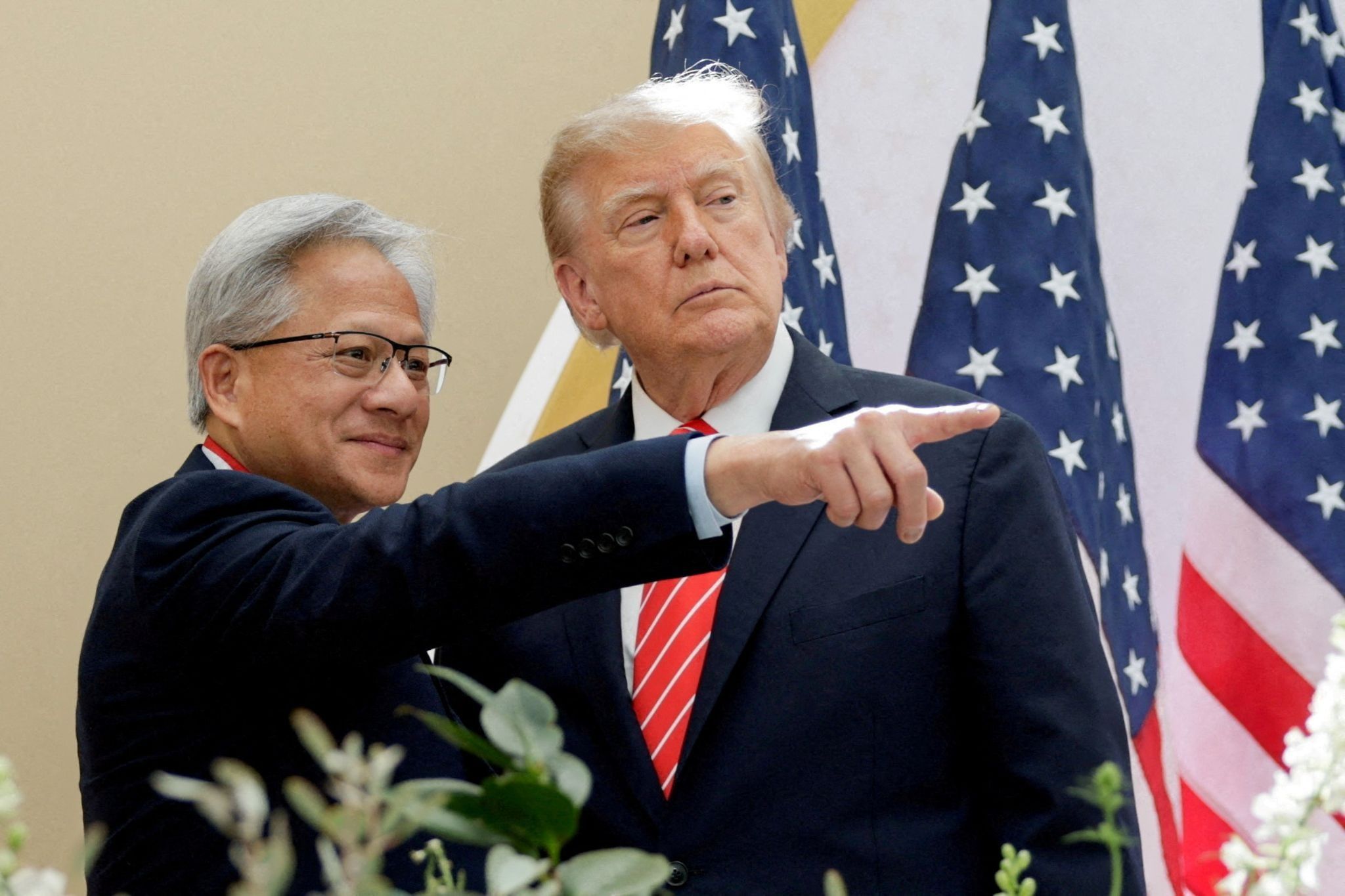
Nobody outside the Oval Office has been more influential on US policy toward chip sales to China — and, by extension, the superpower race for AI supremacy — than Jensen Huang.
The Nvidia CEO had Donald Trump’s ear. And he used his privileged access to make the case that keeping China hooked on Nvidia hardware and software was critical to maintaining the US technological lead. Cutting off sales to America’s chief strategic rival, he cautioned, only encouraged Beijing to speed up development of its own AI technologies that would, over time, become the global default.
Whatever the merits of that argument, the events of the past 48 hours have almost certainly doomed his central contention.
Huang’s admission of an affair with a woman who, according to US intelligence, is a Chinese spy plays directly into the hands of hawks in Washington pressing to clamp down on tech transfers to China. This camp has insisted all along that Huang’s advocacy was not only self-serving — a thin justification for his pursuit of profits — but, on its face, absurd. Under Chinese leader Xi Jinping, China is going all out for tech self-sufficiency precisely to escape the kind of dependencies that Huang envisages.
Indeed, Xi has been cool on Huang’s marketing pitch. Although Trump greenlit sales of Nvidia’s H200 chips to China (taking a cut of revenues for the US government), Beijing is strictly limiting imports.
Huang’s defenders insist he’s been arguing in good faith. Ben Thompson, the author of the influential Stratechery newsletter, argues that “it is entirely rational — and defensible — for Nvidia to want to sell chips to China.” By doing what he thinks is right, Thompson contends, Huang and Nvidia have “achieved unimaginable success.” It also needs pointing out that Huang stands by his patriotism. In a letter to staff, he insisted, “I love our country and our company.”
But having allegedly been compromised in a Chinese “honeytrap,” one of the central figures in US technology and co-founder of one of the world’s most valuable companies, will be hard pressed to convince US congressional investigators he’s always put US national interests first.
They’ll want to know whether Alice Huang extracted any Nvidia secrets in the course of their affair. Did she have access to his unguarded laptop? Or his cellphone? Did she garner any insights into White House strategy during their assignations?
Of special interest to lawmakers looking at potential conflicts of interest: The Nvidia CEO’s relationship with the Singapore company Megaspeed, where Alice Huang was an executive and that was under investigation by the US Commerce Department over suspicions it formed part of a clandestine supply chain shipping Nvidia chips to China and Southeast Asia data centers. The issue is whether the romance influenced his business decisions. (The New York Times reported on Monday that the Commerce Department’s inquiry was suspended following outreach from an Nvidia executive. The department denied wrongdoing, and Nvidia said the company regularly consults with officials.)
This drama will run and run. For the new Democrat-controlled Congress, the scandal offers multiple lines of attack against Trump. I’ve been predicting a backlash to the president’s China policies, widely criticized by politicians in both parties as weak and feckless — particularly his relaxed approach to tech transfers, but also on Taiwan, human rights, and military readiness in the Asia Pacific. The onslaught has now been brought forward.
Chris Coons, the incoming chair of the Senate Committee on Foreign Relations, signaled the start of hostilities in a post on X. “The more I learn about the insane relationship between the Trump Administration, Chinese spies, and AI billionaires,” he wrote “the more I’m convinced there is nothing this administration does that isn’t corrupt.”
Whether Huang will keep his job or not is an open question. Those who claim that he’s irreplaceable may be underestimating the political storm that’s about to break.
In any event, he’s lost the debate on chip sales to China, with significant commercial consequences for Nvidia, and even larger implications for superpower rivalry. He may well feel wronged, but as Thompson, the Stratechery analyst, put it, “he has only himself to blame.”