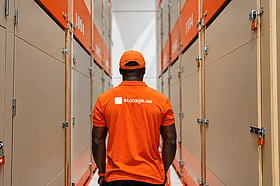
Much of Dubai’s storage market still operates on a traditional self-storage model. Customers rent a unit, transport their belongings to a facility and arrange access during designated hours. Checking what is stored often requires a trip to the warehouse.
Storage.ae has built its service around a different approach, combining collection and delivery with a digital inventory system that allows customers to manage their belongings remotely.
Rather than simply renting a locked unit, customers receive an itemised record of what they have stored. Through the company’s app, they can arrange collections, check their inventory and request individual items back without visiting the facility or making a phone call.
“We wanted to maintain the Dubai standard, so we wanted to make it as easy as possible,” Barghout said. “People can just order their things. They don’t have to drive to the facility.”
The approach reflects a broader shift in consumer expectations in Dubai, where services ranging from groceries to laundry can be arranged through a smartphone.
Storage providers are increasingly competing on not only available warehouse space but also accessibility, security and ease of use.
For Storage.ae, the strategy appears to be supporting expansion. Its increase in capacity over the past year comes alongside the rise in its customer base, suggesting that demand for the service is continuing to grow.
A business built without outside investors
Unlike many companies pursuing rapid expansion, Storage.ae has grown without venture capital or institutional backing.
The business remains bootstrapped, having financed its development through its own resources rather than external investment.
Barghout credits the relatively straightforward operating model with helping the company navigate different economic cycles.
“Storage is a remarkably resilient business,” he said. “The fact that this company has operated for 15 years speaks to the strength of the underlying demand. People will always need space, regardless of economic conditions.”
That resilience reflects the varied circumstances that bring customers to storage providers.
During periods of economic expansion, new residents, relocations and business formation can generate additional demand. During more uncertain times, households and companies may also seek temporary storage while adjusting their living arrangements or operational requirements.
Dubai’s business environment
Barghout also pointed to Dubai’s regulatory environment as a factor supporting the company’s growth.
In one example, licensing costs were reduced by over 75 per cent, according to Barghout, who cited the reduction as an example of government support for businesses.
“Running a business comes with many, many challenges, particularly for SMEs, but the UAE deserves considerable credit for creating an environment where entrepreneurs are supported and businesses are actually given the opportunity to grow,” he said. “There is a genuine commitment to making it easier to do business, and that makes a significant difference for companies like ours.”
The company’s regulatory obligations, including maintaining safe and secure storage facilities, are closely aligned with its commercial priorities, Barghout added.
With an expanding customer base, additional warehouse capacity and continued investment in technology, Storage.ae is positioning itself to capture a larger share of demand for convenient storage services.
The company’s growth also offers a reminder that not every business opportunity in Dubai needs to involve luxury goods or ambitious new developments.
Sometimes, the opportunity is considerably more straightforward: providing people with somewhere to put their stuff.