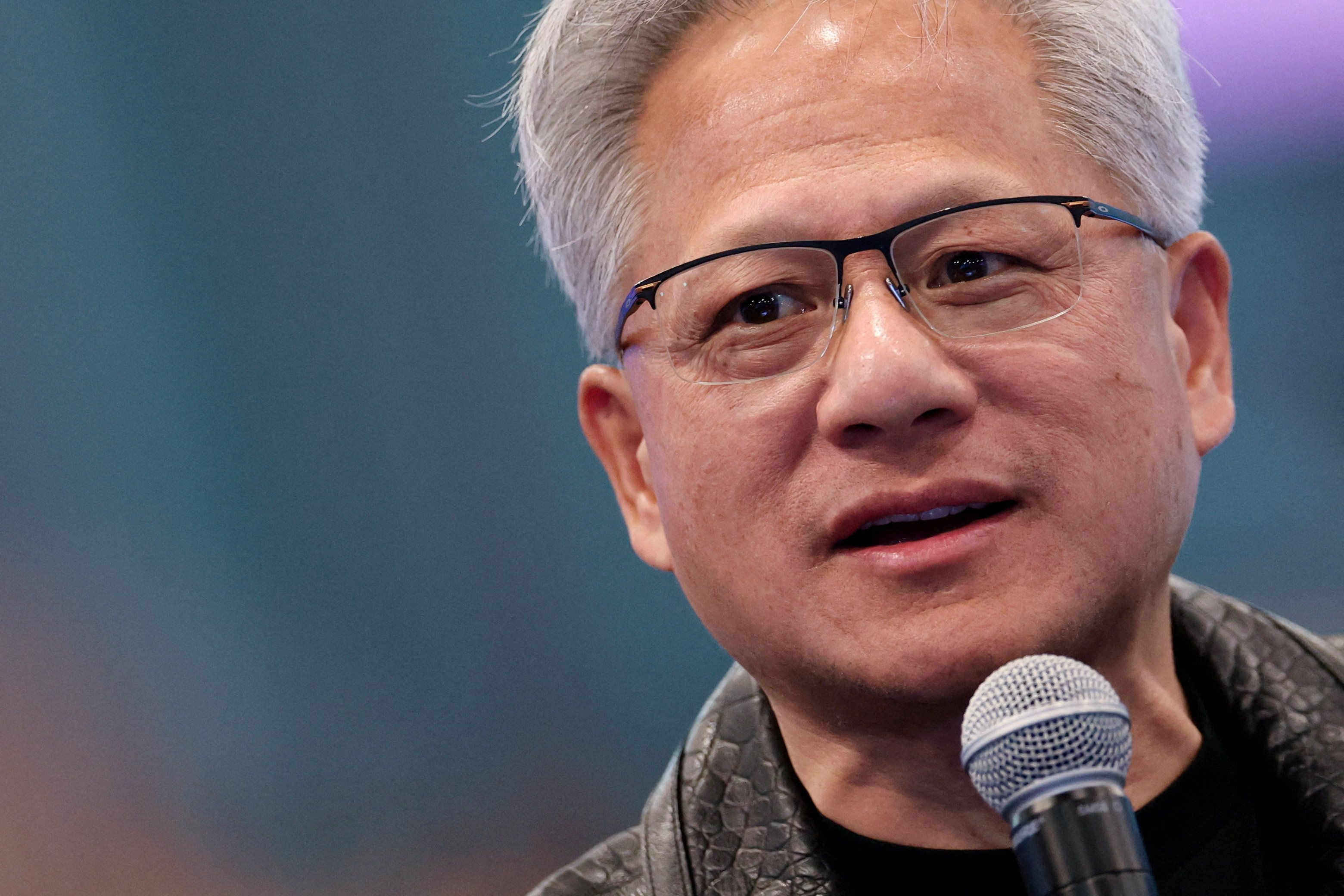
Jensen Huang was ousted as Nvidia’s CEO Thursday, a stunning fall for one of the world’s most powerful figures. His downfall sparked fears of what his departure means for one of America’s chip champions and the unwind of the AI money machine he assembled.
Nvidia’s CFO, Colette Kress, will serve as interim CEO while the board conducts a search for Huang’s replacement. Huang will also leave the board, which he chaired, and will be replaced by Harvey Jones, a board member since Nvidia’s founding in 1993 who ran chip design company Synopsys in the 1980s and 1990s. Semafor had earlier reported that Kress was in the lead to run the company on a temporary basis.
The company said it will look at both internal and external permanent successors to Huang, whose departure leaves the giant chipmaker without a tested leader. Huang had nearly single-handedly turned Nvidia from a niche maker of graphics chips for video games into the centerpiece of the world’s AI boom, and the company has never had another leader. It has no succession plan and few apparent internal successors.
One external candidate under consideration is Apple hardware chief Johny Srouji, who was among the executives considered for Intel CEO in 2019, Semafor reported Wednesday. Other names that have been floated are AMD’s Lisa Su, Huang’s first cousin once removed, as well as an offbeat suggestion by US President Trump on Thursday to tap former Apple CEO Tim Cook for the job.
Huang’s ouster came four days after he admitted to an affair with a suspected Chinese spy and followed a New York Times report that he had another affair with a subordinate. He is now wrapped up in a series of investigations by the board, Congressional leaders, and by the Department of Justice, Semafor reported on Thursday.
The ongoing saga has also shaved hundreds of billions of dollars off of what was once the world’s most valuable companies — one crucial to the US remaining at the forefront of AI development around the world.
Shares fell as much as 7% Thursday, adding to Nvidia’s losses since the first reports of Huang’s relationship with the suspected Beijing spy, who ran a Singaporean company that was a major buyer of Nvidia’s advanced chips. Shares of neoclouds Nebius and CoreWeave, which rely on Nvidia to help AI startups rent space in their data centers, fell as much as 19% and 9%, respectively. Shares in Alphabet, whose TPU chips compete with Nvidia’s GPUs, rose slightly.