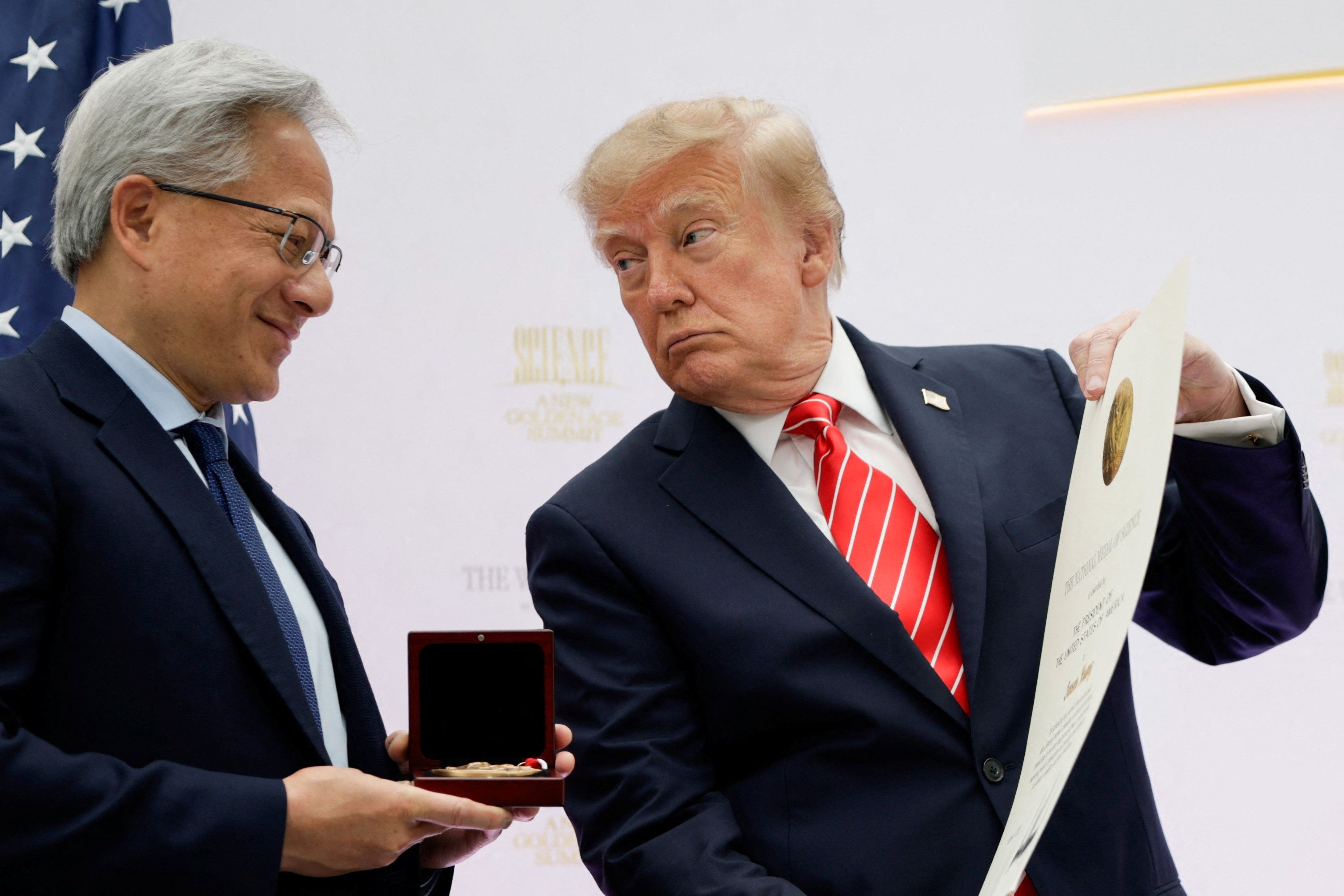
If Trump was Huang’s friend in the White House, Teter was his muscle in Washington. After more than two decades at law firm Cooley LLP, Teter joined Nvidia in 2017, soon after the chipmaker announced the beginning of the “AI computing era.” Nvidia’s GPUs had sparked the “big bang” of modern AI, Huang wrote at the time, years before Nvidia would turn into the world’s most valuable company.
But as Nvidia became a bigger geopolitical force — and Huang became a fixture alongside Trump at meetings, dinners and the Oval Office — Huang and Teter developed a “scorched earth, adversarial attitude,” according to a former government official familiar with their Washington presence. “They make things more personal, going after think tankers, government officials, and the like,” the former official said, referring to reports of Nvidia targeting critics of the company and proponents of export controls.
As he bulldozed through Washington, Teter regularly invoked President Trump’s name to push Nvidia’s agenda. In one exchange viewed by Semafor, Teter accused government officials who were developing export restrictions of misrepresenting Nvidia’s products and President Trump’s policies, chiding them for not carrying out Trump’s agenda and insisting that Trump deserved their support. Teter and the team of Nvidia lobbyists would often capitalize on their implicit White House backing and on the fact that most Hill staffers didn’t have the technical expertise to fight back on the company’s claims that certain restrictions weren’t technically feasible, even if later they were proven wrong, current and former congressional staffers told Semafor. Staffers “were kind of just believing whatever they were told,” and Nvidia would get all sorts of bills watered down, one staffer said.
Nvidia’s “MO has largely been gaslighting,” creating an “intense trust deficit between the government and the Hill and Nvidia,” a former staffer said. And “obviously, the canonical example at this point is Nvidia denying” improper chip sales to China, this person said.
Huang has said there’s no evidence chips were getting diverted to China, but Bloomberg has reported that Nvidia undercounted the Megaspeed sales it reported to the US government by 50,000 chips, worth billions of dollars. Companies tied to Alice Huang, the suspected Chinese spy, have purchased at least $7.5 billion of Nvidia chips since 2023, The Information reported.
But well before Nvidia came under fire for its relationship with Megaspeed, Nvidia told staffers that a provision in the 2025 Chip Security Act, which would require chipmakers to be able to locate their chips, was a nonstarter. “They basically said it was not technically feasible” the former staffer said, “they were like, ‘we would need completely new technology to do this, and even if we did it would be very easily spoofable.’”
In meetings with committee staff, Nvidia lobbyists argued location verification would create security holes. They “ran this line of bullsh-t on how the Chip Security Act was going to create all these cyber vulnerabilities,” a second former staffer said. “We spent six months going behind them and having to unpack all of the bullsh-t that [they were] telling to other offices.”
Then in December, Reuters reported a new location verification technology feature, which Nvidia had been demonstrating privately for months. The feature was launched in May, meaning the company had been “lying to Congress about the technical feasibility while you were literally baking it into your next chip generation,” this person said.
Nvidia declined to comment on the location-verification technology.