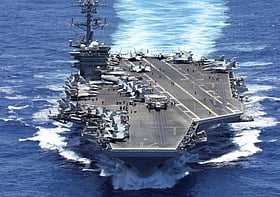
Why the US has deployed 3 carriers
The deployment comes amid the prolonged US-Israel-Iran conflict, which began with US and Israeli strikes on Iran on February 28, 2026.
Washington has used naval power as part of its strategy to restrict Iran's maritime trade and increase economic pressure on Tehran.
The blockade was initially implemented on April 13, 2026, following the collapse of nuclear negotiations. It targets commercial vessels entering or leaving Iranian ports and coastal areas, including ports along the Arabian Gulf and Gulf of Oman.
According to US Central Command, American forces had redirected 100 commercial vessels by May 23, while allowing 26 humanitarian aid ships to pass.
The operation is strategically important because Iran's maritime trade, particularly its oil exports, is a major source of government revenue.
The US naval presence also gives Washington military options should the conflict escalate, including carrier-based air operations, missile defence and maritime surveillance.
Additional force or a replacement?
The USS Theodore Roosevelt departed Singapore in early November and travelled through the Strait of Malacca towards the Indian Ocean.
Its deployment may not necessarily mean the US intends to maintain three carriers in the region indefinitely.
A November 9 report by Stars and Stripes said it remained unclear whether Roosevelt would reinforce the existing deployment or replace one of the two carriers already operating there.
A November 15 assessment by Israel's Institute for National Security Studies also highlighted the possibility of a carrier rotation rather than a permanent three-carrier deployment.