What is AG-UI and how does it fit with MCP and A2A?
The first two widely-supported standard protocols used by agent frameworks, one to allow agents to talk to tools (MCP), and one to allow agents to talk to other agents (A2A), seemed like big deals when they were introduced, and still are, but they aren’t the end of the story. Additional protocols for agents support commerce (UCP), payments (AP2), and UI composition (A2UI). A sixth protocol to support streamed agent-user interaction (AG-UI) is the subject of this article.
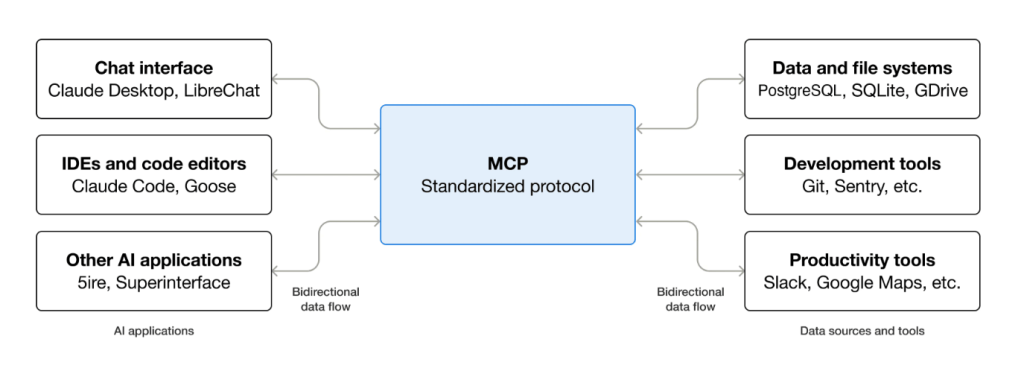
MCP (Model Context Protocol) is an open-source standard framework for connecting AI applications to external systems. It was originally developed at Anthropic and then released to the Agentic AI Foundation (AAIF), under the umbrella of the Linux Foundation. MCP reduces development time and complexity when integrating an agent with data sources, tools and apps. It’s very convenient for small local projects. It’s not the most efficient or secure protocol in the world and it doesn’t really perform well at internet scale, however. If you want an efficient production integration, you’ll have to bite the bullet and use the enterprise APIs of your data sources, tools, and apps.
The Agent2Agent (A2A) protocol is an open standard for communication and collaboration between AI agents. It was proposed by Google in April 2025, and joined the Agentic AI Foundation (AAIF) in August 2026. A2A complements MCP, and does not replace it. With A2A, agents can discover each other’s capabilities, negotiate interaction modalities (text, forms, media), collaborate securely on long-running tasks, and operate without exposing their internal state, memory, or tools. A2A uses JSON-RPC 2.0 over HTTPS.