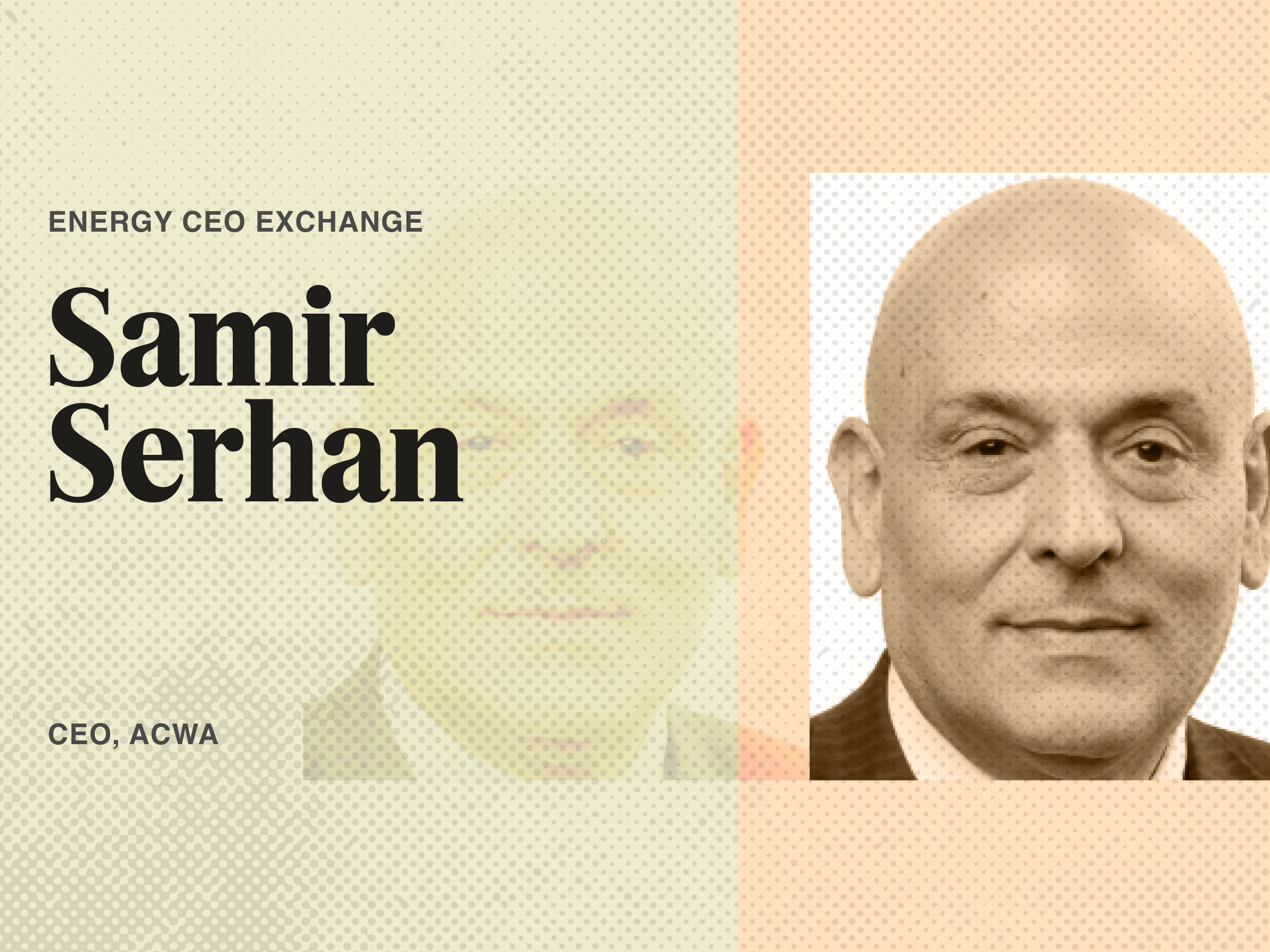
Tim McDonnell: Let’s start with Plenum, your initiative with EIG to invest $4 billion in US power projects with a focus on data centers. Since that was announced in October we’ve had the US election, which involved a lot of pushback against data centers, and then Jensen Huang stepping down from Nvidia, both of which have raised questions about a possible slowdown in the pace of the AI buildout. Is that a risk for Plenum?
Samir Serhan: We’re operating today in five regions in the world, and with Plenum we’re entering the US market. The drive behind it is really the demand for clean electricity. Our main focus right now is to acquire immediately operating assets, instead of building greenfield projects, which take a lot longer. I know the stock market is reacting in a negative way to what’s happening with the Democratic majority and with the personal affairs of the CEO of Nvidia. It’s a shame, but I think this is just going to be a blip. The demand is there. People are seeing the value of AI and of industrial growth, which all need electricity. There might be some little bit of a slowdown in the US, but it will really happen.
So none of this news has changed your capital allocation strategy.
We are committing around $4 billion and we really see the value there. And we’re not just a financial investor. When we typically build an asset, we also operate it, we invest in it, and we stay in for 20, 30 years. So these ups and downs happen sometimes, but the long-term signal definitely is very strong.
Why the focus on acquisitions instead of greenfield projects?
Time, and the risks of construction, and honestly because of all of this demand for data centers means there isn’t enough labor force in the [US]. EPC contractors and supply chains are a problem. There’s just not enough to feed the frenzy. If we buy a platform of projects, we immediately get a footprint.
And we see the energy transition is not a sprint, it’s a marathon. So some of the major oil and gas companies are going back to investing in their traditional assets. They also want renewable power, but they can hire someone like Acwa to build and operate it, and supply it to them, instead of them becoming a power company. And with the hyperscalers, they have a nice balance sheet and they’re in a big race to lead on AI technology. So there are some dislocations in the market and we’re trying to capitalize on this.
Switching focus, you took this job just as the war started in Iran, correct?
What do they say? Timing is everything. With my announcement, basically, the fireworks started.
What were those first days like?
Definitely it’s uneasy. It’s not comfortable to see this thing happening in the region where you’re operating. But you just have to focus on what you can manage. It’s unfortunate, but we’re managing it for the best. Our people are safe. And hopefully this conflict will be behind us soon, inshallah.
You reported in your shareholder filings that some assets were damaged.
Yeah. From a security perspective, I can’t really share what happened. But definitely there were some attacks that impacted some of our facilities. We have a 24-hour command center to monitor the situation and make sure we are proactive and be ready for how to staff our plants that are in the conflict… do we need to go to half staff, or whatever, but keep the asset running.
Were you worried about your assets being targeted from the very beginning?
No doubt about it. That was openly communicated by the people within the conflict. They didn’t make it a secret that they’re targeting critical infrastructure. So definitely that heightened our risk.
How did that impact the business?
You take the cards you’re dealt and make the best out of it. Across the company, the pipeline [of possible projects] is very strong. So we had to basically now become more selective about the opportunities we go after in the whole world. We still want to grow, but we want to focus more on quality growth. And some costs are creeping into our supply chain; in the Gulf region now you’re talking about a factor of 10 to bring a container from China to the Middle East. The cost of financing is going up. And that’s all going to become reflected in our pricing. But we hope this is only going to be temporary.
What does it mean to be more selective about the projects you go after? Are there certain types of projects or geographies where you think, this one’s not for us?
No, we’re really trying to not be biased. If we see an opportunity that has the right risk profile… At the end of the day, these projects need to be bankable, because this is not corporate finance. This is all project finance. So you need to make sure that the government, wherever you’re operating, has a clear mandate. You need to make sure the regulatory environment is predictable so you know what rules you’re working with. And that you need to make sure that the risk mitigation is happening between the off-taker, the banks, and the developer. When that happens, we go for it.
But there are still plenty of potential projects out there that don’t meet those criteria.
That’s correct. And that’s why scale is also really important. Because every project, whether it’s 100 megawatts of solar or one gigawatt, has its own journey, which takes years to develop, years to build and operate. It takes lots of energy from everybody involved: Commercial bank, [development banks], lenders, developers, governments, regulators. Let’s do it like we’re doing now in Türkiye: One shot, two gigawatts. This will have the biggest impact. At a small scale, it just doesn’t move the needle.
So among the stakeholders you mentioned are often Chinese equipment manufacturers or financiers. Policymakers in the US and Europe are really grappling with what kinds of trade barriers to erect to Chinese clean tech. Is that ever a point of tension in your conversations with Washington? Are you under pressure to put more distance between the company and China?
It’s definitely on the table. Some people have reservations about cybersecurity, when we talk to development banks or other partners. And these projects need to be bankable to make them happen, and that sometimes affects our decisions about who the EPC will be or where the supply chain will come from. We had many of these meetings here at COP.
Do you share those concerns about cybersecurity?
It’s on the top of our agenda. For solar PV modules, China is dominating in that market. But there’s no artificial intelligence in this module. Some people might have concerns with the inverters. So what can we do to mitigate this? We built supply chains in Saudi Arabia, in Türkiye, in Europe and the US. I try to find a solution that works for everybody.
But you don’t see enough cause for concern to drop Chinese suppliers altogether?
Not in that extreme fashion, we really don’t see that. We have to follow logic. It’s really more of the exception than the norm when we really have these issues. We closed $8 billion in non-recourse financing this year, with all the conflict around and everything. So capital is still flowing into these projects, which shows there is alignment on cybersecurity, supply chains, cost, or else all these things would not happen. But of course everybody at the table has their own opinion.
Because Chinese suppliers still offer a lot of advantage on cost.
If you’re developing renewables projects in Africa, you need to be competitive. You need to make sure you have a product that people can buy. Or what’s the point? If I don’t have electricity, or you give me electricity I can’t afford, it’s the same thing.