Building a state-of-the-art AI agent today usually means assembling a pile of proprietary scaffolding: custom sandboxes, closed training pipelines, and datasets that nobody outside the lab can reproduce. While there is excitement around agentic AI's capabilities, the research community faces a persistent bottleneck: building state-of-the-art agentic systems often requires proprietary infrastructure, including custom sandboxes, closed training pipelines, and proprietary datasets that most researchers and practitioners cannot access or reproduce. Microsoft Research's answer is Orchard, a fully open-source framework that puts a reusable, Kubernetes-native environment layer at the center of agent training.
One environment to rule them all
At the center of Orchard is Orchard Env, a lightweight, Kubernetes environment that provides reusable isolated components for running and building agents at scale , from collecting training data to reinforcement learning rollouts and evaluation. The key design insight is deceptively simple: unlike existing systems that tightly couple environment execution with specific agent scaffolds or managed services, Orchard Env provides a harness-agnostic interface for command execution, file I/O, and network policy enforcement, making it broadly composable across research settings.
In practice, this means one team can collect training trajectories using OpenHands, run RL rollouts with a different harness, and evaluate with a third , all against the same environment backend. Because the environment layer is a stable service rather than a piece of a training stack, every recipe reuses the same substrate for trajectory distillation, on-policy RL rollouts, and evaluation , so datasets, training recipes, and evaluation protocols stay portable across harnesses, domains, and projects instead of being rebuilt for each new study.
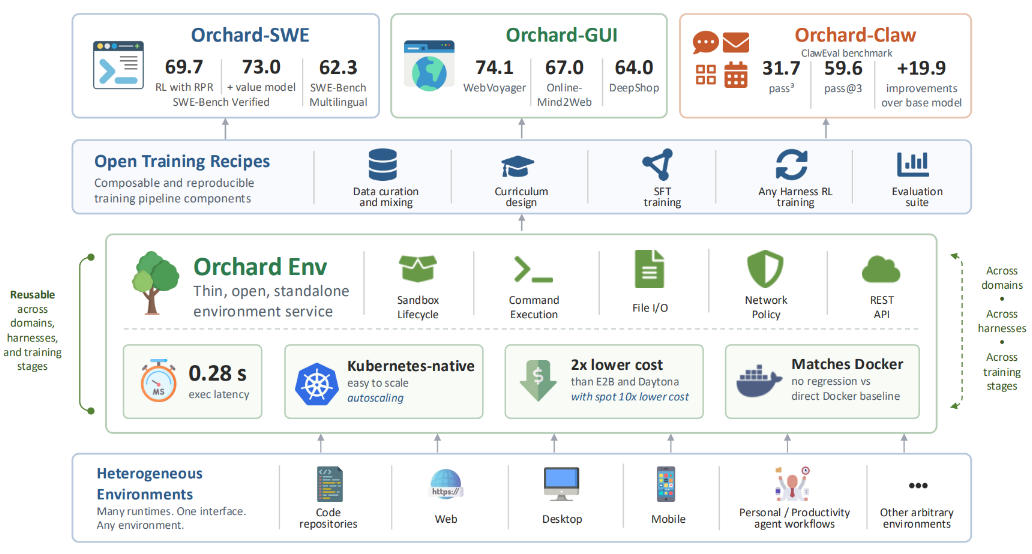
On the infrastructure side, the numbers are compelling. Orchard Env achieves 0.28s average command-execution latency , matching SkyPilot Code Sandbox and running 2.7× faster than E2B and 7.3× faster than Modal. At the cost level, running 128 parallel sandboxes for 240 hours costs $673 on spot instances, versus $7,078 on Daytona or E2B , roughly a 10× reduction.