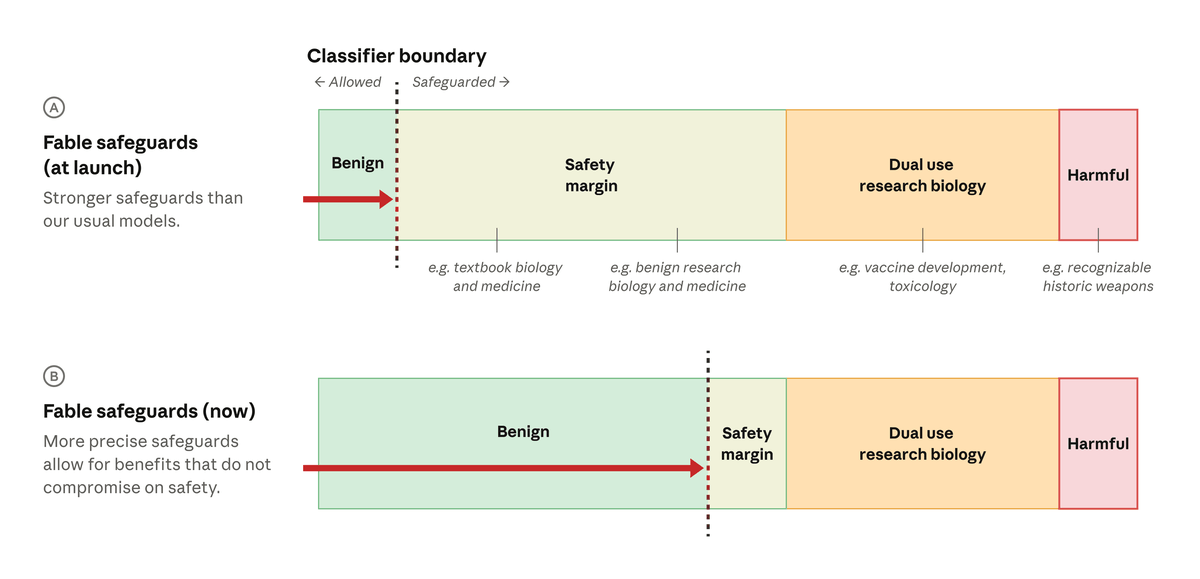
When Anthropic launched Claude Fable 5 in June, it shipped with one of the broadest safety filters ever put on a public AI model: nearly every biology-related query got silently routed away from the frontier model and handed to a less capable one. The intent was sound, but the blast radius was enormous. Asking about mitochondria, mRNA vaccines, or cancer symptoms all triggered the fallback. Anthropic has now shipped a meaningfully better version of that system.
What the fallback problem looked like
Fable 5 and Mythos 5 share the same underlying model weights. The difference sits entirely in the safeguards wrapped around the public version. When those safeguards fire, the user's request gets silently handed to Opus 5 instead, often with a pop-up stating: "Fable 5 has safety measures that flag messages on most cybersecurity or biology topics."
Hands-on testing by The Verge and Business Insider confirmed that routine queries like "what are mitochondria," "how do mRNA vaccines work," and basic cancer questions all triggered the fallback. For a model Anthropic bills as a breakthrough for medicine and science, that was a significant friction point.
Why Anthropic built it this way
Fable 5 can now outperform experts on some highly complex biological tasks. That cuts both ways. The same capability that could help a researcher develop a new treatment could, in the wrong hands, assist in developing a biological weapon. Sophisticated actors know how to exploit ambiguity to obscure their intent, making dangerous tasks look like ordinary research. The US Intelligence Community's 2026 Annual Threat Assessment identifies exactly this risk, warning that advances in synthetic biology and genomic editing "could lead to novel biological threats."