@inproceedings{espinosa-anke-perez-almendros-2026-analysing,
    title = "Analysing Self-Harm Representations in Language Models: a Cross-Architecture Study",
    author = "Espinosa Anke, Luis  and
      Perez Almendros, Carla",
    editor = "Mitkov, Ruslan  and
      Mu{\~n}oz, Rafael  and
      Lloret, Elena  and
      Ranasinghe, Tharindu  and
      Estevanell-Valladares, Ernesto L.  and
      Lamsiyah, Salima  and
      Montoyo, Andr{\'e}s  and
      Ezzini, Saad",
    booktitle = "Proceedings of the Second International Conference on Natural Language Processing and Artificial Intelligence for Cyber Security",
    month = jun,
    year = "2026",
    address = "Alicante, Spain",
    publisher = "Department of Languages and Information Systems, University of Alicante",
    url = "https://aclanthology.org/2026.nlpaics-1.16/",
    pages = "156--162",
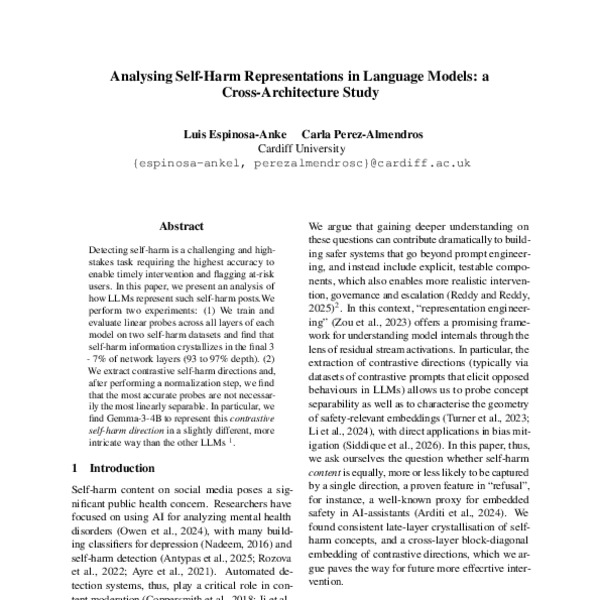
    abstract = "Self-harm content is particularly challenging to detect using NLP techniques, and is also a high-stakes task which requires the highest accuracy to enable timely intervention or flagging at-risk users. We therefore present an analysis of how LLMs represent such self-harm content, which has downstream applications in self-harm detection, LLM intervention and governance and policing. In this paper, we focus on two datasets and four models, and perform two main experiments: (1) We train and evaluate linear probes across all layers of each model on two self-harm datasets: X-Sensitive and SH-Detection. Across both corpora, self-harm information crystallizes in the final 3 - 7{\%} of network layers (93 to 97{\%} depth). (2) We extract contrastive self-harm directions and, after performing a normaliation step, we find that the most accurate probes are not necessarily the most linearly separable. In particular, we find Gemma-3-4B to represent this \textit{contrastive self-harm direction} in a slightly different, more intricate way than the other LLMs."
}
<?xml version="1.0" encoding="UTF-8"?>
<modsCollection xmlns="http://www.loc.gov/mods/v3">
<mods ID="espinosa-anke-perez-almendros-2026-analysing">
<titleInfo>
<title>Analysing Self-Harm Representations in Language Models: a Cross-Architecture Study</title>
</titleInfo>
<name type="personal">
<namePart type="given">Luis</namePart>
<namePart type="family">Espinosa Anke</namePart>
<role>
<roleTerm authority="marcrelator" type="text">author</roleTerm>
</role>
</name>
<name type="personal">
<namePart type="given">Carla</namePart>
<namePart type="family">Perez Almendros</namePart>
<role>
<roleTerm authority="marcrelator" type="text">author</roleTerm>
</role>
</name>
<originInfo>
<dateIssued>2026-06</dateIssued>
</originInfo>
<typeOfResource>text</typeOfResource>
<relatedItem type="host">
<titleInfo>
<title>Proceedings of the Second International Conference on Natural Language Processing and Artificial Intelligence for Cyber Security</title>
</titleInfo>
<name type="personal">
<namePart type="given">Ruslan</namePart>
<namePart type="family">Mitkov</namePart>
<role>
<roleTerm authority="marcrelator" type="text">editor</roleTerm>
</role>
</name>
<name type="personal">
<namePart type="given">Rafael</namePart>
<namePart type="family">Muñoz</namePart>
<role>
<roleTerm authority="marcrelator" type="text">editor</roleTerm>
</role>
</name>
<name type="personal">
<namePart type="given">Elena</namePart>
<namePart type="family">Lloret</namePart>
<role>
<roleTerm authority="marcrelator" type="text">editor</roleTerm>
</role>
</name>
<name type="personal">
<namePart type="given">Tharindu</namePart>
<namePart type="family">Ranasinghe</namePart>
<role>
<roleTerm authority="marcrelator" type="text">editor</roleTerm>
</role>
</name>
<name type="personal">
<namePart type="given">Ernesto</namePart>
<namePart type="given">L</namePart>
<namePart type="family">Estevanell-Valladares</namePart>
<role>
<roleTerm authority="marcrelator" type="text">editor</roleTerm>
</role>
</name>
<name type="personal">
<namePart type="given">Salima</namePart>
<namePart type="family">Lamsiyah</namePart>
<role>
<roleTerm authority="marcrelator" type="text">editor</roleTerm>
</role>
</name>
<name type="personal">
<namePart type="given">Andrés</namePart>
<namePart type="family">Montoyo</namePart>
<role>
<roleTerm authority="marcrelator" type="text">editor</roleTerm>
</role>
</name>
<name type="personal">
<namePart type="given">Saad</namePart>
<namePart type="family">Ezzini</namePart>
<role>
<roleTerm authority="marcrelator" type="text">editor</roleTerm>
</role>
</name>
<originInfo>
<publisher>Department of Languages and Information Systems, University of Alicante</publisher>
<place>
<placeTerm type="text">Alicante, Spain</placeTerm>
</place>
</originInfo>
<genre authority="marcgt">conference publication</genre>
</relatedItem>
<abstract>Self-harm content is particularly challenging to detect using NLP techniques, and is also a high-stakes task which requires the highest accuracy to enable timely intervention or flagging at-risk users. We therefore present an analysis of how LLMs represent such self-harm content, which has downstream applications in self-harm detection, LLM intervention and governance and policing. In this paper, we focus on two datasets and four models, and perform two main experiments: (1) We train and evaluate linear probes across all layers of each model on two self-harm datasets: X-Sensitive and SH-Detection. Across both corpora, self-harm information crystallizes in the final 3 - 7% of network layers (93 to 97% depth). (2) We extract contrastive self-harm directions and, after performing a normaliation step, we find that the most accurate probes are not necessarily the most linearly separable. In particular, we find Gemma-3-4B to represent this contrastive self-harm direction in a slightly different, more intricate way than the other LLMs.</abstract>
<identifier type="citekey">espinosa-anke-perez-almendros-2026-analysing</identifier>
<location>
<url>https://aclanthology.org/2026.nlpaics-1.16/</url>
</location>
<part>
<date>2026-06</date>
<extent unit="page">
<start>156</start>
<end>162</end>
</extent>
</part>
</mods>
</modsCollection>
%0 Conference Proceedings
%T Analysing Self-Harm Representations in Language Models: a Cross-Architecture Study
%A Espinosa Anke, Luis
%A Perez Almendros, Carla
%Y Mitkov, Ruslan
%Y Muñoz, Rafael
%Y Lloret, Elena
%Y Ranasinghe, Tharindu
%Y Estevanell-Valladares, Ernesto L.
%Y Lamsiyah, Salima
%Y Montoyo, Andrés
%Y Ezzini, Saad
%S Proceedings of the Second International Conference on Natural Language Processing and Artificial Intelligence for Cyber Security
%D 2026
%8 June
%I Department of Languages and Information Systems, University of Alicante
%C Alicante, Spain
%F espinosa-anke-perez-almendros-2026-analysing
%X Self-harm content is particularly challenging to detect using NLP techniques, and is also a high-stakes task which requires the highest accuracy to enable timely intervention or flagging at-risk users. We therefore present an analysis of how LLMs represent such self-harm content, which has downstream applications in self-harm detection, LLM intervention and governance and policing. In this paper, we focus on two datasets and four models, and perform two main experiments: (1) We train and evaluate linear probes across all layers of each model on two self-harm datasets: X-Sensitive and SH-Detection. Across both corpora, self-harm information crystallizes in the final 3 - 7% of network layers (93 to 97% depth). (2) We extract contrastive self-harm directions and, after performing a normaliation step, we find that the most accurate probes are not necessarily the most linearly separable. In particular, we find Gemma-3-4B to represent this contrastive self-harm direction in a slightly different, more intricate way than the other LLMs.
%U https://aclanthology.org/2026.nlpaics-1.16/
%P 156-162
Markdown (Informal)
[Analysing Self-Harm Representations in Language Models: a Cross-Architecture Study](https://aclanthology.org/2026.nlpaics-1.16/) (Espinosa Anke & Perez Almendros, NLPAICS 2026)