By Adam Wolf
The term “AI factory” is usually introduced as a hardware story: racks of accelerators, high-speed networking, and validated reference designs. That part is real, but it is not the part most organizations struggle with. The harder shift is operational. Moving from AI as a set of individual experiments to AI as a shared, governed capability that many teams depend on changes how compute is allocated, how environments are built, who owns the platform, and how the work is governed. This piece looks at what actually changes in that transition and what it asks of the people running it.
The phrase has outgrown the hardware
The AI factory idea was popularized by NVIDIA, whose CEO Jensen Huang introduced it to describe data centers purpose-built to produce intelligence at scale. NVIDIA frames the AI factory as a new operational model that tightly integrates accelerated computing, networking, storage, and AI software, with token generation as the unit of output, and the concept has spread across the ecosystem into validated designs from partners such as Dell, HPE, Lenovo, Supermicro, and Red Hat.
It is easy to read all of this as a procurement question, a matter of which racks to buy. The more useful reading for most leadership teams is organizational. NVIDIA itself describes the AI factory less as a collection of servers and more as a center of excellence for enterprise AI, a place where an organization turns its own data into usable output. The interesting question, then, is not what hardware sits in the room. It is what has to change about how AI is organized and operated once it stops being a side project and becomes something the business runs on. NVIDIA’s own framing names the destination well: AI moving from an occasional tool to a capability woven into daily work. Getting there is an operating-model change, not just a hardware refresh.
Where most organizations actually start
Almost every organization begins in what we can call the experiment-tracking era. A data scientist or a small team picks up a problem, runs experiments in notebooks, tracks results with a tracking tool, and gets compute by hand or by waiting in line for a shared cluster. Reproducibility lives in individual habits. Environments are built per project. Governance and security are addressed late, if at all. That is a fair description of how a great deal of AI work still happens today: jobs submitted through ad hoc scripts, infrastructure provisioned manually, and inconsistent environments between training and inference.
None of that is wrong at a small scale. It is how good work gets started. It begins to break when AI becomes load-bearing: when several teams compete for the same expensive accelerators, when a model’s output feeds a product that customers touch, and when the cost of idle or mismanaged compute grows large enough that finance starts asking questions. At that point, the artisanal model stops scaling, and the organization runs into exactly the transition the AI factory language is pointing at.
What actually changes when AI becomes a shared capability
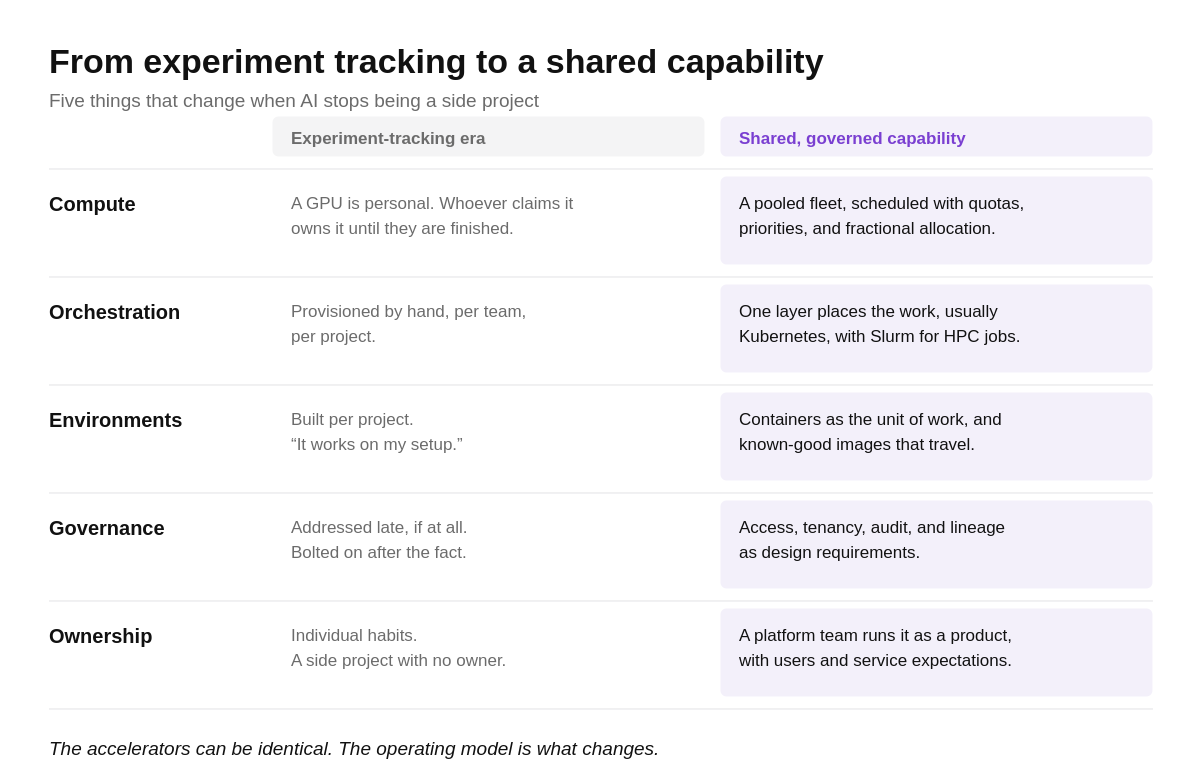
The shift is best understood as a set of specific changes rather than a single upgrade. Five of them matter most.
Compute becomes a shared, scheduled resource
In the experiment-tracking era, a GPU is effectively personal: whoever claimed it owns it until they are finished. In a shared capability, compute is a pooled fleet that is scheduled, with quotas, priorities, and the ability to subdivide a single accelerator across smaller jobs. Utilization stops being a private matter and becomes a managed metric, because idle accelerators are now a visible cost. The survey data shows how raw the starting point still is. In ClearML’s State of AI Infrastructure at Scale 2025-2026 report, 44 percent of surveyed IT leaders said they assign workloads to GPUs manually or have no specific strategy for managing utilization, and cost control was the single most cited infrastructure planning priority, named by 70 percent.
Orchestration standardizes, usually on Kubernetes
Hand-provisioning does not survive contact with many teams. A shared capability needs a common orchestration layer that places work, recovers from failures, and scales services. In practice that layer is increasingly Kubernetes, with batch and gang-scheduling primitives added on top for training, while established HPC schedulers such as Slurm continue to run tightly coupled jobs. The AI factory reference designs assume this kind of standardized orchestration substrate rather than per-team improvisation. Platforms such as ClearML sit on that substrate and abstract it so that AI builders can submit work without operating Kubernetes directly.
Environments get validated, not hand-built
When one person runs a model, a bespoke environment is fine. When many teams depend on it, environments have to be standardized and reproducible, which is why containers have become the common unit of work and why so much of the AI factory narrative centers on validated designs and pre-packaged, tested model environments. The shift is from “it works on my setup” to a known-good image that behaves the same way wherever it lands.
Governance moves from afterthought to design requirement
A shared capability is, by definition, multi-tenant, and that forces governance to the front. Access control, tenant isolation, audit trails, cost accountability, and model lineage stop being things you bolt on later and become part of the design. This is not a hypothetical concern. In the same ClearML report, nearly one-third of respondents named stronger governance controls across data, models, and compute as their top operational priority.
Ownership shifts to a platform team
The quietest but most consequential change is organizational. Someone has to own the shared capability as a product, with users, a roadmap, and service expectations. That usually means a platform or AI infrastructure team that runs the compute, the orchestration, and the guardrails, so that data scientists and AI engineers can self-serve without having to become infrastructure engineers themselves. The aim is to keep builders focused on building while the platform handles scheduling, access, and reproducibility underneath them.
Why the shift is happening now
Two forces are accelerating this transition. The first is that the workloads themselves are getting heavier and more central. Inference, and increasingly agentic systems that reason and call tools more or less continuously, run constantly rather than in occasional bursts, which raises both the stakes and the bill. In the ClearML report, 89 percent of organizations said they planned to deploy AI agents within six months, which moves a large amount of AI from experiment to production on a short timeline.
The second force is economic. As both analysts and vendors have observed, accelerated computing is turning compute from a back-office cost center into a production system whose output, measured in tokens, performance per watt, and cost per token, ties directly to the business. When AI spend is that large and that visible, leaders are pushed to run it as a managed capability rather than a loose collection of projects. Flexibility is part of the same calculation: in the ClearML report, 63 percent of respondents said proprietary dependencies had already delayed or constrained their ability to scale AI, which makes the operating model, and how locked-in it is, a strategic decision rather than a technical footnote.
What this asks of leaders
For the people responsible for the transition, the AI factory framing translates into a handful of concrete decisions.
- Treat the platform as a product. Give the shared capability an owner, a roadmap, and internal users, the same way you would treat any product the business depends on.
- Standardize the unit of work. Make a container the default, so the same workload is portable across training and inference and across whatever schedulers you run.
- Make utilization and cost visible. If no one can see which teams consume which resources, you cannot manage cost or fairness. Chargeback, or at least showback, belongs in the operating model rather than in a year-end accounting exercise.
- Build governance in from the start. Decide access, tenancy, audit, and lineage as design requirements, because retrofitting them onto a running platform is painful and risky.
- Protect your flexibility. Favor an orchestration and platform layer that runs across your existing hardware and clouds so that today’s procurement choice does not become tomorrow’s constraint.
Where a platform layer fits
Most of the AI factory conversation is about the bottom of the stack: accelerators, networking, and validated reference designs. Those matter, but they do not by themselves turn hardware into a shared capability. The layer that does that is the software control plane that schedules work, enforces policy, isolates tenants, tracks usage, and gives builders a self-service path to compute. This is where AI infrastructure platforms operate, and it is the part of the operating model an organization actually has to run day to day.
ClearML is one such AI infrastructure platform. It sits on top of existing compute, whether that is bare metal, virtual machines, Kubernetes, or HPC schedulers such as Slurm, and presents it as a single scheduled resource. Through its infrastructure control plane, ClearML provides priority-based job scheduling, dynamic fractional GPUs so a single accelerator can be shared across smaller workloads, secure multi-tenancy with per-tenant role-based access control, usage-based billing and chargeback, and lineage across the AI lifecycle for governance and reproducibility. Because ClearML is silicon-agnostic and runs across on-premises, cloud, and hybrid environments, it speaks to the flexibility concern the survey data keeps surfacing, rather than tying the operating model to a single hardware or cloud vendor.
None of that replaces the hardware story. It is the software layer that sits above it and makes the difference between owning accelerators and operating a shared AI capability. That distinction, more than any particular rack, is what separates an experiment-tracking practice from an AI factory.
Learn more
For the survey data referenced here, see ClearML’s State of AI Infrastructure at Scale 2025-2026 report. To see how a single control plane manages scheduling, governance, and multi-tenant access across existing compute, explore the ClearML Infrastructure Control Plane.