We have a conviction that digital policy works best when the people it affects help shape it. At the 15th Africa Internet Governance Forum in Accra, Ghana, from 2 to 5 November 2026, we let this same conviction guide us. Across ten different sessions, we brought research-based evidence on how Africans use and experience technology to better represent the voices that frequently go missing when decisions are made – from young innovators to the communities most exposed to digital harms, we prioritised telling the stories of those most impacted by technological deployment across Africa.
Young innovators’ interactions with the IGF community
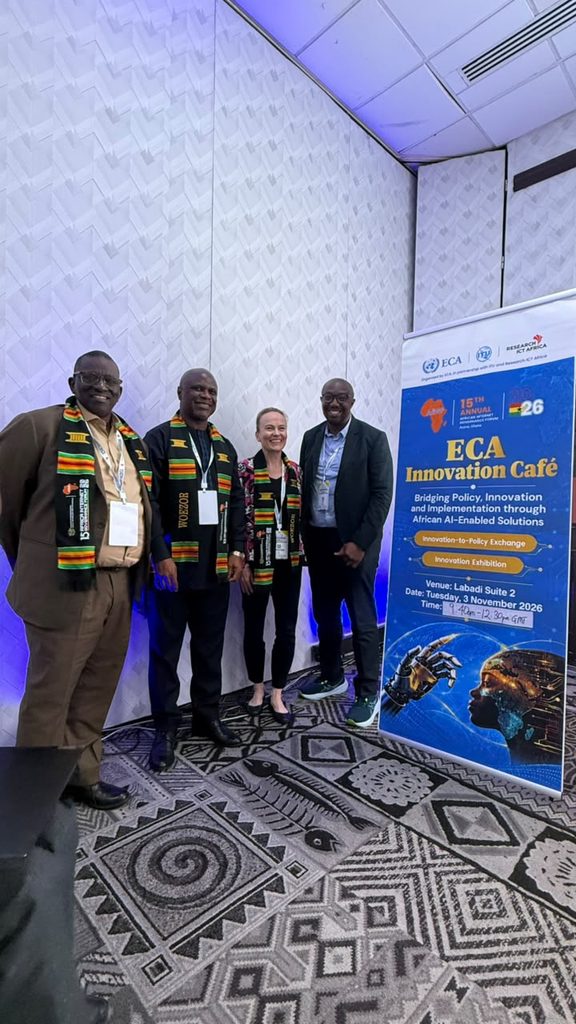
To start, we identified a concerning gap: innovators, especially young ones, are rarely in the room when AI policy is made, despite being the ones building the solutions those policies will govern. Coordinated by Researcher and Engagement Lead, Elizabeth Orembo, we partnered with the UN Economic Commission for Africa (UNECA) and ITU to design the ECA Innovation Café, which aimed to bring two select entrepreneurs to Accra for an exchange with policymakers, investors and researchers from the IGF community.
The call drew more than 800 applications and was narrowed to five innovators, one from each African subregion, who pitched to a panel of AI experts, including Researcher Diana Nyakundi. Among them, most prominent was a team from Cameroon that built a solar-powered cold store that extends the life of tomatoes from five days to about three weeks, serving over 3,000 farmers. Alongside them was a Nigerian team’s AI dictation tool, which listened to doctors’ consultations and drafted clinical notes, saving doctors about two and a half hours a day across six clinics. Finally, a Kenyan team showed us how they invited device users to submit phone photos that could tell road engineers whether a stretch of road was worth repairing. Most of these solutions were built with very limited resources, and in a challenging market environment, but spoke directly to African needs.
Opening the session, RIA Research Director Dr Kola Ijasan set out the questions we ask of any innovation, drawn from our Just AI work: does it solve a clearly identified African problem, does it include people usually left out, and can it move from pilot to scale? The innovators left with direct feedback, new contacts, and commitments from UNECA and ITU to support them to market. The result was a commitment to amplifying the voices behind the innovation that Africa’s future will certainly depend on.

Fifteen years of the Freedom Online Coalition
Looking back at the promise of multistakeholderism for digital rights, Orembo, who also co-chairs of the FOC Advisory Network, joined speakers from Media Rights Agenda, the telecomms sector, and the Ghanaian and Swiss governments at the session titled Freedom Online Coalition at 15: Africa Regional Dialogue.
Orembo argued that the IGF, together with its national and regional initiatives, remains one of Africa’s strongest bottom-up multistakeholder spaces. When those forums worked well, governments and other stakeholders took their recommendations seriously, and they fed into gains in connectivity, access-to-information laws, and e-governance.
However, as participants noted, the gaps are still wide. Orembo noted that surveillance often happens without a legal basis and shutdowns persist around elections, while Mohamed Farahat highlighted how many data protection authorities still lack independence. African stakeholders are stretched thin across the Global Digital Compact, the World Summit on the Information Society and other processes whose norms do not always align.
As for African representation within these fora, Edetaen Ojo from Media Rights Agenda noted that only four or five of the FOC’s 42 members are African, with Ghana carrying much of that representation. He also warned that civil society is treated as one bloc, while the groups most affected, including media, women and communities, are least present where decisions are made.
An African AI safety agenda


Global AI safety debates are led by countries with AI safety institutes; yet Africa has none, and its problems look different, shaped by differing realities and needs. At RIA’s session, Beyond Imported Checklists: Toward an African AI Safety Agenda, moderated by Orembo and Sam Kuuku from GIZ, participants with backgrounds in software engineering, cyber security, and public broadcasting responded to this contradiction by naming the harms they already see. Among that feedback, the most significant point was that safeguards that work in English vanish in African languages, and with little AI deployed on the continent, safety testing and standards specific to local needs are limited, resulting in technology being deployed without prior checks.
Similarly, Nyakundi emphasises that in these instances, compliance alone falls short: a system can be reliable and still produce unjust outcomes for the people it touches. RIA’s Just AI Framework of Inquiry and the proceedings of our 2026 Just AI conference start from that question: who is at risk, who holds power, and what redress exists? Orembo proposed testing AI from the outside, through how it affects people, so that evaluation does not depend on access to company systems.
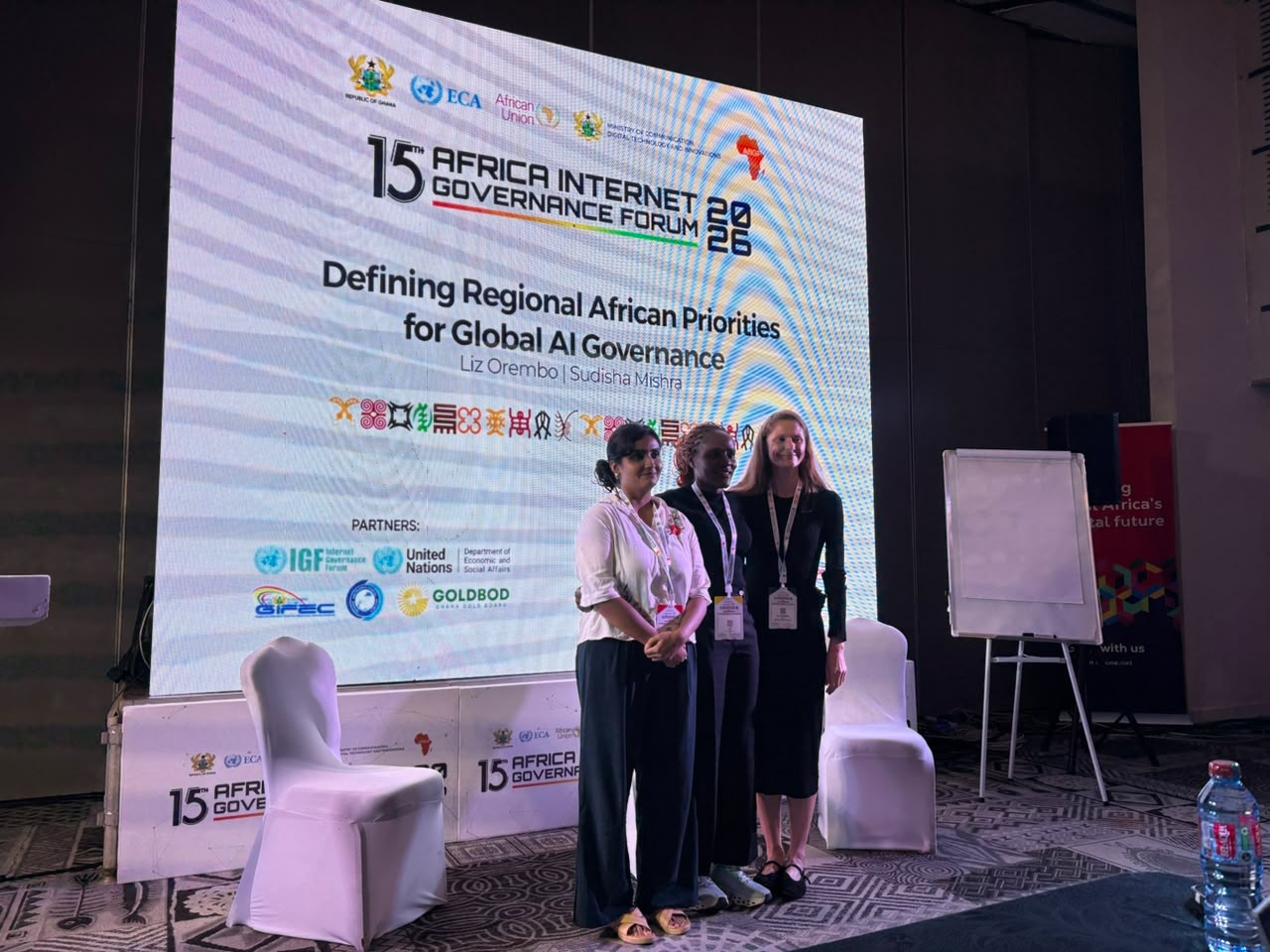
The Just AI Framework also shaped the session, Defining Regional African Priorities for Global AI Governance, which RIA co-hosted with the Global Network Initiative and the Centre for Communication Governance under the Map AI project. Building on the AfriSIG 2026 practicum, participants raised concerns around AI-generated voters in the national voter register, unfunded national AI strategies, and AI in armed conflict. These points build off of points already raised in various pieces for Tech Policy Press, including What Kenya’s AI Bill Gets Wrong About Political Expression, Redefining AI for Africa, and Dissent and Resistance to Silicon Valley AI Narratives.
Evidence that turns commitments into practice
Africa produces a great deal of data, yet stakeholders use little of it. Much of what exists is unstructured, needs heavy work before it can be used, and sits in institutional silos. But to do this, we also need digital policies in place – another thing Africa has an abundance of on paper, but often struggles to put into practice.
To redress this, RIA supported the development of the African Union Data Policy Framework and, in partnership with GIZ, helps countries implement it through the provision of mulitstakeholder technical support, implementation toolkits, and capacity building. So far, RIA has supported the validation of national data policies and strategies for The Gambia, Somalia and the Comoros.


At The Missing Middle of Data Governance, Nyakundi and Mpho Moyo tested RIA’s Data Policy Implementation Toolkit, which shows countries “what work needs to be done to enable implementation at an institutional level,” as Nyakundi put it. Regulators, legislators and civil society from Nigeria and Ghana described siloed systems and ministries competing for the same mandate. One Ghanaian participant put the silo problem bluntly: “The telcos have cleaner data than the government.” GIZ’s Kuuku, whose Data Governance in Africa programme has worked with more than 40 African countries, said that at every validation, stakeholders ask the same question: now that the policy is validated, what happens next? Even Ghana and Nigeria, which already have policies, face that gap, because, as they said, “the actual work and the benefits are in the implementation.” Similarly, Moyo pointed out that, often these benefits come from more effective data exchange and sharing practices.
Connecting data to public services, discussions about digital public infrastructure, and particularly digital ID, also looked at how digital technology in public service delivery could either benefit or hinder inclusion. Through the Africa DPI Study and its Community of Practice, Dr Thomas Linder ran our second pan-African DPI workshop, presenting findings on a CIPESA panel. Participants from Ghana, Uganda and Nigeria’s identity agency described exclusion when ID is linked to SIM cards, banking and health insurance. Dr Linder urged civil society to build coalitions that engage before systems are procured.
Discussions about inclusion continued as we presented findings from our After Access surveys, which demonstrated the difference between coverage and use. Research Director Dr Kola Ijasan brought this evidence to the African Union Commission’s dialogue on internet governance. Meanwhile, Orembo brought it to Paradigm Initiative’s WSIS session, and a UNECA panel on data centres, where she argued that hosting data centres will not necessarily produce value for Africans.


What’s next
In Accra, RIA’s reinforced its commitment to ensuring that Africa’s digital is determined by Africans, for Africans. To the innovators, civil society groups, regulators and researchers we met on the way, here is what we commit to do next:
- Keep opening policy rooms. We will work with UNECA to make the Innovation Café a lasting bridge between young innovators and policymakers.
- Carry African priorities to global AI governance. Through Map AI and our Just AI work, we will take what we heard to the UN Global Dialogue on AI Governance and the Geneva AI Summit, inviting those working on AI safety to join us.
- Defend bottom-up multistakeholderism. Through the FOC Advisory Network, we will push for IGF outcomes with follow-up plans and call for more African governments to be included in these discussions.
- Support implementation. We will share the Data Policy Implementation Toolkit for comment, publish the DPI working group’s policy brief, and release After Access 2026 finding, including our first module on AI use.
To work with us, get in touch or subscribe to our updates.