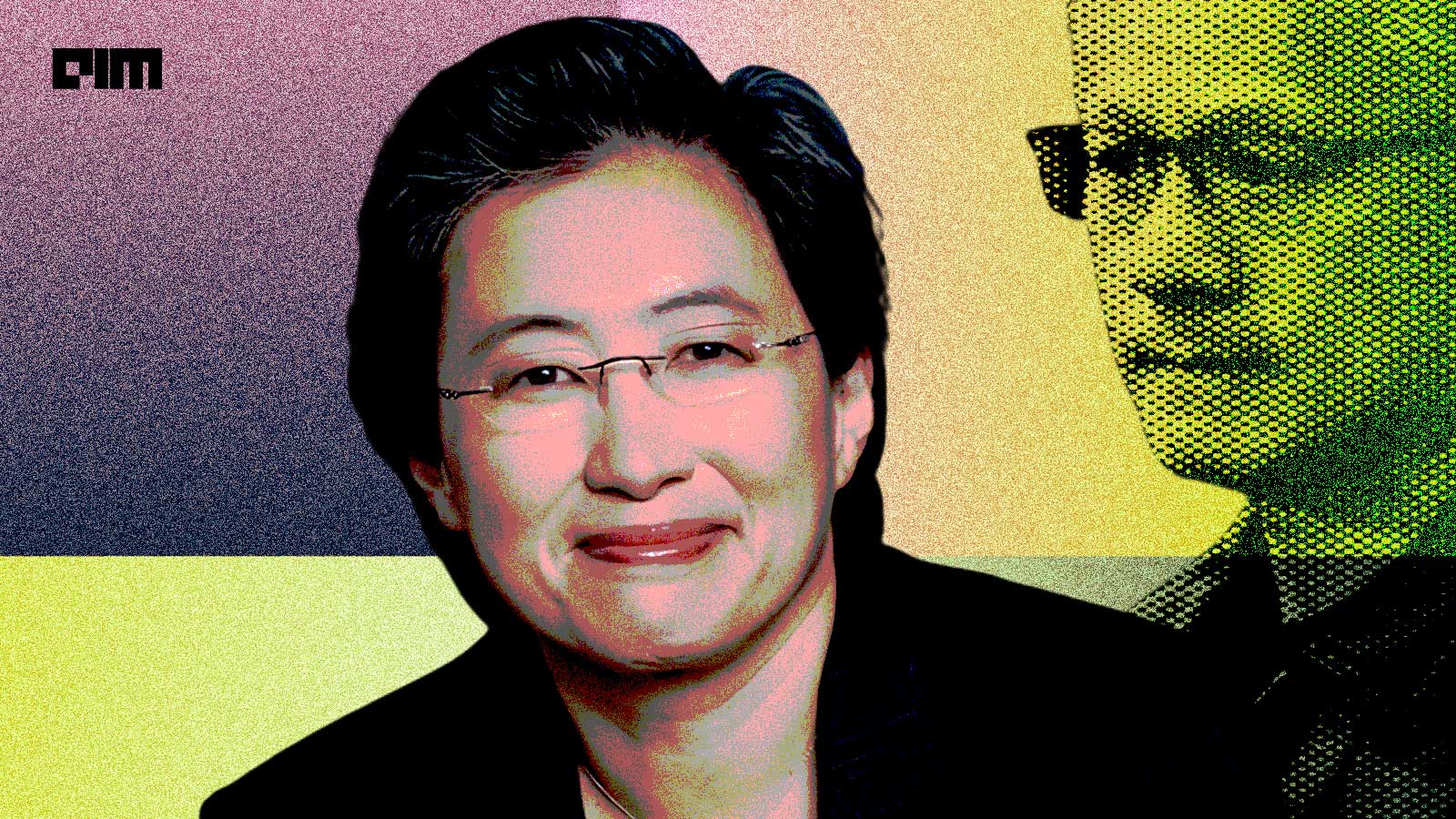
On the same day that Jensen Huang resigned as NVIDIA’s chief executive after 33 years at the helm of the company he co-founded, another semiconductor company CEO was being celebrated. AMD CEO Lisa Su was named Yahoo Finance’s 2026 CEO of the Year.
Su has had quite a triumphant year. AMD shares have been up nearly 139% year-to-date. She signed significant deals with OpenAI and Oracle to deploy its Instinct GPUs. She also surprised investors and AI watchers alike by acquiring Fei-Fei Li’s spatial intelligence startup World Labs for $8.2 billion, in a move that gives her an advantage in guiding future GPU architectures.
But the timing is not lost on anyone. Su’s ascension comes at a trying time for NVIDIA. Huang’s abrupt departure has left the world’s most valuable AI chipmaker facing questions about succession, strategy, and its ability to maintain its competitive edge.
NVIDIA’s shares fell 4.34% to $166.19 on November 12, following Huang’s resignation, while AMD shares rose 5.86%. The former’s stock has seen a 13.7% correction year-to-date, with shares nosediving 32% from when NVIDIA hit its all-time record on October 6, erasing roughly $1.86 trillion in valuation.
Is NVIDIA in Trouble?
Huang’s exit raises questions about whether NVIDIA can maintain its strategic direction and industry relationships. Even CFO Colette Kress’ appointment as interim CEO is not enough to calm Wall Street nerves.
“Jensen’s role, presence, vision and execution have been central to what NVIDIA and the AI ecosystem are where they are right now,” Neil Shah, Co-founder and Vice President of Research at Counterpoint Research, tells AIM.
In the near term, at least, the departure may not cause disruption to NVIDIA’s core operations. Hyperscaler hardware orders are locked in through at least Q3 and Q4 FY27. NVIDIA’s near-term product roadmap, which runs from Blackwell through Vera Rubin and even Feynman generations, is locked in with deep engineering bench strength.
However, a leadership exit immediately creates a strategic and diplomatic vacuum. After all, it was Huang who arbitrated GPU allocations and orchestrated multi-billion-dollar circular financing and compute-backed deals.
“The immediate challenge for interim leadership under Colette Kress will be maintaining ecosystem trust, managing enterprise relationships, and proving that NVIDIA’s innovation velocity can persist without its visionary founder at the helm, observes Prabhu Ram, VP of Industry Research Group, CyberMedia Research.
Huang’s personal relationships that he has carefully curated over three decades across the value chain—from the biggest chip manufacturer TSMC and EMS player Foxconn to players such as SoftBank—have been critical in holding together massive sovereign AI deals, neocloud financing arrangements, and geopolitical lobbying efforts.
“Without him at the helm, we will likely see a slowdown in new, aggressive ecosystem-level investments and lucrative bilateral AI infrastructure deals from NVIDIA’s side,” Shah notes.
AMD’s Moment
Su’s recognition comes after a year of major commercial wins for AMD.
The company reported third-quarter 2026 revenue of $13.4 billion, up 45% year-on-year. Its data centre business generated $8.5 billion, growing 97% from a year earlier, driven by demand for EPYC server processors and Instinct AI accelerators.
AMD’s biggest advantage is no longer simply that it offers an alternative to NVIDIA GPUs. It is increasingly securing large, multi-year infrastructure commitments from some of the biggest AI companies.
In October last year, AMD signed a multi-generation agreement with OpenAI to deploy up to 6 gigawatts of its GPUs. Earlier this year, Meta signed another agreement to deploy up to 6 GW of AMD Instinct GPUs. The first deployments for both is expected to begin in the second half of 2026, using custom MI450-based accelerators.
Anthropic followed in July with a commitment to deploy up to 2 GW of AMD MI450 GPUs in its Helios rack-scale systems, with the first gigawatt scheduled for the first half of 2027. AMD also committed to invest up to $5 billion in Anthropic, including plans to buy $2.5 billion of Anthropic’s non-voting stock during the IPO.
But AMD is not the only company on NVIDIA’s coattails. NVIDIA’s next CEO has to hold off OpenAI, Broadcom, Google, Anthropic, Meta, and Amazon chip teams too.
In a recent TBPN podcast, Dylan Patel of Seminanalyis said Jensen Huang’s successor could struggle to replicate his influence over NVIDIA’s supply chain.
“NVIDIA wants to make aggressive moves, lock up supply and convince suppliers to do things they have never done before, both in terms of technology and supply. That could become a lot harder given that whoever takes over as CEO is unlikely to be as charismatic as Jensen,” he believes.
Shah says hyperscalers and sovereign funds will think more about diversification beyond NVIDIA. “A likely leadership transition, combined with tighter US export rules, end-user audits, and post-midterm power and permitting bottlenecks, could give buyers the exact excuse to speed up deployments of custom silicon like Google’s TPUs, AWS Trainium, and AMD accelerators,” he notes.
Per Counterpoint Research, custom ASICs were already on track to surpass GPU accelerator unit shipments next year, and this only adds to the uncertainty at NVIDIA, squeezing its inference share and pricing power.
Google’s Growing TPU Business
Google has spent more than a decade developing its Tensor Processing Units (TPUs) to power its own AI workloads, including Gemini. It is now taking the technology beyond its internal infrastructure and turning it into a commercial product.
During Alphabet’s third-quarter earnings call, Google Cloud CEO Thomas Kurian revealed that more than 100 significant TPU customers were using its cloud infrastructure. Google has also started selling complete TPU systems to customers that want to deploy them in their own data centres.
In October, Google announced a partnership with Oracle to bring TPUs to Oracle Cloud Infrastructure (OCI) from 2027. This will make Oracle the first hyperscaler outside Google to offer the chips.
That’s significant. Companies were reluctant to bet on ASICs given that NVIDIA GPUs were the only portable option across AWS, Azure, Google Cloud, and OCI. That lock-in has now weakened.
Google recently expanded its eighth-generation (TPU) portfolio with two new systems, TPU 8tx and TPU 8i Max, to meet the computing requirements of enterprises deploying autonomous AI agents.
What’s Next for NVIDIA?
Till now, NVIDIA had been using its backstop programme to provide credit support for GPU clusters in exchange for a share of cloud revenue, giving it considerable influence over how computing capacity is distributed between hyperscalers and neocloud providers.
This financing model was underpinned by Huang’s credibility and willingness to make bold commitments. His successor may find it harder to take similar risks—espcially as according to reports from The Information and WSJ, Kress repeatedly pushed back internally against Huang’s riskiest financing bets, including paring down OpenAI data centre commitment from $250 billion to $120 billion.
“Huang’s exit instantly alters the competitive calculus. Hyperscalers and Big Tech buyers who have long navigated NVIDIA’s ironclad market control will now test for leverage, while chipmaking rivals could see an opening to capture market share,” says Ram.
That said, it is not going to be a cakewalk for NVIDIA competitors.
Buying an AMD GPU or Google TPU is one thing. Migrating workloads, retraining engineers, and adapting software to a different computing architecture is a different challenge altogether.
NVIDIA’s CUDA ecosystem remains deeply embedded in AI development. AMD's ROCm software has been improving, while Google is expanding PyTorch support to make TPUs more accessible to developers.
For customers, it is about having more choices, negotiating better prices and avoiding dependence on a single supplier.
“For the broader AI investment cycle, this does not mean data centre capex for 2027 and 2028 will collapse as the underlying demand for AI compute remains structurally strong. However, it will trigger a major reallocation of capital and accelerate diversification,” says Shah.