Epistemic status: A comparison of two yogurt labels and prices, plus a personal anecdote.
AI use: Research, fact-checking, nutrition calculations, editing (grammar and light phrasing), source footnotes, and code to combine the screenshots.
I've already written about marketing claims that are properties of an entire class of products. Recently, a friend of mine mentioned a yogurt with 20 g of protein, and this happened to be another example of a marketing claim that sounds more distinctive than it is.
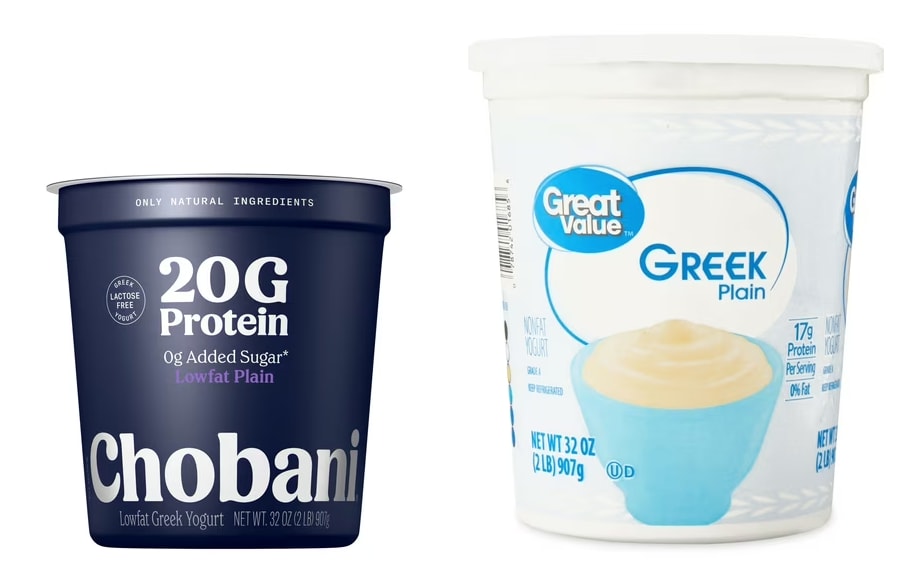
The yogurt in question is Chobani® High Protein Greek Yogurt, Lowfat Plain.
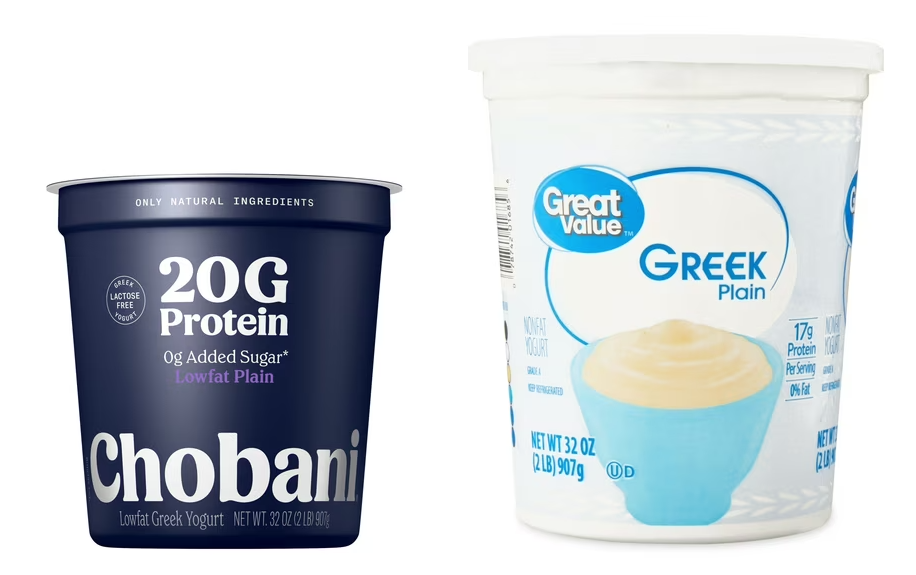
Which yogurt has more protein? Chobani (left) or Great Value (right). Original product screenshots from Walmart.com, placed side by side.
The 20 g claim sounds impressive, but how much yogurt is that? The label says it is per serving:
Serving size | 3/4 cup (190 g) |
|---|---|
Calories | 140 |
Servings per container | About 5 |
US serving sizes are regulated: the FDA's reference amount for yogurt is 170 g.[1]Yet these two labels use 190 g and 170 g, respectively. In this case, it is 20 g of protein per 140 calories (or 190 g) of product. The listed price at Walmart is $6.77 for 2 lb.
I happened to know that lowfat Greek yogurt is high in protein in general. And indeed, the cheapest, least fancy Greek yogurt I could find, from Walmart's budget brand, has more protein per calorie (but only 17 g per serving), while costing $3.28.
Item | Chobani | Great Value |
|---|---|---|
Price per 32 oz tub | $6.77 | $3.28 |
Serving size | 190 g (3/4 cup) | 170 g (2/3 cup) |
Calories per serving | 140 | 100 |
Protein per serving | 20 g | 17 g |
Protein per 100 g | 10.53 g | 10 g |
Protein per 100 calories | 14.29 g | 17 g |
Protein per dollar | 14.1 g | 27.7 g |
Saturated fat per 100 g | 1.05 g | 0 g |
Labeled lactose-free | Yes | No |
Calculated from the rounded labels and the prices quoted above. Full nutrition comparison below.
I find it comedic that a product with less protein per calorie and a price just over twice as high makes a much more prominent marketing claim. It at least caught my friend's attention. I tried to find other ways to explain the price difference: Chobani uses cultured lowfat milk and lactase, while Great Value uses cultured pasteurized Grade A nonfat milk. Chobani therefore has more fat and is labeled lactose-free, but the lactose-free claim is not as prominent on its packaging as the protein content (e.g., I missed it originally).
In this case, this situation is possible due to different serving sizes. A common denominator would have made the comparison obvious.
Appendix: full nutrition comparison
Item | Chobani per serving | Great Value per serving | Chobani per 100 cal | Great Value per 100 cal | Chobani per 100 g | Great Value per 100 g |
|---|---|---|---|---|---|---|
Product weight | 190 g | 170 g | 135.7 g | 170 g | 100 g | 100 g |
Price | $1.42 | $0.61 | $1.01 | $0.61 | $0.75 | $0.36 |
Calories | 140 | 100 | 100 | 100 | 73.7 | 58.8 |
Total fat | 3 g (4%) | 0 g (0%) | 2.14 g | 0 g | 1.58 g | 0 g |
Saturated fat | 2 g (10%) | 0 g (0%) | 1.43 g | 0 g | 1.05 g | 0 g |
Trans fat | 0 g | 0 g | 0 g | 0 g | 0 g | 0 g |
Cholesterol | 20 mg (7%) | 5 mg (2%) | 14.3 mg | 5 mg | 10.5 mg | 2.94 mg |
Sodium | 70 mg (3%) | 50 mg (2%) | 50 mg | 50 mg | 36.8 mg | 29.4 mg |
Total carbohydrate | 8 g (3%) | 7 g (3%) | 5.71 g | 7 g | 4.21 g | 4.12 g |
Dietary fiber | <1 g (2%) | 0 g (0%) | <0.71 g | 0 g | <0.53 g | 0 g |
Total sugars | 7 g | 7 g | 5 g | 7 g | 3.68 g | 4.12 g |
Added sugars | 0 g (0%) | 0 g (0%) | 0 g | 0 g | 0 g | 0 g |
Protein | 20 g (40%) | 17 g (34%) | 14.29 g | 17 g | 10.53 g | 10 g |
Vitamin D | 0 mcg (0%) | 0 mcg (0%) | 0 mcg | 0 mcg | 0 mcg | 0 mcg |
Calcium | 200 mg (15%) | 210 mg (15%) | 142.9 mg | 210 mg | 105.3 mg | 123.5 mg |
Iron | 0.3 mg (0%) | 0 mg (0%) | 0.21 mg | 0 mg | 0.16 mg | 0 mg |
Potassium | 260 mg (6%) | 240 mg (6%) | 185.7 mg | 240 mg | 136.8 mg | 141.2 mg |
Vitamin B12 | 1.7 mcg (70%) | Not listed | 1.21 mcg | Not listed | 0.89 mcg | Not listed |
Calculated values are approximate and use the rounded nutrition-label amounts. “Not listed” does not mean zero. Parentheses show the label’s % Daily Value.