AI/ML News & Innovations Hub

AI/ML news, top picks, and generated innovation digests.

★ Visit ai-karthik.com
422Sources
8459News Items
8Top Picks
68Blogs
successLast Run

Latest AI/ML News

8459 matching items

Spark Hack Toronto Winner Spotlight: Belong & City Flow
NVIDIA Developer YouTube 2026-06-13 00:28 UTC Score 53.0 AI-144-20260613-podcasts-and-6841f9b8 Full article

Spark Hack Toronto Winner Spotlight: Belong & City Flow

NVIDIA Spark Hack Toronto brought developers together for a weekend challenge: build an agentic application that runs locally on DGX Spark using open models and Toronto Open Data. Teams tackled everything from small business forecasting and dementia care to city-scale traffic simulation — all on an ASUS Ascent GX10 powered by the NVIDIA GB10 Grace Blackwell Superchip. Belong won the Public Services track with an AI companion designed for people living with dementia and their caregivers. Running entirely on DGX Spark, it helps users recognize family members, remember appointments, and find local services — keeping all conversations and memory data on-device using Nemotron, speech, and retrieval systems. CityFlow won the Economic Systems track with a real-time intelligence platform for small businesses. By combining transit disruptions, road closures, weather, events, and other Toronto data sources, it helps business owners answer practical questions like "Am I properly staffed for Friday night?" — using Nemotron to generate recommendations and NVIDIA cuOpt to turn forecasts into actual staffing plans. Join us live to see demos and chat with both teams. Bring your questions about building with local AI compute and Toronto Open Data.


Microsoft Research Podcast 2026-06-12 20:30 UTC Score 27.0 AI-147-20260612-podcasts-and-80e399a1 Full article

Ire identifies another LOTUSLITE specimen

Project Ire examined a timely malware sample and determined its intent through reverse engineering—identifying LOTUSLITE characteristics even as most major EDR tools did not detect it. The post Ire identifies another LOTUSLITE specimen appeared first on Microsoft Research .

AI Alignment Forum 2026-06-12 17:14 UTC Score 58.0 USR-0151-20260612-community-fo-ceb57313 Full article

Building and evaluating model diffing agents

This is the second in a series of informal research updates from the Google DeepMind Language Model Interpretability team, in interpretability and adjacent areas. The first post can be found here . TL;DR It is possible to build extremely simple agents that reliably find interesting behavioural differences between distinct models. We call these ‘diffing agents’. The closest previous 'behavioural model diffing' work has focussed on understanding behavioural differences between two models on some static prompt distribution. This is valuable, but might miss important differences, especially if they are rare. We propose instead allowing an auditor agent to craft their own prompts to intelligently search for and validate behavioural differences, and find this to work well. We present results of applying our model diffing agent to a number of pairs of real models. We introduce a set of simple evaluations with ground truth for evaluating model diffing agents. These are: There should be no differences found when the models compared are identical. In model organisms with a conditional system instruction , the only difference found by the agent should be the intended behavioural change specified by the conditional system instruction. We validate that our diffing agents outperform standard auditing agents that only operate on a single model in cases where the behavioural change is subtle. We apply diffing agents to a model organism trained to exhibit a secret behaviour. We find that dif…

Arize AI Blog 2026-06-12 15:00 UTC Score 30.0 USR-0079-20260612-ai-specialis-c6cdd40b Full article

Memory is still a missing primitive: Cataloguing what the field is actually shipping

This week the field shipped four kinds of memory, and Apple paid Google a billion dollars a year for one of them. None of the four is what the demos imply. A field map of what's actually shipping, and the missing primitive that sits between the buckets. The post Memory is still a missing primitive: Cataloguing what the field is actually shipping appeared first on Arize AI .

Stack Overflow AI Blog 2026-06-12 14:00 UTC Score 27.0 USR-0063-20260612-ai-specialis-0d45756b Full article

Paging Charity? How do I get my leaders to stop running teams Into the ground?​​​​‌‍​‍​‍‌‍‌​‍‌‍‍‌‌‍‌‌‍‍‌‌‍‍​‍​‍​‍‍​‍​‍‌​‌‍​‌‌‍‍‌‍‍‌‌‌​‌‍‌​‍‍‌‍‍‌‌‍​‍​‍​‍​​‍​‍‌‍‍​‌​‍‌‍‌‌‌‍‌‍​‍​‍​‍‍​‍​‍‌‍‍​‌‌​‌‌​‌​​‌​​‍‍​‍​‍‌‍​‌‍‌‌​​‍‍‌​‌‌​‌‍​‌‌‍​‌‍‍‌‍‌‌‍‌‍‌‌‌​‍‌‍‌‍‌‍​‌‍‌…

Capacity is one of the hardest problems because it sits at the knotty, gnarled-up intersection of so many other hard problems.​​​​‌‍​‍​‍‌‍‌​‍‌‍‍‌‌‍‌‌‍‍‌‌‍‍​‍​‍​‍‍​‍​‍‌​‌‍​‌‌‍‍‌‍‍‌‌‌​‌‍‌​‍‍‌‍‍‌‌‍​‍​‍​‍​​‍​‍‌‍‍​‌​‍‌‍‌‌‌‍‌‍​‍​‍​‍‍​‍​‍‌‍‍​‌‌​‌‌​‌​​‌​​‍‍​‍​‍‌‍​‌‍‌‌​​‍‍‌​‌‌​‌‍​‌‌‍​‌‍‍‌‍‌‌‍‌‍‌‌‌​‍‌‍‌‍‌‍​‌‍‌‌​‍‍‌‍​‌‍​‍‌‍‍‌‌‍‍‌‌​‌‍‌‌‌‍‍‌‌​​‍‌‍‌‌‌‍‌​‌‍‍‌‌‌​​‍‌‍‌‌‍‌‍‌​‌‍‌‌​‌‌​​‌​‍‌‍‌‌‌​‌‍‌‌‌‍‍‌‌​‌‍​‌‌‌​‌‍‍‌‌‍‌‍‍​‍‌‍‍‌‌‍‌​​‌​​‍​​‌‍‌‌​​‌​‍‌​‌​​‍​‌‍‌‍​‍‌‌‍‌‍‌‍​‌‍​‌​​​​‍‌​‌​​‌​‌‍‌​​‍​​‍‌‌‍​‌‌‍​‌‍​​‌​‍‌​​​​​‌‍‌​​‌‌​​‍‌‍‌‌​‌‌‌‍‌‌​‌‌‌‍​‍​‌‌‌‍‌‌​‍‌‌​‌‍‌‌​​‌‍‌‌​‌‌‍​‍‌‍​‌‍‌‍‌‌‌​​‌‍‌​‌‌​​‍‌​​‌‍​‌‌‌​‌‍‍​​‌‌‍‌‌‌‍​‌‍​‌‍‌‌‌​‍‌​​‌‌​​‌‍​‍‌‍​‌‌​‌‍‌‌‌‌‌‌‌​‍‌‍​​‌‌‍‍​‌‌​‌‌​‌​​‌​​‍‌‌​​‌​​‌​‍‌‌​​‍‌​‌‍​‍‌‌​​‍‌​‌‍‌‍​‌‍‌‌​​‍‍‌​‌‌​‌‍​‌‌‍​‌‍‍‌‍‌‌‍‌‍‌‌‌​‍‌‍‌‍‌‍​‌‍‌‌​‍‍‌‍​‌‍​‍‌‍‌‍‍‌‌‍‌​​‌​​‍​​‌‍‌‌​​‌​‍‌​‌​​‍​‌‍‌‍​‍‌‌‍‌‍‌‍​‌‍​‌​​​​‍‌​‌​​‌​‌‍‌​​‍​​‍‌‌‍​‌‌‍​‌‍​​‌​‍‌​​​​​‌‍‌​​‌‌​​‍‌‍‌‌​‌‌‌‍‌‌​‌‌‌‍​‍​‌‌‌‍‌‌​‍‌‍‌‌​‌‍‌‌​​‌‍‌‌​‌‌‍​‍‌‍​‌‍‌‍‌‌‌​​‌‍‌​‌‌​​‍‌‍‌​​‌‍​‌‌‌​‌‍‍​​‌‌‍‌‌‌‍​‌‍​‌‍‌‌‌​‍‌​​‌‌​​‍‌‍‌​​‌‍‌‌‌​‍‌​‌​​‌‍‌‌‌‍​‌‌​‌‍‍‌‌‌‍‌‍‌‌​‌‌​​‌‌‌‌‍​‍‌‍​‌‍‍‌‌​‌‍‍​‌‍‌‌‌‍‌​​‍​‍‌‌

PyTorch Tutorials 2026-06-12 13:47 UTC Score 25.0 AI-191-20260612-developer-an-e3e49035 Full article

PyTorch Meetup Singapore: A milestone in APAC

TL;DR Eighty engineers, researchers, and community builders gathered for the inaugural PyTorch Meetup Singapore. Hosted at the Red Hat Asia Pacific office and organised by Sudhir Dharanendraiah, Ayush Satyam, Sumantro...

Amazon Science AI 2026-06-12 12:40 UTC Score 80.0 AI-058-20260612-official-ai--0a894f67 Full article

AutoClimDS: Climate data science agentic AI — A knowledge graph is all you need

Climate data science faces persistent barriers stemming from the fragmented nature of data sources, heterogeneous formats, and the steep technical expertise required to identify, acquire, and process datasets. These challenges limit participation, slow discovery, and reduce the reproducibility of scientific workflows. In this paper, we present a proof of concept for addressing these barriers through the integration of a curated knowledge graph (KG) with AI agents designed for cloud-native scientific workflows. The KG provides a unifying layer that organizes datasets, tools, and workflows, while AI agents—powered by generative AI services—enable natural language interaction, automated data access, and streamlined analysis. Together, these components drastically lower the technical threshold for engaging in climate data science, enabling non-specialist users to identify and analyze relevant datasets. By leveraging existing cloud-ready API data portals, we demonstrate that 'a knowledge graph is all you need' to unlock scalable and agentic workflows for scientific inquiry. The open-source design of our system further supports community contributions, ensuring that the KG and associated tools can evolve as a shared commons. Our results illustrate a pathway toward democratizing access to climate data and establishing a reproducible, extensible framework for human–AI collaboration in scientific research.

Python Concepts Every AI Engineer Must Master
Machine Learning Mastery 2026-06-12 12:00 UTC Score 18.0 AI-039-20260612-ai-specialis-c2362f61 Full article

Python Concepts Every AI Engineer Must Master

Transitioning from writing local experimental scripts to building scalable, production-grade AI systems requires a shift in how we write Python.

Research ICT Africa AI 2026-06-12 10:08 UTC Score 49.0 USR-0187-20260612-regional-new-b0b7a0a7 Full article

Governance beyond ethics: Reflections from the Just AI Fellows

AI systems are not neutral Embedded in every AI model’s dataset is an assumption about who that technology is meant to serve. In the case of most globally recognisable AI […] The post Governance beyond ethics: Reflections from the Just AI Fellows appeared first on Research ICT Africa .

Data Science Stack Exchange 2026-06-12 10:02 UTC Score 24.0 AI-111-20260612-social-media-024a8446 Full article

Matching first names, full names and pronouns

I am working on a graph store of entities and relationships extracted from a factual test document of around 500 words. The first pass (NER) extracts named entities, the second extracts relationships (RE). For a given person, there are different references in the text: Maria, Maria Gotthard, Dr. Maria Gotthard and can also be referred to by 'she', for example 'she was rewarded by the company'. The goal is to merge all these references into one entity so that the relationship graph is not fragmented into different contexts. I have seen a few posts on different forums saying this is a very difficult problem, but hopefully someone out there has some insights or experience to share 🙂 To make things interesting, references to the same entity can occur in different chunks of text, making it impossible for the LLM (currently Ollama/Mistral) to process the cross-chunk context in one call. To address this, I have added a pass across all extracted entities, including exact text matching and a Levenshtein similarity check, but this does not handle first name v full name and comes with a host of other issues. It has a high risk of over-merging, for example if a set of entities consist of incrementally numbered items they will all be merged into one entity. I am wondering if there is a particular architecture for this problem, for example pre-processing a document to link related entities before extracting. Doesn't have to be LLM-based, heuristics and algorithms sometimes do the trick as…

Stack Overflow Machine Learning Tag 2026-06-12 08:56 UTC Score 21.0 AI-112-20260612-social-media-cb5f7edf Full article

Trigram Language Model :Two implementations give different loss, are they equivalent?

I am implementing a trigram character-level language model following Andrej Karpathy's makemore series. I have two implementations and I want to understand if they are mathematically equivalent or fundamentally different models( i gave them in the snippets) Implementation 1 :Direct 27x27x27 weight tensor: W = torch.randn((27, 27, 27), requires_grad=True) for k in range(200): logits = W[xs1, xs2] counts = logits.exp() probs = counts / counts.sum(1, keepdim=True) loss = -probs[torch.arange(num), ys].log().mean() W.grad = None loss.backward() W.data += -50 * W.grad '''Here xs1 and xs2 are integer tensors of character indices. W[xs1, xs2] directly indexes into the 3D weight tensor to get logits of shape (N, 27).''' Implementation 2 :Concatenated one-hot vectors with 54x27 weight matrix: W= torch.randn((54, 27), requires_grad=True) for k in range(200): xenc1 = F.one_hot(xs1, num_classes=27).float() xenc2 = F.one_hot(xs2, num_classes=27).float() xenc = torch.cat([xenc1, xenc2], dim=1) logits = xenc @ W loss = F.cross_entropy(logits, ys) W.grad = None loss.backward() W.data -= 50 * W.grad.data My understanding so far: Implementation 1 has 27x27x27 = 19683 parameters. Every (char1, char2) pair has a completely unique and independent set of 27 weights. Implementation 2 has 54x27 = 1458 parameters. Because of the concatenation and matrix multiply, the contribution of char1 and char2 are additive char1 selects rows W[0:27] and char2 selects rows W[27:54] and they are summed together. S…

Stack Overflow AI Blog 2026-06-12 07:40 UTC Score 35.0 USR-0063-20260612-ai-specialis-bed3391f Full article

Developers are emotionally attached to their tools​​​​‌‍​‍​‍‌‍‌​‍‌‍‍‌‌‍‌‌‍‍‌‌‍‍​‍​‍​‍‍​‍​‍‌​‌‍​‌‌‍‍‌‍‍‌‌‌​‌‍‌​‍‍‌‍‍‌‌‍​‍​‍​‍​​‍​‍‌‍‍​‌​‍‌‍‌‌‌‍‌‍​‍​‍​‍‍​‍​‍‌‍‍​‌‌​‌‌​‌​​‌​​‍‍​‍​‍‌‍​‌‍‌‌​​‍‍‌​‌‌​‌‍​‌‌‍​‌‍‍‌‍‌‌‍‌‍‌‌‌​‍‌‍‌‍‌‍​‌‍‌‌​‍‍‌‍​‌‍​‍‌‍‍‌‌‍‍‌…

Ryan welcomes Trisha Gee, a Java champion and developer productivity advocate, to explore how AI is transforming the role of IDEs and the broader developer experience; the relevance of traditional tools, muscle memory, the risks of hype; and how to adapt workflows for AI-driven development.​​​​‌‍​‍​‍‌‍‌​‍‌‍‍‌‌‍‌‌‍‍‌‌‍‍​‍​‍​‍‍​‍​‍‌​‌‍​‌‌‍‍‌‍‍‌‌‌​‌‍‌​‍‍‌‍‍‌‌‍​‍​‍​‍​​‍​‍‌‍‍​‌​‍‌‍‌‌‌‍‌‍​‍​‍​‍‍​‍​‍‌‍‍​‌‌​‌‌​‌​​‌​​‍‍​‍​‍‌‍​‌‍‌‌​​‍‍‌​‌‌​‌‍​‌‌‍​‌‍‍‌‍‌‌‍‌‍‌‌‌​‍‌‍‌‍‌‍​‌‍‌‌​‍‍‌‍​‌‍​‍‌‍‍‌‌‍‍‌‌​‌‍‌‌‌‍‍‌‌​​‍‌‍‌‌‌‍‌​‌‍‍‌‌‌​​‍‌‍‌‌‍‌‍‌​‌‍‌‌​‌‌​​‌​‍‌‍‌‌‌​‌‍‌‌‌‍‍‌‌​‌‍​‌‌‌​‌‍‍‌‌‍‌‍‍​‍‌‍‍‌‌‍‌​​‌‌‍‌‌‌‍‌‌‌‍‌​​​‍‌‍​‍​‌​​‌‍‌‍‌‍​‍‌​​​‌​‌‍​‍​‍​​‍‌​‌​‌‍‌‍‌‍​‌‍​‍​‍‌‌‍​‍​‌‌​‌‌​​‍​‍‌​​‍‌‍​‍‌‍​‌‍​​​‍​‌‌‌‍​​​‌‌‍​‌‍‌‌​‌​​‌​​‍‌‌​‌‍‌‌​​‌‍‌‌​‌‌‍​‍‌‍​‌‍‌‍‌‌‌​​‌‍‌​‌‌​​‍‌​​‌‍​‌‌‌​‌‍‍​​‌‌‍‌‌‌‍​‌‍​‌‍‌‌‌​‍‌​​‌‌​​‌‍​‍‌‍​‌‌​‌‍‌‌‌‌‌‌‌​‍‌‍​​‌‌‍‍​‌‌​‌‌​‌​​‌​​‍‌‌​​‌​​‌​‍‌‌​​‍‌​‌‍​‍‌‌​​‍‌​‌‍‌‍​‌‍‌‌​​‍‍‌​‌‌​‌‍​‌‌‍​‌‍‍‌‍‌‌‍‌‍‌‌‌​‍‌‍‌‍‌‍​‌‍‌‌​‍‍‌‍​‌‍​‍‌‍‌‍‍‌‌‍‌​​‌‌‍‌‌‌‍‌‌‌‍‌​​​‍‌‍​‍​‌​​‌‍‌‍‌‍​‍‌​​​‌​‌‍​‍​‍​​‍‌​‌​‌‍‌‍‌‍​‌‍​‍​‍‌‌‍​‍​‌‌​‌‌​​‍​‍‌​​‍‌‍​‍‌‍​‌‍​​​‍​‌‌‌‍​​​‌‌‍​‌‍‌‌​‌​​‌​​‍‌‍‌‌​‌‍‌‌​​‌‍‌‌​‌‌‍​‍‌‍​‌‍‌‍‌‌‌​​‌‍‌​‌‌​​‍‌‍‌​​‌‍​‌‌‌​‌‍‍​​‌‌‍‌‌‌‍​‌‍​‌‍‌‌‌​‍‌​​‌‌​​‍‌‍‌​​‌‍‌‌‌​‍‌​‌​​‌‍‌‌‌‍​‌‌​‌‍‍‌‌‌‍‌‍‌‌​‌‌​​‌‌‌‌‍​‍‌‍​‌‍‍‌‌​‌‍‍​‌‍‌‌‌‍‌​​‍​‍‌‌

Gemini Omni: AI Video Generation Inside Gemini
Analytics Vidhya 2026-06-12 07:30 UTC Score 35.0 AI-034-20260612-ai-specialis-c15b6022 Full article

Gemini Omni: AI Video Generation Inside Gemini

Gemini models have always kept up with AI advancements. From text-based chatbots in 2023, Gemini has evolved into a multimodal system capable of understanding and generating text, audio, images… and now videos. AI video generation is no longer a standalone tool. With Gemini Omni, video creation becomes mainstream. Gemini Omni isn’t important because it generates […] The post Gemini Omni: AI Video Generation Inside Gemini appeared first on Analytics Vidhya .

Generate Synthetic Data for Physical AI With NVIDIA Brev Launchables and Agent Skills
NVIDIA Developer YouTube 2026-06-12 07:06 UTC Score 67.0 AI-144-20260612-podcasts-and-0509f277 Full article

Generate Synthetic Data for Physical AI With NVIDIA Brev Launchables and Agent Skills

Join NVIDIA for a live demonstration of how developers can generate synthetic data for physical AI using NVIDIA Brev Launchables and agent skills. Building synthetic data pipelines for robotics, digital twins, and autonomous systems often requires configuring GPU infrastructure, simulation environments, notebooks, and orchestration tools before meaningful work can begin. In this livestream, we'll show how NVIDIA Brev Launchables and agent skills simplify that process by packaging these components into ready-to-run workflows that help developers move from setup to data generation faster. In this livestream, you'll learn how to: - Launch preconfigured Physical AI development environments - Generate synthetic data using AI-powered workflows - Accelerate robotics, simulation, and digital twin development - Scale from individual tasks to larger synthetic data pipelines - Integrate data generation workflows into broader Physical AI ecosystems Through live, hands-on demonstrations, we'll show how developers can streamline synthetic data creation and reduce the complexity of building Physical AI workflows. Whether you're building robots, training computer vision models, creating digital twins, developing autonomous systems, or exploring Physical AI applications, this session provides a practical introduction to synthetic data generation with NVIDIA Brev Launchables and agent skills. -------------------------------- 📓 Resources Launchable: - Nurec: https://brev.nvidia.com/launchable/…

Latent Space Podcast 2026-06-12 05:34 UTC Score 20.0 AI-142-20260612-podcasts-and-3e7d8d10 Full article

[AINews] Loopcraft: The Art of Stacking Loops

a quiet day lets us highlight a great concept from Peter Steinberger, Boris Cherny, and Andrej Karpathy

Stack Overflow Machine Learning Tag 2026-06-12 03:20 UTC Score 41.0 AI-112-20260612-social-media-889b8e73 Full article

Best pre-trained vision model for multi-plant disease detection in async web back-end

I'm building a web app with FastAPI + async/await Python backend. Users upload leaf photos via API and the server should return: 1) plant species, 2) disease label or "healthy". Constraints: Generalization: Must handle multiple crops. Users can upload "any" plant leaf, not just tomato/corn. Target 15+ species. Server inference: Runs on GPU server, not mobile. Latency 1-2s is acceptable, so model size isn't a bottleneck. Pre-trained + 100% free: Need open-source weights for transfer learning. No paid APIs. License must allow commercial use. Dataset: Starting with PlantVillage dataset + ~2,000 custom field images. Lab images vs real field images is a domain shift issue. Tech stack: PyTorch + timm library. Inference runs in async endpoints, so I use run_in_executor to avoid blocking. What I tried: Fine-tuned ResNet50 on PlantVillage. 95% accuracy on lab images, but it drops to ~62% on field images. Overfitting to clean backgrounds. Questions: For multi-crop + multi-disease, is a 2-stage approach better: Model A for species ID, Model B for disease per species? Or one multi-label model? Between ConvNeXt-Base, Swin-Base, and ViT-Base, which fine-tunes best on PlantVillage + field data for accuracy in 2025? Are there plant-specific foundation models/checkpoints better than ImageNet pre-training for this domain? I'm looking for architecture + dataset + fine-tuning strategy advice, not code.

Nature Machine Intelligence 2026-06-12 00:00 UTC Score 39.0 AI-025-20260612-global-ai-ne-06deebb0

Towards AI-augmented decision making in psychiatry

Nature Machine Intelligence, Published online: 12 June 2026; doi:10.1038/s42256-026-01256-2 Psychiatric disorders are heterogeneous, and care depends on interpreting unstructured longitudinal narratives, creating variability that hinders standardization. A study now shows that a psychiatry-specific large language model (LLM) may help clinicians to deliver more consistent, high-quality care.

ClearML Blog 2026-06-11 20:56 UTC Score 33.0 USR-0084-20260611-ai-specialis-e5264950

Inside NERSC at Berkeley Lab: How a DOE Office of Science User Facility Is Exploring ClearML for Scientific AI Workflows

By Adam Wolf NERSC, the mission high-performance computing center for the U.S. Department of Energy Office of Science, is using ClearML as part of the AI infrastructure stack for Perlmutter, the upcoming Doudna supercomputer, and the broader American Science Cloud. Here is a look at what they are exploring and why it matters for AI […]

MongoDB AI Blog 2026-06-11 19:46 UTC Score 59.0 USR-0070-20260611-ai-specialis-3fe555ce Full article

Production-Ready Agents Need A Production-Ready Data Platform

There’s a common theme to the conversations I’ve been having with AI teams lately: change. Constant, head-spinning change. Teams across industries are evaluating and re-evaluating model providers, agent frameworks, and harnesses on a continuous basis. At MongoDB, we believe that your choice of technology partner—specifically, your data platform—should simplify how you build with AI. It should deliver performance at scale, enable you to build and run anywhere, and it should allow you to choose your own providers and frameworks. This is exactly what MongoDB offers, and it’s why more than 67,000 customers rely on us for their most important applications. The organizations seeing the most AI success are the ones whose technology stacks are set up for the current pace of change. For example, DevRev’s AgentOS platform is powered by MongoDB Atlas. AgentOS handles billions of requests each month, for everything from AI-assisted insights and analytics to internal communications and development. Relying on MongoDB Atlas has helped DevRev get innovations to market faster, and enables the company to scale seamlessly as it grows. MongoDB is ideal for agentic AI in two key ways. First, an agent is only as smart as its context—which requires blending short-term memory, long-term knowledge, and enterprise data. Because this information is highly dynamic and unstructured, JSON is the ideal format. It provides the schema flexibility inherently needed by the data and allows attaching metadata…

Stack Overflow Machine Learning Tag 2026-06-11 19:13 UTC Score 12.0 AI-112-20260611-social-media-24a3832d Full article

Why is the cost of my neural network inconsistent (and sometimes increasing)?

I tried to follow this crash course to create a neural network from scratch. It seems to be working, which is great, but as I kept running the simulation I noticed that the cost of the network sometimes behaves, continuously decreasing until it reaches a minimum. Other times, it will hit a low, then go back up and rest at that higher position. Other times, it always increases! Why is it happening? I wrote it in C# as a Visual Studio Console App. int[] layerLengths = { 2, 30, 30, 30, 1 }; double[][,] weights = new double[layerLengths.Length - 1][,]; double[][,] biases = new double[layerLengths.Length - 1][,]; double[][,] layers = new double[layerLengths.Length][,]; Random rand = new Random(); double[,] input = { { 142, 64, 27 }, { 185, 71, 42 }, { 128, 62, 23 }, { 210, 74, 51 }, { 167, 68, 35 }, { 154, 66, 29 }, { 198, 72, 46 }, { 135, 63, 21 }, { 176, 70, 38 }, { 221, 75, 54 }, { 149, 65, 31 }, { 162, 67, 33 }, { 193, 73, 48 }, { 124, 61, 20 }, { 181, 69, 41 }, { 205, 76, 57 }, { 157, 66, 30 }, { 170, 68, 36 }, { 138, 64, 25 }, { 214, 74, 53 }, { 146, 65, 28 }, { 189, 72, 44 }, { 132, 62, 22 }, { 173, 69, 37 }, { 201, 73, 49 }, { 159, 67, 32 }, { 144, 64, 26 }, { 178, 70, 39 }, { 226, 77, 60 }, { 151, 65, 29 }, { 166, 68, 34 }, { 196, 74, 47 }, { 127, 61, 19 }, { 183, 71, 43 }, { 208, 75, 55 }, { 155, 66, 31 }, { 171, 69, 36 }, { 140, 63, 24 }, { 217, 76, 58 }, { 148, 65, 27 }, { 191, 73, 45 }, { 130, 62, 21 }, { 175, 70, 38 }, { 203, 74, 50 }, { 160, 67, 33 }, { 145, 64, 26…

CENIA Chile 2026-06-11 18:45 UTC Score 27.0 USR-0218-20260611-research-aca-a432e831 Full article

Investigador principal de CENIA recibe el Premio Alonzo Church 2026

El investigador principal de CENIA, Pablo Barceló, fue destacado por su artículo “Querying Regular Graph Patterns”, cuyo aporte teórico sustenta hoy los lenguajes con los que se consultan bases de datos en grafos a nivel mundial. Pablo Barceló, investigador principal del Centro Nacional de Inteligencia Artificial (CENIA) de Chile, doctor en Ciencias de la Computación […] The post Investigador principal de CENIA recibe el Premio Alonzo Church 2026 appeared first on CENIA .

GPU-Accelerated Virtual Drug Screening with cuML and Agent Platform
NVIDIA Developer YouTube 2026-06-11 18:01 UTC Score 48.0 AI-144-20260611-podcasts-and-ebe84368 Full article

GPU-Accelerated Virtual Drug Screening with cuML and Agent Platform

GPUs aren’t just for LLMs; they are accelerating life saving discoveries in tabular data science. On the next Google Cloud Live livestream, join experts from Google Cloud and NVIDIA for a live, end-to-end breakdown of GPU-accelerated virtual drug screening. Hosted by Tilde, alongside Jeff Nelson, William Hill, and Dr. Saee Paliwal, discover how to take molecular predictions from pipeline to production. Watch along and learn about: Interactive live demo: Drop everyday compounds in the chat and watch our web app predict lung cancer (EGFR) binding likelihood in seconds. GPU-accelerated pipelines: Learn how to get 20x-45x training speedups using cuDF and cuML without rewriting your pandas or scikit-learn code. Stop waiting on CPU bottlenecks and learn how to virtualize screening at the trillion molecule scales. Speakers: Tilde Thurium, Jeff Nelson, William Hill, Saee Paliwal Products Mentioned: GPU, NVIDIA, Google Cloud

Bring production agent traces from Arize into Databricks Unity Catalog
Arize AI Blog 2026-06-11 17:00 UTC Score 41.0 USR-0079-20260611-ai-specialis-aa9c4fa6 Full article

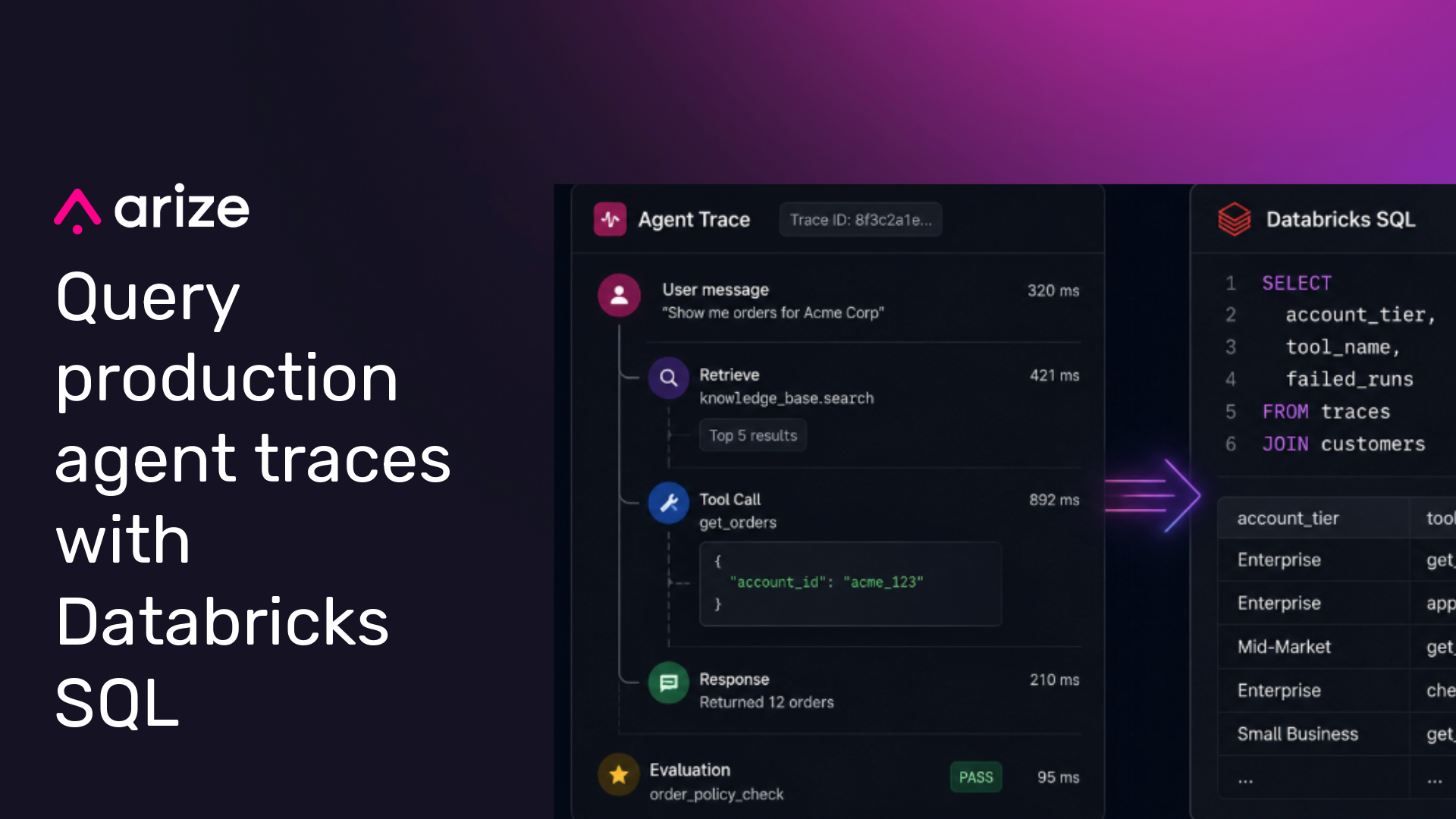
Bring production agent traces from Arize into Databricks Unity Catalog

Arize Data Fabric now supports Databricks, helping teams sync production agent traces, evaluations, and annotations into customer-owned storage for governed analysis in Unity Catalog. The post Bring production agent traces from Arize into Databricks Unity Catalog appeared first on Arize AI .

LatAm Journalism Review AI 2026-06-11 15:20 UTC Score 18.0 AI-176-20260611-regional-ai--d4a26312 Full article

First Afro-Mexican radio station fights against invisibility and for survival

Women activists from Oaxaca secured the first license of its kind in Mexico to create the station Voces Afromexicanas. Now, they face challenges keeping it afloat. The post First Afro-Mexican radio station fights against invisibility and for survival appeared first on LatAm Journalism Review by the Knight Center .

Stack Overflow Machine Learning Tag 2026-06-11 15:12 UTC Score 29.0 AI-112-20260611-social-media-e0ab0049 Full article

Why is it so difficult to train an accuracte GAN model?

I'm trying to train a GAN model, but its results are very bad. The Generator doesn't seem to work. Can someone suggest how this can be improved? What is the best way to remember the code? Can this also be done using a builtin library? import os import torch import torchvision import torch.nn as nn import torch.optim as optim import torch.nn.functional as F import torchvision.datasets as datasets import torchvision.transforms as transforms from torch.utils.data import DataLoader import matplotlib.pyplot as plt import numpy as np random_seed = 42 torch.manual_seed(random_seed) BATCH_SIZE = 128 AVAIL_GPUS = min(1, torch.cuda.device_count()) DEVICE = torch.device("cuda" if AVAIL_GPUS else "cpu") LATENT_DIM = 100 transform = transforms.Compose([ transforms.ToTensor(), transforms.Normalize((0.5,), (0.5,)) # scale to [-1, 1] for tanh output ]) dataset = datasets.MNIST(root="./data", train=True, download=True, transform=transform) dataloader = DataLoader(dataset, batch_size=BATCH_SIZE, shuffle=True, num_workers=2, drop_last=True) class Generator(nn.Module): def __init__(self, latent_dim=100, img_channels=1, feature_maps=64): super().__init__() self.net = nn.Sequential( nn.ConvTranspose2d(latent_dim, feature_maps * 4, kernel_size=7, stride=1, padding=0, bias=False), nn.BatchNorm2d(feature_maps * 4), nn.ReLU(True), nn.ConvTranspose2d(feature_maps * 4, feature_maps * 2, kernel_size=4, stride=2, padding=1, bias=False), nn.BatchNorm2d(feature_maps * 2), nn.ReLU(True), nn.ConvTranspose2d(…

Vector Institute News 2026-06-11 12:57 UTC Score 33.0 USR-0017-20260611-research-aca-ed421671 Full article

Anne Martel: Using AI to personalize cancer treatment

Anne Martel, Professor, University of Toronto | Vector Institute Faculty Member Every cancer patient faces a fundamental question: what treatment do I need? Not too little, which might allow the […] The post Anne Martel: Using AI to personalize cancer treatment appeared first on Vector Institute for Artificial Intelligence .