LWiAI Podcast #232 - ChatGPT Ads, Thinking Machines Drama, STEM
OpenAI to test ads in ChatGPT as it burns through billions, The Drama at Thinking Machines, STEM: Scaling Transformers with Embedding Modules
AI/ML news, top picks, and generated innovation digests.
9091 matching items
OpenAI to test ads in ChatGPT as it burns through billions, The Drama at Thinking Machines, STEM: Scaling Transformers with Embedding Modules
Thriving in a world of agents
Integration Consulting, a Brazil-headquartered management consultancy with offices worldwide, has announced the appointment of Carolina Flores as partner. She becomes the firm’s 13th partner. Now in her 15th year at Integration Consulting, Carolina Flores leads complex projects for major Brazilian companies across retail, consumer goods, healthcare and financial services.
As AI increasingly shapes geopolitics, elections, and civic life, its impact on democracy is becoming impossible to ignore. In this episode, Daniel and Chris are joined by security expert Bruce Schneier to explore how AI and technology are transforming democracy, governance, and citizenship. Drawing from his book Rewiring Democracy , they explore real examples of AI in elections, legislation, courts, and public AI models, the risks of concentrated power, and how these tools can both strengthen and strain democratic systems worldwide. Featuring: Bruce Schneier – X Chris Benson – Website , LinkedIn , Bluesky , GitHub , X Daniel Whitenack – Website , GitHub , X Links: Schneier on Security Sponsors: Framer - The website builder that turns your dot com from a formality into a tool for growth. Check it out at framer.com/PRACTICALAI Zapier - The AI orchestration platform that puts AI to work across your company. Check it out at zapier.com/practical Upcoming Events: Register for upcoming webinars here !

Sinister variations on the positive state of flow
AI for Good Impact Africa, our second regional event brought together innovators, policymakers, startups, and youth from across the continent for the transformative week of dialogue and discovery. Held alongside AI Expo Africa in Johannesburg, the event marked a milestone in fostering local innovation, building capacity, and strengthening partnerships to advance responsible artificial intelligence across […]

What makes something truly *intelligent?* Is a rock an agent? Could a perfect simulation of your brain actually *be* you? In this fascinating conversation, Dr. Jeff Beck takes us on a journey through the philosophical and technical foundations of agency, intelligence, and the future of AI. Jeff doesn't hold back on the big questions. He argues that from a purely mathematical perspective, there's no structural difference between an agent and a rock – both execute policies that map inputs to outputs. The real distinction lies in *sophistication* – how complex are the internal computations? Does the system engage in planning and counterfactual reasoning, or is it just a lookup table that happens to give the right answers? *Key topics explored in this conversation:* *The Black Box Problem of Agency* – How can we tell if something is truly planning versus just executing a pre-computed response? Jeff explains why this question is nearly impossible to answer from the outside, and why the best we can do is ask which model gives us the simplest explanation. *Energy-Based Models Explained* – A masterclass on how EBMs differ from standard neural networks. The key insight: traditional networks only optimize weights, while energy-based models optimize *both* weights and internal states – a subtle but profound distinction that connects to Bayesian inference. *Why Your Brain Might Have Evolved from Your Nose* – One of the most surprising moments in the conversation. Jeff proposes that the…
And an Overview of Recent Inference-Scaling Papers

Professor Mazviita Chirimuuta joins us for a fascinating deep dive into the philosophy of neuroscience and what it really means to understand the mind. *What can neuroscience actually tell us about how the mind works?* In this thought-provoking conversation, we explore the hidden assumptions behind computational theories of the brain, the limits of scientific abstraction, and why the question of machine consciousness might be more complicated than AI researchers assume. Mazviita, author of *The Brain Abstracted,* brings a unique perspective shaped by her background in both neuroscience research and philosophy. She challenges us to think critically about the metaphors we use to understand cognition — from the reflex theory of the late 19th century to today's dominant view of the brain as a computer. *Key topics explored:* *The problem of oversimplification* — Why scientific models necessarily leave things out, and how this can sometimes lead entire fields astray. The cautionary tale of reflex theory shows how elegant explanations can blind us to biological complexity. *Is the brain really a computer?* — Mazviita unpacks the philosophical assumptions behind computational neuroscience and asks: if we can model anything computationally, what makes brains special? The answer might challenge everything you thought you knew about AI. *Haptic realism* — A fresh way of thinking about scientific knowledge that emphasizes interaction over passive observation. Knowledge isn't about read…
Ipsos’ and Google’s study shows how public perceptions on AI have evolved as people have come to see AI as a practical tool for learning, work, and daily life. In 2025, the world decisively crossed the AI adoption threshold. People moved past casual experimentation – the highest use case in 2024 – and embraced AI as an […]
OpenAI to test ads in ChatGPT as it burns through billions, Sequoia to invest in Anthropic, Zhipu AI breaks US chip reliance, The Drama at Thinking Machines Is Riveting Silicon Valley
By John Knechtel From the telescope to the balance sheet – a Foundation Models for Science Workshop recap relates how scientists can help businesses solve their most stubborn data problems and […] The post The New Cartography of the Invisible appeared first on Vector Institute for Artificial Intelligence .
Earthwise, a boutique advisory firm from the Netherlands specialising in sustainability, has opened a new office in Colombia as part of its international expansion. Founded in 2024 by a team of “sustainability enthusiasts”, Earthwise advises mid-sized and large organisations on ESG and sustainability-related challenges.
Cross-repo search provides semantic code understanding across repositories.
As generative AI moves into production, traditional guardrails and input/output filters can prove too slow, too expensive, and/or too limited. In this episode, Alizishaan Khatri of Wrynx joins Daniel and Chris to explore a fundamentally different approach to AI safety and interpretability. They unpack the limits of today’s black-box defenses, the role of interpretability, and how model-native, runtime signals can enable safer AI systems. Featuring: Alizishaan Khatri – LinkedIn Chris Benson – Website , LinkedIn , Bluesky , GitHub , X Daniel Whitenack – Website , GitHub , X Upcoming Events: Register for upcoming webinars here !
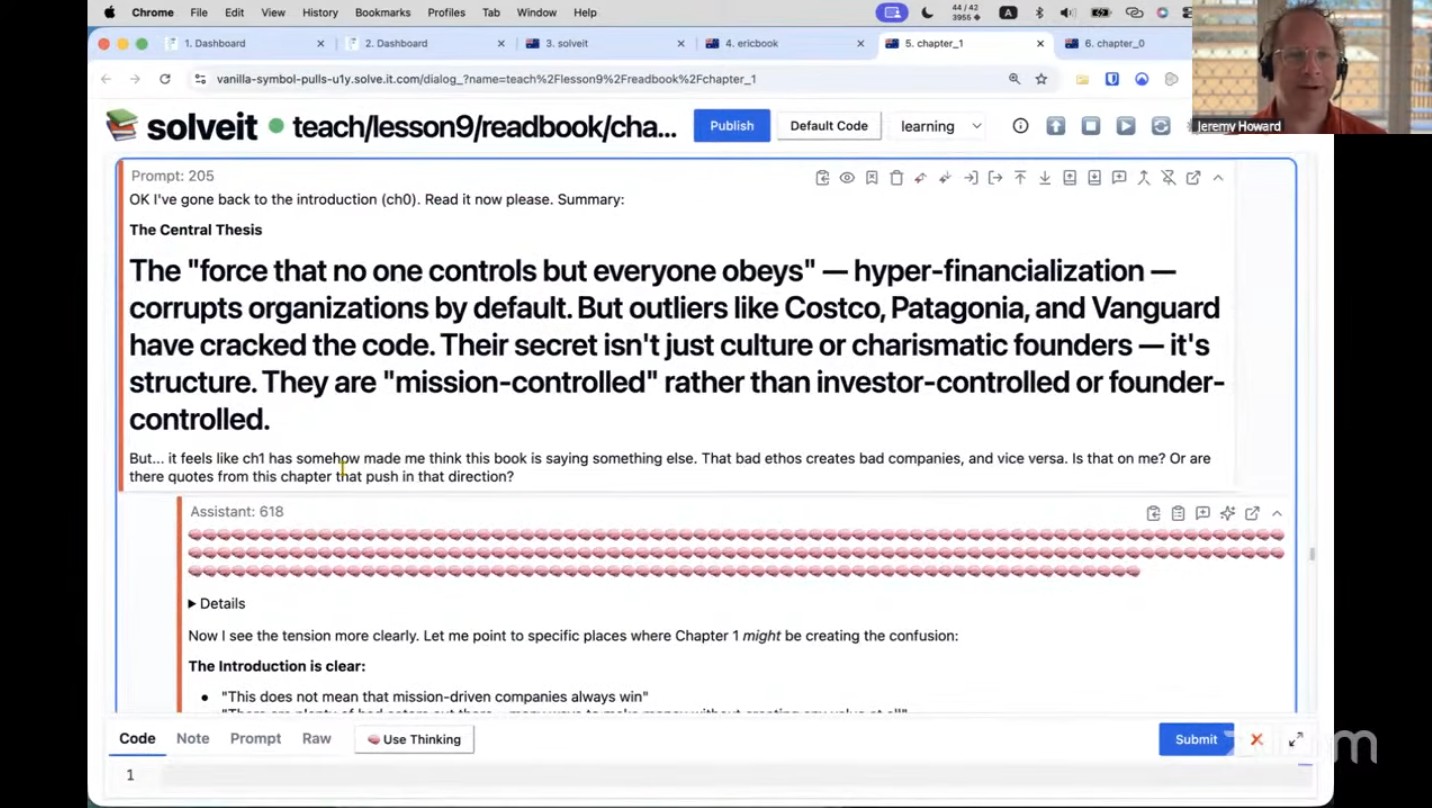
Experiments in reading with LLMs
Colombians are largely supportive of ESG initiatives, with a new study indicating that over 80% of the population believes it is essential for both the government and large corporations to transition toward renewable energy and make a real effort for a more sustainable system.
![Why Every Brain Metaphor in History Has Been Wrong [SPECIAL EDITION]](https://i1.ytimg.com/vi/pO0WZsN8Oiw/hqdefault.jpg)
What if everything we think we know about the brain is just a really good metaphor that we forgot was a metaphor? This episode takes you on a journey through the history of scientific simplification, from a young Karl Friston watching wood lice in his garden to the bold claims that your mind is literally software running on biological hardware. We bring together some of the most brilliant minds we've interviewed — Professor Mazviita Chirimuuta, Francois Chollet, Joscha Bach, Professor Luciano Floridi, Professor Noam Chomsky, Nobel laureate John Jumper, and more — to wrestle with a deceptively simple question: *When scientists simplify reality to study it, what gets captured and what gets lost?* *Key ideas explored:* *The Spherical Cow Problem* — Science requires simplification. We're limited creatures trying to understand systems far more complex than our working memory can hold. But when does a useful model become a dangerous illusion? *The Kaleidoscope Hypothesis* — Francois Chollet's beautiful idea that beneath all the apparent chaos of reality lies simple, repeating patterns — like bits of colored glass in a kaleidoscope creating infinite complexity. Is this profound truth or Platonic wishful thinking? *Is Software Really Spirit?* — Joscha Bach makes the provocative claim that software is literally spirit, not metaphorically. We push back hard on this, asking whether the "sameness" we see across different computers running the same program exists in nature or only in our…
We’re excited to announce that OpenMined has joined the Open Forum for AI (OFAI), an international initiative led by Carnegie Mellon University that’s bringing together academic institutions and nonprofit organizations to advance human-centered and ethical approaches to artificial intelligence. Launched at Carnegie Mellon University in 2024, OFAI was created to foster collaboration, transparency, and inclusion […] The post OpenMined Joins Open Forum for AI to Advance Responsible Data Governance appeared first on OpenMined .
User feedback led us to clean up outdated mitigations. See why observability and lifecycle management are critical for defense systems. The post When protections outlive their purpose: A lesson on managing defense systems at scale appeared first on The GitHub Blog .
The 2026 AI Impact Summit in India is the latest iteration of an event that has become a bellwether for global discourse around the AI industry, especially the question of whether, and how, it can be governed. But it also demonstrates how important ideas can be invoked in ways that dilute their meaning or co-opt their force. In this series—produced by AI Now Institute, Aapti Institute, and The Maybe—we bring together leading advocates, builders, and thinkers from around the world who live and breathe substance, analysis, and meaningful action into these ideas. The post Reframing Impact: AI Summit 2026 appeared first on AI Now Institute .
In a recent article published by the Communications of the ACM — the flagship publication of the Association for Computing Machinery — OpenMined’s Executive Director, Andrew Trask, was featured as a key voice in the growing conversation around synthetic data, AI training, and the critical importance of controlling how data shapes model behavior. The Growing […] The post OpenMined Featured in Communications of the ACM on the Future of Synthetic Data and AI Training appeared first on OpenMined .
“One newsroom response to the disruption of artificial intelligence in content generation is not technological but editorial. The Journalism and Technology Trends and Predictions 2026 report says that, in a world where generative systems can create and repackage information at scale, news outlets are redefining which content is worth producing. According to the report, prepared […] The post As artificial intelligence reshapes news, media double down on investigations and field reporting appeared first on LatAm Journalism Review by the Knight Center .
“One newsroom response to the disruption of artificial intelligence in content generation is not technological but editorial. The Journalism and Technology Trends and Predictions 2026 report says that, in a world where generative systems can create and repackage information at scale, news outlets are redefining which content is worth producing. According to the report, prepared […] The post As artificial intelligence reshapes news, media double down on investigations and field reporting appeared first on LatAm Journalism Review by the Knight Center .
Paul Rosolie is a naturalist, explorer, author of a new book titled Junglekeeper, and is someone who has dedicated his life to protecting the Amazon rainforest. Thank you for listening ❤ Check out our sponsors: https://lexfridman.com/sponsors/ep489-sc See below for timestamps, transcript, and to give feedback, submit questions, contact Lex, etc. Transcript: https://lexfridman.com/paul-rosolie-3-transcript CONTACT LEX: Feedback – give feedback to Lex: https://lexfridman.com/survey AMA – submit questions, videos or call-in: https://lexfridman.com/ama Hiring – join our team: https://lexfridman.com/hiring Other – other ways to get in touch: https://lexfridman.com/contact EPISODE LINKS: Junglekeeper (new book): https://amzn.to/4q7vpAp Paul’s Instagram: https://instagram.com/paulrosolie Junglekeepers Website: https://junglekeepers.org Paul’s Website: https://paulrosolie.com Mother
This is a transcript of Lex Fridman Podcast #489 with Paul Rosolie. The timestamps in the transcript are clickable links that take you directly to that point in the main video. Please note that the transcript is human generated, and may have errors. Here are some useful links: Go back to this episode’s main page Watch the full YouTube version of the podcast Table of Contents Here are the loose “chapters” in the conversation. Click link to jump approximately to that part in the transcript: 0:00 – Episode highlight 1:08 – Introduction 3:59 – Uncontacted tribes in the Amazon Jungle
Information comes in many shapes and forms. While retrieval-augmented generation (RAG) primarily focuses on plain text, it overlooks vast amounts of data along the way. Most enterprise knowledge resides in complex documents, slides, graphics, and other multimodal sources. Yet, extracting useful information from these formats using optical character recognition (OCR) or other parsing techniques is often low-fidelity, brittle, and expensive. Vision RAG makes complex documents—including their figures and tables—searchable by using multimodal embeddings, eliminating the need for complex and costly text extraction. This guide explores how Voyage AI’s latest model powers this capability and provides a step-by-step implementation walkthrough. Vision RAG: Building upon text RAG Vision RAG is an evolution of traditional RAG built on the same two components: retrieval and generation. In traditional RAG, unstructured text data is indexed for semantic search. At query time, the system retrieves relevant documents or chunks and appends them to the user’s prompt so the large language model (LLM) can produce more grounded, context-aware answers. Figure 1. Text RAG with Voyage AI and MongoDB. Text RAG with Voyage AI and MongoDB Enterprise data, however, is rarely just clean plain text. Critical information often lives in PDFs, slides, diagrams, dashboards, and other visual formats. Today, this is typically handled by parsing tools and OCR services. Those approaches create several problems:…
An encoder (optical system) maps objects to noiseless images, which noise corrupts into measurements. Our information estimator uses only these noisy measurements and a noise model to quantify how well measurements distinguish objects. Many imaging systems produce measurements that humans never see or cannot interpret directly. Your smartphone processes raw sensor data through algorithms before producing the final photo. MRI scanners collect frequency-space measurements that require reconstruction before doctors can view them. Self-driving cars process camera and LiDAR data directly with neural networks. What matters in these systems is not how measurements look, but how much useful information they contain. AI can extract this information even when it is encoded in ways that humans cannot interpret. And yet we rarely evaluate information content directly. Traditional metrics like resolution and signal-to-noise ratio assess individual aspects of quality separately, making it difficult to compare systems that trade off between these factors. The common alternative, training neural networks to reconstruct or classify images, conflates the quality of the imaging hardware with the quality of the algorithm. We developed a framework that enables direct evaluation and optimization of imaging systems based on their information content. In our NeurIPS 2025 paper , we show that this information metric predicts system performance across four imaging domains, and that optimizing it prod…
In this start-of-year FC episode, Chris and Daniel break down what really mattered in AI in 2025, and what to expect in 2026. They explore the rise of AI agents, the practical reality of multimodal AI, and how reasoning models are reshaping workflows. The conversation dives into infrastructure and energy constraints, the continued value of predictive models, and why orchestration (not just better models) is becoming the defining skill for AI teams. The episode wraps with grounded 2026 predictions on where AI systems, tooling, and builders are headed next. Featuring: Chris Benson – Website , LinkedIn , Bluesky , GitHub , X Daniel Whitenack – Website , GitHub , X Sponsor: Framer - The enterprise-grade website builder that lets your team ship faster. Get 30% off at framer.com/practicalai Upcoming Events: Register for upcoming webinars here !
Today, we're joined by Nikita Rudin, co-founder and CEO of Flexion Robotics to discuss the gap between current robotic capabilities and what’s required to deploy fully autonomous robots in the real world. Nikita explains how reinforcement learning and simulation have driven rapid progress in robot locomotion—and why locomotion is still far from “solved.” We dig into the sim2real gap, and how adding visual inputs introduces noise and significantly complicates sim-to-real transfer. We also explore the debate between end-to-end models and modular approaches, and why separating locomotion, planning, and semantics remains a pragmatic approach today. Nikita also introduces the concept of "real-to-sim", which uses real-world data to refine simulation parameters for higher fidelity training, discusses how reinforcement learning, imitation learning, and teleoperation data are combined to train robust policies for both quadruped and humanoid robots, and introduces Flexion's hierarchical approach that utilizes pre-trained Vision-Language Models (VLMs) for high-level task orchestration with Vision-Language-Action (VLA) models and low-level whole-body trackers. Finally, Nikita shares the behind-the-scenes in humanoid robot demos, his take on reinforcement learning in simulation versus the real world, the nuances of reward tuning, and offers practical advice for researchers and practitioners looking to get started in robotics today. The complete show notes for this episode can be found at…
With the right tools, AI can accomplish impressive things
Written by Rohan Varshney , with support from Devon Mittow & Janice Lee . This article expands upon a presentation from the Feature Store Summit 2025, which can be viewed in full here . There is also another video available on the evolution of Lyft’s Feature Store from DE4AI 2024. Introduction and Core Purpose Lyft’s Feature Store stands as a core infrastructural pillar within its Data Platform organization, designed to optimize the management and deployment of Machine Learning (ML) features at massive scale. Its primary objective is to centralize feature engineering efforts, guaranteeing uniformity across diverse models and workflows that perform important data-driven decision making across the entire rideshare stack. By streamlining the entire lifecycle — from feature creation and storage to low-latency access and high-throughput processing — it facilitates effective offline and online model training and inference. This post will provide a refreshed look ( since 5 years ago ) at the architectural evolution, practical applications, performance tuning, and significant improvements in developer experience we’ve performed over the past few years to improve efficiency, scalability, performance, and user accessibility. Ultimately, we aim to illustrate how the Feature Store empowers Lyft engineers to develop highly effective service components and ML models, a capability that is becoming vital for emerging AI and Large Language Model (LLM) applications. Defining Our Audience and…
As the international community accelerates its transition toward renewable energy and digital infrastructure, a significant paradox has emerged within the mining sector: More than a quarter of the total global output of copper remains inaccessible because of complications related to ESG, according to a study from GEM Mining Consulting.
Have you ever wanted to train a machine learning model on distributed private data without anyone sharing their raw data? In this tutorial, you’ll learn how to run a complete federated learning workflow directly from Google Colab—no local setup required. We’ll use the PIMA Indians Diabetes dataset split across two data owners to train a […] The post Zero-Setup Federated Learning: Train Models Across Private Datasets Using Only Google Colab appeared first on OpenMined .
![AutoGrad Changed Everything (Not Transformers) [Dr. Jeff Beck]](https://i2.ytimg.com/vi/9suqiofCiwM/hqdefault.jpg)
Dr. Jeff Beck, mathematician turned computational neuroscientist, joins us for a fascinating deep dive into why the future of AI might look less like ChatGPT and more like your own brain. **SPONSOR MESSAGES START** — Prolific - Quality data. From real people. For faster breakthroughs. https://www.prolific.com/?utm_source=mlst — **END** *What if the key to building truly intelligent machines isn't bigger models, but smarter ones?* In this conversation, Jeff makes a compelling case that we've been building AI backwards. While the tech industry races to scale up transformers and language models, Jeff argues we're missing something fundamental: the brain doesn't work like a giant prediction engine. It works like a scientist, constantly testing hypotheses about a world made of *objects* that interact through *forces* — not pixels and tokens. *The Bayesian Brain* — Jeff explains how your brain is essentially running the scientific method on autopilot. When you combine what you see with what you hear, you're doing optimal Bayesian inference without even knowing it. This isn't just philosophy — it's backed by decades of behavioral experiments showing humans are surprisingly efficient at handling uncertainty. *AutoGrad Changed Everything* — Forget transformers for a moment. Jeff argues the real hero of the AI boom was automatic differentiation, which turned AI from a math problem into an engineering problem. But in the process, we lost sight of what actually makes intelligence work.…
A 2025 review of large language models, from DeepSeek R1 and RLVR to inference-time scaling, benchmarks, architectures, and predictions for 2026.
In June, I shared a bonus article with my curated and bookmarked research paper lists to the paid subscribers who make this Substack possible.
![Your Brain Doesn't Command Your Body. It Predicts It. [Max Bennett]](https://i3.ytimg.com/vi/RvYSsi6rd4g/hqdefault.jpg)
Tim sits down with Max Bennett to explore how our brains evolved over 600 million years—and what that means for understanding both human intelligence and AI. Max isn't a neuroscientist by training. He's a tech entrepreneur who got curious, started reading, and ended up weaving together three fields that rarely talk to each other: comparative psychology (what different animals can actually do), evolutionary neuroscience (how brains changed over time), and AI (what actually works in practice). *Your Brain Is a Guessing Machine* You don't actually "see" the world. Your brain builds a simulation of what it *thinks* is out there and just uses your eyes to check if it's right. That's why optical illusions work—your brain is filling in a triangle that isn't there, or can't decide if it's looking at a duck or a rabbit. *Rats Have Regrets* In a fascinating experiment called "Restaurant Row," rats make choices about waiting for food. When they skip a short wait for something they like and end up stuck with a long wait for something they don't—you can literally watch their brain imagine eating the food they passed up. They regret their choice and make different decisions next time. *Chimps Are Machiavellian* The most gripping story is about two chimps, Rock and Belle. Belle learns where food is hidden. Rock figures out he can just follow her and steal it. So Belle starts hiding the food when she finds it. Then Rock starts *pretending* not to watch her, then sprinting to grab the food o…
Global IT services company Atos has divested its South American business to Brazilian company Semantix, marking its exit from the regional market. The deal sees around 2,800 employees in Brazil, Argentina, Chile, Colombia, Uruguay and Peru transfer to Semantix, which now becomes one of the largest players in South America in the field of digital transformation and IT services.

Letsgooo

https://ykilcher.com/discord Links: TabNine Code Completion (Referral): http://bit.ly/tabnine-yannick YouTube: https://www.youtube.com/c/yannickilcher Twitter: https://twitter.com/ykilcher Discord: https://discord.gg/4H8xxDF BitChute: https://www.bitchute.com/channel/yannic-kilcher Minds: https://www.minds.com/ykilcher Parler: https://parler.com/profile/YannicKilcher LinkedIn: https://www.linkedin.com/in/yannic-kilcher-488534136/ BiliBili: https://space.bilibili.com/1824646584 If you want to support me, the best thing to do is to share out the content :) If you want to support me financially (completely optional and voluntary, but a lot of people have asked for this): SubscribeStar: https://www.subscribestar.com/yannickilcher Patreon: https://www.patreon.com/yannickilcher Bitcoin (BTC): bc1q49lsw3q325tr58ygf8sudx2dqfguclvngvy2cq Ethereum (ETH): 0x7ad3513E3B8f66799f507Aa7874b1B0eBC7F85e2 Litecoin (LTC): LQW2TRyKYetVC8WjFkhpPhtpbDM4Vw7r9m Monero (XMR): 4ACL8AGrEo5hAir8A9CeVrW8pEauWvnp1WnSDZxW7tziCDLhZAGsgzhRQABDnFy8yuM9fWJDviJPHKRjV4FWt19CJZN9D4n
![Why Scientists Can't Rebuild a Polaroid Camera [César Hidalgo]](https://i3.ytimg.com/vi/vzpFOJRteeI/hqdefault.jpg)
César Hidalgo has spent years trying to answer a deceptively simple question: What is knowledge, and why is it so hard to move around? We all have this intuition that knowledge is just... information. Write it down in a book, upload it to GitHub, train an AI on it—done. But César argues that's completely wrong. Knowledge isn't a thing you can copy and paste. It's more like a living organism that needs the right environment, the right people, and constant exercise to survive. Guest: César Hidalgo, Director of the Center for Collective Learning The Big Ideas 1. Knowledge Follows Laws (Like Physics) Just as temperature and gravity follow predictable rules, so does knowledge. César outlines three laws: - Time: How knowledge grows (fast at first, then it plateaus) - Space: How knowledge spreads (it's way harder than you think) - Value: How we can measure a country's "knowledge potential" 2. You Can't Download Expertise The most memorable stories in this conversation prove that knowledge is embodied—it lives in people, teams, and organizations, not in manuals. 3. Why Big Companies Fail to Adapt César explains "architectural innovation"—the idea that small changes (like shipping books directly to customers) can require a completely different organizational structure. 4. The "Infinite Alphabet" of Economies Every skill, every industry, every capability is like a letter in an alphabet. César's research shows you can actually predict which countries will grow by counting their "letter…

Paper: https://arxiv.org/abs/2511.08923 Abstract: Diffusion language models hold the promise of fast parallel generation, while autoregressive (AR) models typically excel in quality due to their causal structure aligning naturally with language modeling. This raises a fundamental question: can we achieve a synergy with high throughput, higher GPU utilization, and AR level quality? Existing methods fail to effectively balance these two aspects, either prioritizing AR using a weaker model for sequential drafting (speculative decoding), leading to lower drafting efficiency, or using some form of left-to-right (AR-like) decoding logic for diffusion, which still suffers from quality degradation and forfeits its potential parallelizability. We introduce TiDAR, a sequence-level hybrid architecture that drafts tokens (Thinking) in Diffusion and samples final outputs (Talking) AutoRegressively - all within a single forward pass using specially designed structured attention masks. This design exploits the free GPU compute density, achieving a strong balance between drafting and verification capacity. Moreover, TiDAR is designed to be serving-friendly (low overhead) as a standalone model. We extensively evaluate TiDAR against AR models, speculative decoding, and diffusion variants across generative and likelihood tasks at 1.5B and 8B scales. Thanks to the parallel drafting and sampling as well as exact KV cache support, TiDAR outperforms speculative decoding in measured throughput and…
![PhD Bodybuilder Predicts The Future of AI (97% Certain) [Dr. Mike Israetel]](https://i1.ytimg.com/vi/4yYcN_mFi18/hqdefault.jpg)
This is a lively, no-holds-barred debate about whether AI can truly be intelligent, conscious, or understand anything at all — and what happens when (or if) machines become smarter than us. Dr. Mike Israetel is a sports scientist, entrepreneur, and co-founder of RP Strength (a fitness company). He describes himself as a "dilettante" in AI but brings a fascinating outsider's perspective. Jared Feather (IFBB Pro bodybuilder and exercise physiologist) The Big Questions: 1. When is superintelligence coming? 2. Does AI actually understand anything? 3. The Simulation Debate (The Spiciest Part) Tim says a simulation of fire doesn't get hot. They go back and forth on whether you could upload your mind to a computer — Mike says yes, Tim says absolutely not. 4. Will AI kill us all? (The Doomer Debate) Mike thinks the "AI will exterminate humanity" crowd has it backwards. His argument: any system smart enough to wage war is smart enough to realize cooperation is the winning strategy. Super-intelligent AI would want to *study* us, not destroy us. He uses the raccoon analogy to explain what agency really means. 5. What happens to human jobs and purpose? 6. Do we need suffering? In a surprisingly emotional moment, Tim asks if suffering gives life meaning. Mike's answer? "Fuck no. Desperately" Mikes channel: https://www.youtube.com/channel/UCfQgsKhHjSyRLOp9mnffqVg RESCRIPT INTERACTIVE PLAYER: https://app.rescript.info/public/share/GVMUXHCqctPkXH8WcYtufFG7FQcdJew_RL_MLgMKU1U --- TIMESTAMPS:…

People are using AI for mental health advice and life decisions, but there's no oversight and no safety ratings. We grade models on speed and smarts... but not on whether they're safe to use. Why isn't that just as important? Featuring Andrew Gordon and Nora Petrova from Prolific, discussing AI evaluation, benchmarks, and why human preference matters. 🎙️ Full episode: https://youtu.be/rqiC9a2z8Io #AIShorts #AISafety #MachineLearning
It’s nearly the end of the year—again! That means it’s time for an end-of-year blog post that expresses disbelief at the passage of time. Which, as the saying goes, flies when you’re having fun. And definitely when you’re as busy as MongoDB was in 2025. It was a big year for the company—and more importantly, for the tens of thousands of customers and millions of developers who rely on MongoDB’s modern data platform for their most mission-critical workloads. At MongoDB, everything we do starts with our obsession with customers and their needs, and if there’s a theme to MongoDB’s 2025, it was (and will continue to be) enabling customer innovation and helping them succeed in the AI era. So here are a few highlights of how MongoDB acted on behalf of customers in 2025. From the acquisition of Voyage AI to customer success across industries, a lot happened in 2025. Let’s go!* *Read to the end for 2026 thoughts. 2025: The (MongoDB) year that was Voyage AI, modernization, and search In February, MongoDB announced the acquisition of Voyage AI, a pioneer in embedding and reranking models, to enhance the accuracy of AI applications. Integrating Voyage AI's advanced retrieval technology with MongoDB’s modern, AI-ready data platform addresses a critical challenge: LLM model hallucinations caused by a lack of context. By improving retrieval accuracy for specialized domains like finance and law, the integration enables businesses to deploy AI for mission-critical use cases. To learn more,…
And why Nano Banana Pro is such a big deal