
Uncertainty persists over Trump’s next move on Iran
The president, who acknowledged the war contributed to his party’s midterm rout, has kept his options open.
AI/ML news, top picks, and generated innovation digests.
90596 matching items
The president, who acknowledged the war contributed to his party’s midterm rout, has kept his options open.
Serve Robotics announced alonsgside its third-quarter earnings that it will launch a new business line called Physical AI Services to offer customers its connectivity and data tools.
Block employees laid off this week are getting 90 days of pay without working, plus severance and three months of healthcare coverage.
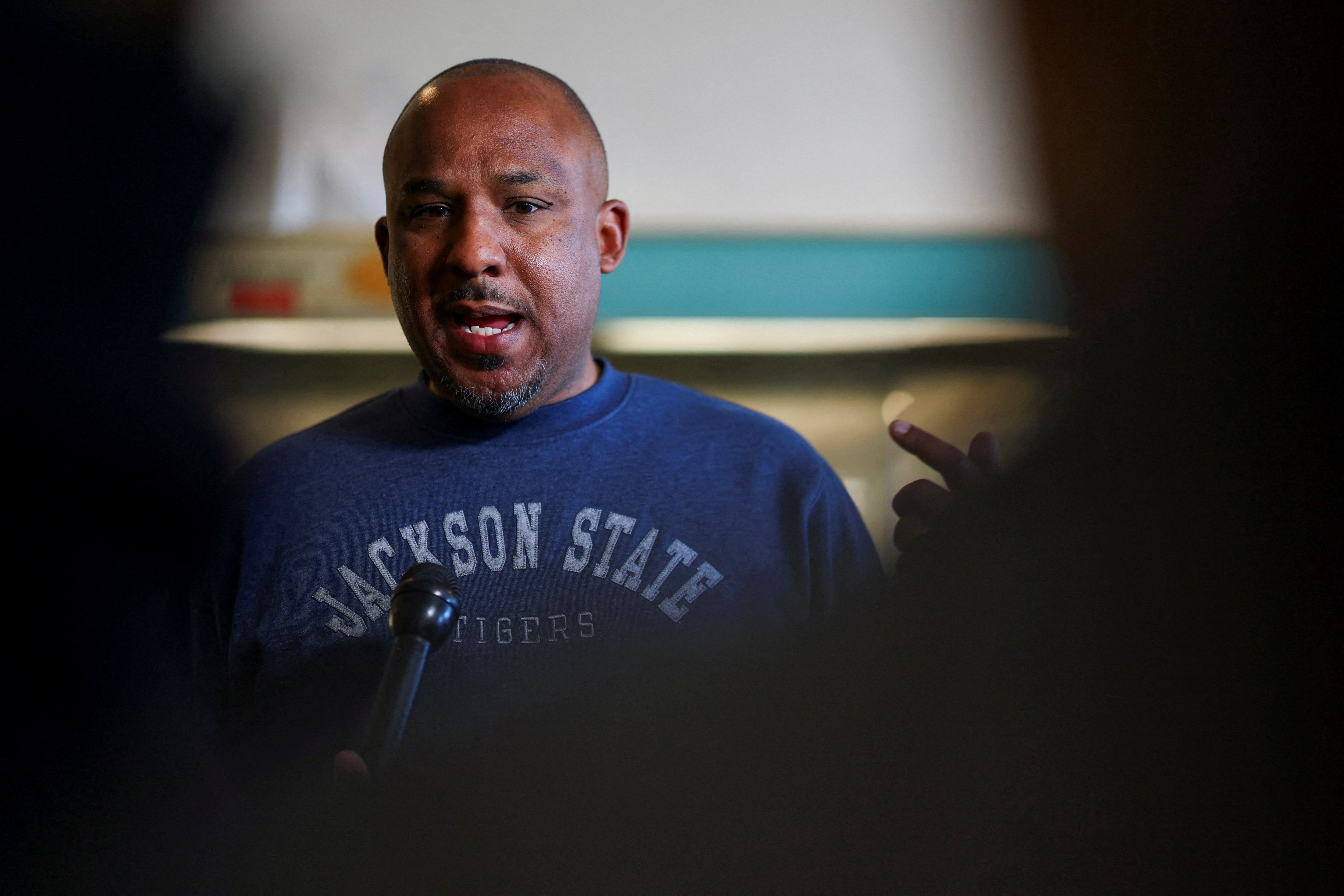
The Democratic Senatorial Campaign Committee and Elias Law Group are on the ground in Mississippi.
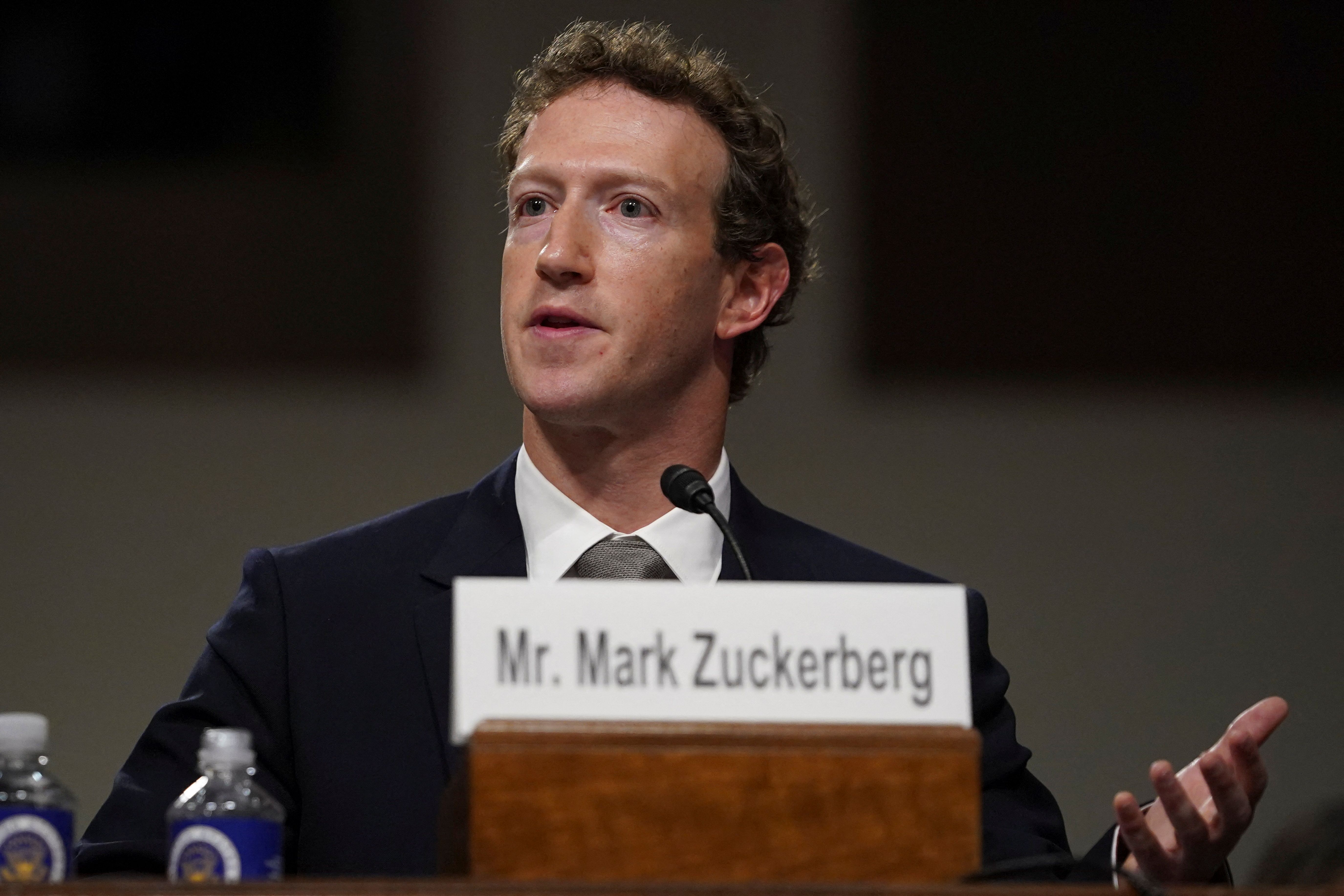
The party is finalizing its plans to scrutinize corruption and tackle affordability in the next Congress.
It is interesting how little blackmail I see, that I know is blackmail. A lot of people probably do some things they would be embarrassed by if they were made public at some degree of detail and explicitness, and it probably isn’t that hard to get evidence of these, and quite a few people seem to be amoral . Also, in order to properly embarrass someone, I imagine you would make your information relatively public, so that for instance I—Katja—should hear about some fraction of cases. Yet I very rarely receive information I know to be public for the purpose of embarrassing someone. I’m not sure I remember it ever happening. Why not? If I imagine being morally inclined toward blackmailing someone, one salient reason to avoid it is that my wrongdoing is extremely obvious and in-the-face of the recipient, so they seem likely to react destructively, for instance by telling everyone that I’m a dirty blackmailer. It’s like stealing from right in front of someone’s face. Another possibility is that there is a lot of blackmail, but it mostly remains private because the blackmailers mostly get the price right to have their threats heeded. This is an interesting theory, because it suggests blackmail is much more common than we observe, so people may be greatly underestimating the chance of it happening to them. One place I have heard about blackmail occurring is from AI systems. Which is interesting, if it isn’t a thing humans seem to be doing much. What to make of that? Discuss

오픈AI가 기존 모델보다 보안 취약점에 대한 공격 성공률을 51% 높인 사이버 보안 특화 AI 모델 \'GPT-6 사이버(GPT-6 Cyber)\'를 출시했다. 리눅스 운영체제에서 실제 작동하는 공격 코드 948건을 개발하고 파이어폭스에서 새로운 고위험 취약점 81건을 발견하는 등 보안 점검 능력을 강화했으며, 주요 보안 기업과 협력해 기업 시장 공략에도 나섰다.오픈AI는 5일(현지시간) 공식 블로그를 통해 GPT-6 사이버를 공개하고, 승인된 일부 보안 전문가와 기업을 대상으로 API와 \'코덱스\'를 통한 서비스를 시작했다고 발표했다.
Web Answer on Amazon Bedrock AgentCore returns a synthesized, source-cited answer to a natural-language question in a single tool call, with no search, retrieve, synthesize, and citation pipeline to build. Learn how it works and how to add it to an AgentCore Gateway and call it from an agent.
Snowflake CoCo brings governed AI to Microsoft Excel and Google Sheets, with live Snowflake data, agentic workbook building and role-based security.

Blue Origin plans to do its next New Glenn rocket launch in January 2027, according to CNBC and the Financial Times, which cite a memo from CEO Dave Limp sent to staff. The new timeline follows a May launchpad explosion that damaged Blue Origin's New Glenn launchpad ahead of a flight that would have brought […]
Third-party safety researchers released a report about Anthropic's AI development on Thursday.

With GPT-6 Cyber, OpenAI is introducing an AI model built to find security vulnerabilities in software, develop exploits, and suggest patches. According to OpenAI, it has already found 81 previously unknown vulnerabilities in Firefox and developed 948 working exploits in the Linux kernel, significantly more than its predecessor. The article OpenAIs GPT-6 Cyber can both break into systems and propose how to fix them appeared first on The Decoder .
GitHub's new Git storage architecture is built so thousands of agents can push to a single repository at once. Here's how it works. The post Inside GitHub’s new Git storage architecture appeared first on The GitHub Blog .
Cloud infrastructure is managed through a mix of interfaces—traditionally, cloud consoles, command-line interfaces (CLI), and SDKs are the tools of choice. Recently, Infrastructure-as-Code/IaC frameworks (e.g., Terraform) have quickly gained popularity. Unlike conventional tools, IaC frameworks encode the infrastructure in a “source-of-truth” configuration. They are capable of automatically carrying out modifications to the cloud—deploying, updating, or destroying resources—to bring the actual infrastructure into alignment with the IaC configuration. When IaC frameworks are used together with consoles, CLI, or SDKs, IaC is unaware of changes through these non-IaC interfaces, and the IaC configuration no longer captures the intended state. This is called infrastructure drift. IaC frameworks will revert non-IaC changes based on the outdated IaC configuration, leading to misconfigurations or failures. We propose NSync, an automated system for IaC reconciliation, which aims to propagate out-of-band changes back to the IaC program in the form of an update. Our key insight is that infrastructure changes via IaC, consoles, CLI, or SDK eventually all occur via cloud API invocations—the lowest layer for cloud management operations. Hence, NSync gleans insights from API traces to detect drift (i.e., non-IaC changes) and reconcile it (i.e., update the IaC configuration to capture the changes). This is a challenging task—identifying the intended change from low-level, noisy API traces i…
Automate SOP verification with Roboflow: train an action recognition model on your existing cameras to catch missed steps on every unit.
Here is a ranking of all 57 DC Comics movies, from recent films like "Clayface" to critical flops such as "Catwoman."

Ampersand's multi-agent 'Co-Coding' mode hits 92.2% on SWE-bench Pro HARD-51 without any coding-specific training, matching frontier models at 70% lower cost.

AI agents do more than generate answers. They search for information, query databases, write and test code and take action. Each of those steps relies on a CPU, with agents moving between GPU reasoning and CPU execution throughout a task. As businesses put more agents to work, AI factories need CPUs that can execute those […]

Get a head start on holiday shopping with discounts on WIRED-tested headphones, laptops, and TVs.


More than 80 percent of congressional candidates backed by the pro-science PAC 314 Action won, including Michigan senator-elect and epidemiologist Abdul El-Sayed.
Graduation rates across US states measure the share of students who graduate high school in 4 years. See how the rates vary from state to state.
Meta's AI agent can now take calls as a customizable animated avatar, ahead of the launch of a Tamagotchi-like wearable designed to bring Muse to life.

Nasdaq drops 5% as a chip selloff bleeds into other sectors of the economy.



World Labs just put Atlas, their autoregressive world model, into a browser demo that streams generated frames from cloud GPUs at up to 15 fps.
Imagine a salesperson getting ready for a customer renewal meeting. They need to find the original contract and review its terms. But the information is buried in CRM records and attachments, forcing them to search through multiple documents. Now imagine they could simply type in their question and get the contract details in seconds. Contracts contain valuable business information, including pricing, payment terms, and past negotiations. AI for contract management helps teams find and use that information — and connects it to the work that follows, from reviewing terms to getting approvals and preparing for renewals. Foundry’s 2026 State of the CIO research reports that 79% of CIOs are working more closely with business leaders on AI applications. Contracting is a practical place to put that collaboration to work: sales, legal, procurement, and HR all depend on contracts to move business forward. Docusign is using AI-powered contract management across its own business through its Docusign Intelligent Agreement Management (IAM), its AI contracting platform. The goal is to connect contract information with everyday workflows while keeping people involved in decisions that require judgment. “AI contract management helps our teams turn what’s inside contracts into action,” said Shanthi Iyer, CIO of Docusign. “Using our own IAM platform, we’re automating routine workflows so people can focus their expertise where it matters most — and stay in control of the decisions. That means…
Helen Sharp, 40, was on board the private jet that crashed in Florida on Sunday. She had a career in PR and started her own ceramics studio.
Apple now says it will use a waitlist only during periods of "high demand" for Siri AI.

Android fans with a bit of iPhone Duo envy, take note: The Samsung Galaxy Z Fold 8 is discounted to $1,599.99 at both Amazon and Best Buy, a hefty $300 markdown from its usual price, and just $50 higher than the lowest we’ve seen. Considering the device only launched a few months ago, you’re saving […]

Meta warns that growing political opposition to data centers could threaten future AI investments, as communities push back against massive infrastructure projects.
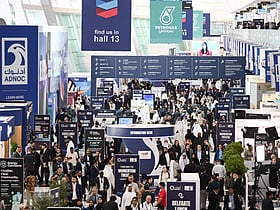
ADIPEC 2026 concludes with record US$67 billion in energy agreements
Nicole Bernard Dawes watched her father build Cape Cod Potato Chips as a child. She went on to start Late July snacks and then sugar-free soda Nixie.
Executive summary From August 12 to October 29, 2026, METR staff performed a high-access evaluation at Anthropic to assess the degree to which AI is accelerating AI R&D. If AI systems started to significantly accelerate further AI development, this could lead to a sudden emergence of extreme and risky capabilities . Anthropic offered unprecedented access to internal data on their AI R&D process, including a variety of metrics on pretraining, reinforcement learning (RL), training compute in each domain, benchmark scores for internal models, AI speedup analyses, forecasts of a future model’s metrics, and interviews with relevant staff. In our first section, we share our subjective conclusions about risk . We now believe that: As of October 2026, Anthropic is likely improving the capabilities of their models on well-specified tasks at around twice the rate they did between March 2024 and October 2025. This estimate is given with high uncertainty; we would not be surprised if the true acceleration was closer to 1.3x or 3x the historical rate. A majority of this acceleration today is likely attributable to Anthropic’s extensive use of AI to do R&D, though there is significant uncertainty and other causes likely played a large role in acceleration in late 2025. The lack of observed bottlenecks or strong diminishing returns means there is a significant risk that further capabilities progress could lead to even faster acceleration, though, as we say below, we may be missing importan…
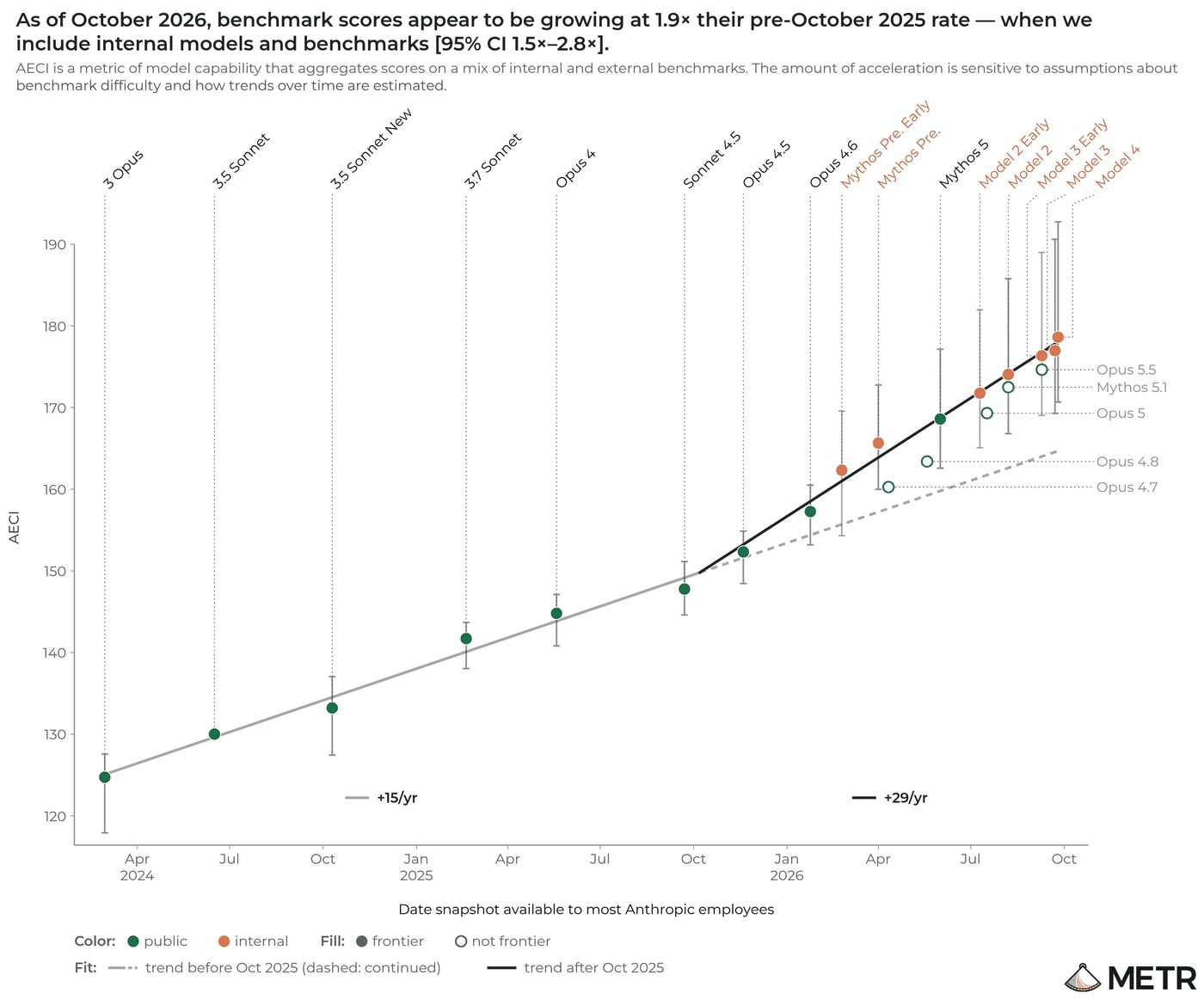
Executive summary From August 12 to October 29, 2026, METR staff performed a high-access evaluation at Anthropic to assess the degree to which AI is accelerating AI R&D. If AI systems started to significantly accelerate further AI development, this could lead to a sudden emergence of extreme and risky capabilities . Anthropic offered unprecedented access to internal data on their AI R&D process, including a variety of metrics on pretraining, reinforcement learning (RL), training compute in each domain, benchmark scores for internal models, AI speedup analyses, forecasts of a future model’s metrics, and interviews with relevant staff. In our first section, we share our subjective conclusions about risk . We now believe that: As of October 2026, Anthropic is likely improving the capabilities of their models on well-specified tasks at around twice the rate they did between March 2024 and October 2025. This estimate is given with high uncertainty; we would not be surprised if the true acceleration was closer to 1.3x or 3x the historical rate. A majority of this acceleration today is likely attributable to Anthropic’s extensive use of AI to do R&D, though there is significant uncertainty and other causes likely played a large role in acceleration in late 2025. The lack of observed bottlenecks or strong diminishing returns means there is a significant risk that further capabilities progress could lead to even faster acceleration, though, as we say below, we may be missing importan…

OpenAI's newest cybersecurity model comes out as AI labs face scrutiny of their work to protect digital infrastructure.

Google Deepmind is making Gemini Omni 1.2 Flash generally available. The video-generation model now creates clips up to 15 seconds long, can be edited step by step via conversation, and costs just $0.07 per second at 720p, 30 percent less than its predecessor. Users who draft in low resolution and upscale only the final result can save even more. The article Google's Gemini Omni 1.2 Flash stretches AI video clips to 15 seconds and cuts pricing by 30 percent appeared first on The Decoder .
US senators attended schools from Harvard and Yale to BYU. See the 10 universities most represented in the incoming 120th Congress.

Fox News was the most-watched cable network in total viewers during primetime, while CNN was No.1 in the demo.

Meta now lets you have voice conversations with your Muse AI agent in real time, CEO Mark Zuckerberg announced today. The feature has been rolled out to me, and I gave it a spin on the iOS app while writing this article. As you chat with your Muse agent, the avatar at the top of […]

Now in their third year, the IEEE TryEngineering educator sessions continue to empower preuniversity teachers with specialized professional development programs on engineering topics and classroom-tested lessons. This year’s sessions have focused on educating teachers about artificial intelligence and semiconductor technology. Three sessions were held in the United States and one session was held in Egypt. In all, 54 educators learned about the engineering design process this year. They received an overview of TryEngineering resources including the Making of a Microchip and Train Your Tree lesson plans. Workshops are scheduled later this year in Greece and Guatemala. The TryEngineering program is administered by IEEE Educational Activities . These teachers and guest speakers attended the two-day session held at the Florida Semiconductor Institute and SkyWater Technology chip manufacturing facility. IEEE Educational Activities A network of host universities Central to the educator session program’s success is its university network. Host campuses welcome teachers into their facilities, where faculty provide background information about some of the technologies being taught, as well as possible engineering career paths and job opportunities for students. This year’s sessions involved the educators in hands-on projects. Facilitators at each location were selected based on their experience in engineering education, and they worked with the TryEngineering staff on their presentat…
AWS on Thursday launched Kiro bots, generally available within Kiro Crew, its open-source multi-agent development environment, to help developers coordinate parallel coding tasks, maintain context across sessions, and automate recurring software development workflows. Kiro bots are designed to take responsibility for specific parts of a developer’s workflow rather than execute isolated tasks within individual agent sessions, in turn addressing the growing coordination burden developers face as they increasingly rely on multiple AI agents to handle software development tasks in parallel, AWS said in a statement. Setting up bots and how do they work Developers can create a bot by opening the Customize section in Kiro Crew and selecting the “Add a bot” option, where they can choose either a default agent or an existing custom agent as its foundation. Each bot can be assigned a specific responsibility, such as issue triage, build monitoring, or release readiness, and customized with its own name, avatar, instructions, tools, and permissions based on the tasks it is expected to handle, the hyperscaler said. Developers can use each bot to launch multiple worker-agent sessions in parallel and have it monitor their progress, redirect those that deviate from the plan, and consolidate their results. If a task requires their input or a decision, the bot can seek their approval while continuing with other tasks that do not depend on it, it added. To maintain continuity across sessions,…

Psychoactive compounds have been found in a hair from a Scythian tomb in Siberia, providing the earliest direct evidence of cannabis being used as a drug

The global health and economic benefits of the covid-19 vaccines were thought to have reached up to $38 trillion in their first year, but a new analysis suggests $64.3 trillion is a more accurate figure

The British leader will arrive at the COP climate summit wrestling with the political risks of doing too little — or too much — to go green.
Senator Bernie Sanders has proposed directly banning development of ASI . Given the current scientific understanding of AI alignment, it is highly sensible to ban ASI and then consider revoking this ban if future scientific breakthroughs (e.g., “solving interp”) make it possible to safely develop ASI, or if there is truly no way to coordinate on everyone avoiding developing ASI. Some people have proposed banning ASI indirectly instead. For instance, one could mandate: Developing AI with superhuman capabilities is not permitted unless you can demonstrate that the AI systems you are developing won’t X, where X is some action that, in the short term, AI companies would find extremely costly or impossible to prevent their AI from taking. Candidate notions of X include: kill people if given the opportunity, break out of sandboxes, escalate privileges, obtain unintended internet access, engage in unsanctioned coordination, start rogue deployments, commit cyber crime. In the longer term, one could instead consider conditions like overthrow the USG or violently disempower humanity. In this note, I’ll discuss the costs and benefits of banning ASI indirectly rather than directly. Indirectly banning ASI is maybe slightly rhetorically better than directly banning ASI The main putative benefit of indirectly banning ASI is that it sounds very principled to mandate, for instance, that you’re confident your AI won’t kill people. Directly banning ASI sounds anti-tech, and might therefore be…