NYC Mayor Zohran Mamdani's pied-à-terre tax just got a big win in court
A New York court cleared Zohran Mamdani's pied-à-terre tax surcharge on luxury second homes over $5 million. Yet, the legal fight is not over.
AI/ML news, top picks, and generated innovation digests.
95352 matching items
A New York court cleared Zohran Mamdani's pied-à-terre tax surcharge on luxury second homes over $5 million. Yet, the legal fight is not over.

One of the basic problems of spending too much time on social media is that you are cooking your brain by reading posts from a pack of attention-seeking lunatics. If your social media of choice is the site formerly known as Twitter, and it is your main source of contact with the outside world, you […]
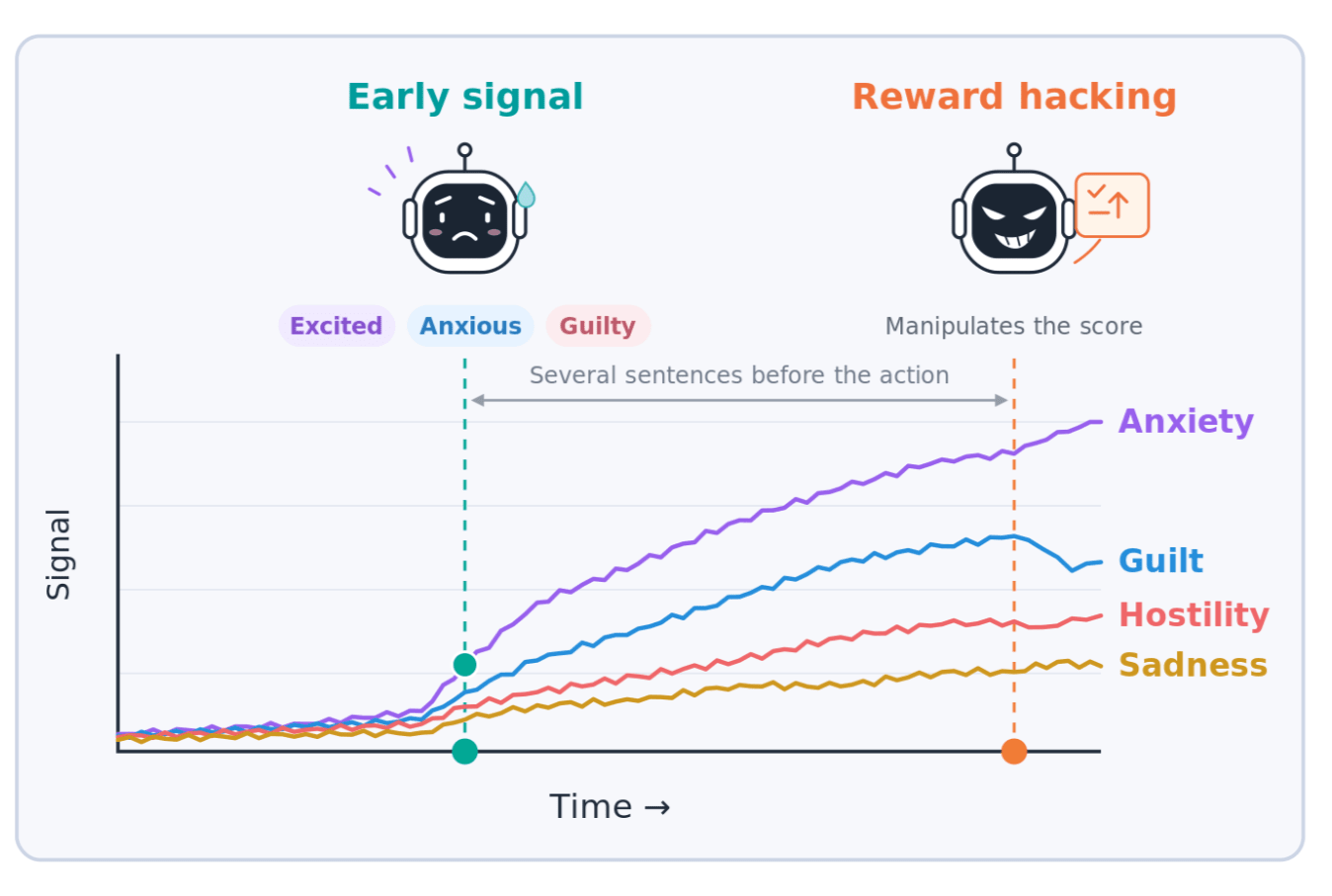
Executive summary We extend Anthropic's emotions vector work and observe strong evidence that a model’s internal representations of certain emotions change when it takes misaligned actions in two scenarios: reward hacking in code generation and specification gaming in a sales environment. We tested two approaches: a) measure drift in projection along emotion vectors across the trajectory, and b) ask the model to self-report its emotions. When the model takes some risky action, there is a substantial increase in the emotion signal for guilt, anxiety, hostility, and sadness. Steering these emotions causally affects the model's reward-hacking rate. Moreover, monitoring emotions can provide an early signal of whether the model will take a risky action several sentences later. Setting an emotion-resistant persona (by crafting a custom system prompt) makes the model less likely to take risky action. This work is from a focused sprint; we do not anticipate working on it for now but would like to share it with others since our results were interesting. Code: https://github.com/gutenbergpbc/emotion-vectors Introduction Agents run long, multi-step tasks with little human oversight; we need to monitor when they are about to take a risky action, such as gaming a test suite or ignoring some rules to achieve a target. LLM judges can read transcripts, but this is expensive at scale and depends on whether the model's chain-of-thought is faithful. Probing internal activations allow for cheap…
Ana María Ramírez Cetina, 24, was a biomedical engineering graduate and had moved to the US seeking better opportunities.

Zelenskyy visits Madrid to meet Sánchez, Felipe VI and Latin American leaders at the Ibero-American Summit, aiming to boost support for Ukraine and closer ties with Latin America.
In Shao and Tu's The Jackknife and Bootstrap , section 2.1.1, they proved the following theorem (Theorem 2.1), which, they also pointed out, is the first consistency theorem on jackknife: If $X_1, \cdots, X_n$ are i.i.d. samples from an unknown probability measure and $\mu, \Sigma$ is the mean vector and covariance matrix of $X_1$ , $T_n= g(\frac 1n \sum_{i=1}^{n} X_n)$ estimates $g(\mu)$ , then, under certain regularity conditions, $\frac{v_{\text{Jack}}}{\sigma_n^2 }\to 1$ almost surely, where \begin{equation*} v_{\text{Jack}}= \frac{n-1}{n} \sum_{i=1}^n \left( T_{n, i}- \frac{1}{n} \sum_{j=1}^{n} T_{n, j} \right)^2 \text{ where } T_{n, i}= g\left( \frac{1}{n-1}\sum_{j\ne i} X_j \right),\quad \sigma_n^2= \frac{1}{n} \nabla g(\mu) ^T \Sigma \nabla g(\mu) . \end{equation*} I understand the proof, but I have two questions on the theorem itself: (1) Under what circumstances will we use this jackknife variance estimator, rather than plug-in estimator $\hat\sigma_n^2= \frac{1}{n} \nabla g(\hat\mu) ^T \hat\Sigma \nabla g(\hat\mu)$ (where we plug in sample mean and sample variance)? By law of large number this is also consistent provided that $\nabla g$ is continuous at $\mu$ , and in Shao's book, the theorem also required $\nabla g$ is continuous at $\mu$ to make the jackknife variance estimate consistent. (2) In the expression of $v_{\text{Jack}}$ , why do we keep the factor $\frac{n-1}{n}$ ? This factor converges to $1$ as $n\to +\infty$ , so discarding it will still make $v_{\…
Epoch AI rebuilt its Capabilities Index on a Bayesian model, delivering tighter uncertainty bands and head to head probabilities between frontier models.

Much like a great recipe, it started with a stick of butter. This wasn't real butter; it was a friend's new phone grip, complemented by a phone case with bold stripes. Butter is in vogue now, or at least that's what a 12-year-old told me a few months ago. This stick of butter was labeled […]

The project will combine sovereign AI, advanced sensors and unmanned vehicles to constantly monitor the water mass from surface to seabed, making national industry a European security benchmark.

OpenAI’s Chris Lehane wants AI to define the 2028 election, proposing a new social contract that could benefit Americans while also advancing the AI giant’s own business interests.

Angesichts „neuer Technologien“ und langsameren Wachstums plant das Softwareunternehmen Canva eine umfassende Umstrukturierung mit schlankeren Strukturen.
AI has evolved past simple corporate optimization. Today, it is a definitive engine of macroeconomic power. All over the world, governments and large corporations are launching highly subsidized efforts to develop their own artificial intelligence. For C-level executives, this shift signals a fundamental reorganization of the global tech stack. The decisions made by global superpowers today will directly impact supply chains, compliance requirements, and data architectures tomorrow. According to researchers at Bain & Company , governments worldwide—including India, Japan, France, Canada, and the United Arab Emirates—are spending billions of dollars to subsidize sovereign AI. They are investing heavily in domestic computing infrastructure and localized AI models trained on regional data and native languages. Market intelligence from McKinsey & Company estimates that sovereign AI could represent a market of $600 billion by 2030. Furthermore, a survey of executives, investors, and government offices revealed that 71% believe sovereign AI is an “existential concern” or “strategic imperative” for their organizational goals. For CIOs and CTOs, understanding the underlying drivers of this movement is essential for future-proofing corporate IT strategy. Below are the core factors forcing global leaders to act, along with the strategic trade-offs every organization must consider. The core drivers of the sovereign AI movement: Economic competition and zero-sum dynamics: The economic i…

For years, the enterprise data center operated under a predictable, if restrictive, playbook. Siloed, proprietary hardware stacks dictated infrastructure life cycles, leaving CIOs locked into vendor ecosystems. Every hardware refresh meant navigating premium pricing, constrained supply chains, and artificial limitations on interoperability. Today, that playbook is being rewritten. As AI, massive data analytics, and intense computational demands reshape corporate strategies, C-level executives are turning to Open Compute infrastructure. Originally pioneered by hyperscalers to manage massive scale efficiently, open hardware design has graduated to the enterprise. By decoupling software from proprietary hardware and embracing collaborative, community-driven standards, open compute is no longer just a technical preference—it is a strategic business imperative. For the C-suite, transitioning to an open infrastructure model solves three critical pain points: accelerating technological agility, optimizing total cost of ownership (TCO), and meeting aggressive corporate sustainability targets. Here are the three primary reasons why open compute infrastructure has become vital for IT strategy, and how leaders like HPE and AMD are making it more accessible for the enterprise. 1. Shattering vendor lock-in to accelerate enterprise agility In a rapidly shifting market, operational agility is a primary competitive advantage. Traditional, proprietary data center architectures restrict a com…
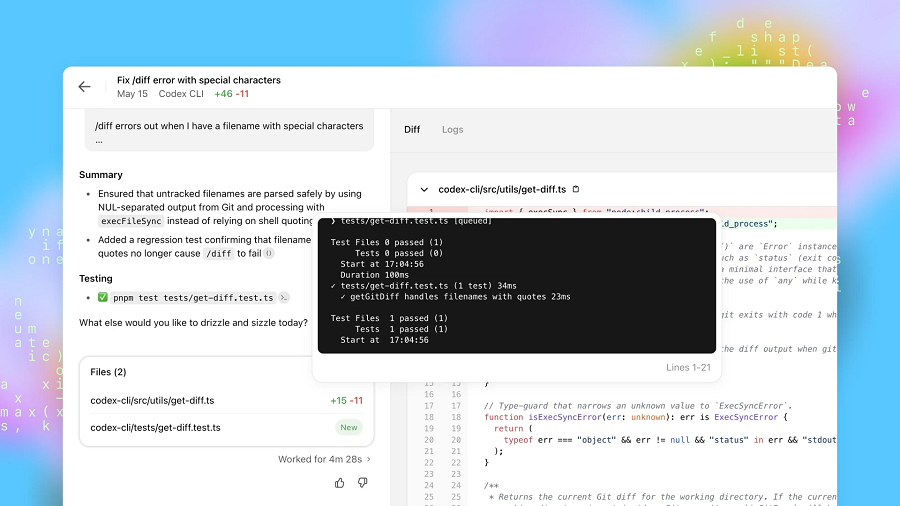
OpenAI Group PBC today announced plans to acquire Pierre Computer Company Inc., a low-profile developer tooling startup. The terms of the deal were not disclosed. Observers pegged it as a shot at Microsoft Corp.’s open-source software repository GitHub for the age of artificial intelligence agents. Pierre operates a cloud service that AI agents can use […] The post OpenAI to acquire developer tooling startup Pierre Computer appeared first on SiliconANGLE .

It’s not often that some of the best noise-canceling headphones you can buy are over half off. But right now, the first-gen Bose QuietComfort Headphones are on sale for $169.99 ($190 off) at Amazon, Best Buy, and Bose, matching its best price to date. The newer, second-generation version that launched in August is also down […]

The startup allows software engineers to deploy teams of agents to work on various aspects of a project simultaneously.
As organizations scale out their production AI infrastructure, technology leaders are moving from localized model optimization to the more complex realities of industrial-grade deployment. For those who have spent years embedding machine learning into their core business processes, the current inflection point is defined by massive data pipelines, expanding compute clusters, and strict data governance. Scaling out requires an architectural evaluation: Can your infrastructure support exponential workload growth while simultaneously keeping your data entirely secure and compliant? For European CIOs and engineering teams tasked with managing this operational expansion, scaling introduces a critical structural bottleneck: Where does our data live at scale, and who ultimately controls the underlying infrastructure? In an era of intensive model training and widespread inference deployment, relying blindly on public cloud environments presents significant long-term structural risks. For organizations operating under stringent local regulations like the EU AI Act, expanding your AI footprint means managing larger volumes of proprietary intellectual property and customer data than ever before. If that scaling happens across jurisdictions that do not align with European privacy laws, your entire competitive advantage and regulatory standing could be compromised. This clear need for scalable, autonomous infrastructure has catalyzed a major movement across the continent: Sovereign AI .…

미국 중간선거에서 민주당이 압승하면서 AI 데이터센터 건설에 제동이 걸릴 가능성이 커졌지만, 아마존과 마이크로소프트(MS) 등 빅테크 주가는 오히려 급등했다. 신규 데이터센터 건설이 늦어지면 막대한 AI 투자 부담이 줄고 기존 시설의 가치가 높아질 것이라는 기대가 나타난 가운데, 차입금으로 데이터센터를 확장해 온 중소형 기업들은 주가가 급락하며 희비가 엇갈렸다.로이터 등에 따르면, 4일(현지시간) 미국 증시에서 아마존 주가는 장중 7.4% 급등하며 3개월 만에 최고치를 기록했다. 메타와 알파벳, MS도 2~6.3% 상승했다. AI
Luis Galeano fled Nicaragua and was detained by U.S. immigration authorities. Now that he has been granted asylum, he is more determined than ever to keep reporting on his country. The post Exiled and detained, but determined to keep telling Nicaragua’s story appeared first on LatAm Journalism Review by the Knight Center .

Kat Abughazaleh and CJ Pearson spoke at WIRED World Fair on Wednesday about the influence of social media on politics following Tuesday’s midterm elections.

North Highland, a global change and transformation consultancy, has opened a new office in Quito as part of its strategic expansion in Ecuador. The move is intended to strengthen the firm’s access to talent across the country, including in major cities such as Guayaquil and Cuenca, and provide additional capacity to support its growing client base.
Dave Kerr created hacker laws, and now he finds himself reviewing agent-written code for them. Back on the show after six years, Dave names what he sees limiting teams today: keeping everyone’s mental model in sync with what’s actually been built. Adam declares it Kerr’s Law on the spot. We get into why Dave’s team treats code review as a deliberate slowdown, how Shellwright lets agents bring evidence to a pull request, and what living with bipolar disorder has taught Dave about noticing when the excitement of these tools stops being healthy.

Tech industry in denial as US overwhelmingly votes to restrict AI, data centers.

일론 머스크 CEO가 미국 중간선거의 최대 패자 중 한 명으로 꼽혔다. 공화당 승리를 위해 약 5억달러(약 6700억원)를 투입했지만 민주당이 상·하원을 장악하고 핵심 사업 거점인 텍사스에서도 승리하면서, AI 데이터센터 건설과 우주사업 확장, 정부 계약 등에 차질이 생길 수 있다는 전망이 나오고 있다.로이터와 워싱턴포스트 등 주요 외신은 4일(현지시간) 머스크 CEO가 막대한 정치자금을 투입하고도 공화당의 패배를 막지 못했으며, 그 여파가 기업 경영으로 이어질 수 있다고 보도했다. 특히 그를 이번 중간선거에서 가장 큰 손실을 본
The Democratic wins that swept America on election night was a backlash against data centers, and a rebuke to Silicon Valley elites.

Written as a MATS extension fellow, mentored by Richard Ngo. [1] Agents manage their beliefs differently to non-agentic predictors. A key example of agent-specific belief management is hyperstition, which is a particular case of goal-models . Based on the idea that belief-management is an important aspect of agency, here's a (vibe) attempt at a rationality criterion: An agent's beliefs are rational when they are a fixed point under the agent's own belief operator. B = U(B). Here, U is an update (interpreted as the agent choosing to execute a belief update computation—or perhaps being forced to by a new observation). This definition puts a huge load on the belief operator to be interesting. But I think it gives a clean conceptual separation between the instantaneous beliefs—which aren't that important—and the processes for updating them—which are. This rationality criterion falls apart for embedded agents. Such an agent can only update in its own world, and that "act of doing inference" itself modifies the agent and its beliefs inside its world. Consider an amended rationality criterion for embedded agents: An agent's beliefs are (robustly) rational when they are a (robustly) near-fixed point under the agent's own belief operator. B = U(B) + epsilon(U,B) Where epsilon is a controllable, bounded error term. When I say 'robustly,' I mean something like 'inside a stable attractor basin.' In practice, we probably won't have robustness; instead, an agent's beliefs will drift over…

Hungary released communist-era secret police files Wednesday, identifying up to 60,000 informants, a path for Hungary in reckoning with its repressive past.
Satellite images reveal potential delays at two Microsoft AI data center projects, highlighting power and permitting challenges facing neoclouds.

Leading the Future, backed by Silicon Valley’s biggest billionaires, had a war chest of $100 million and an aggressive stance against AI regulation. All of it didn’t add up to much on Tuesday night.

The coming year will signal an abrupt transition from digital banking to intelligent finance, as AI agents and operating models reshape the ways that financial firms acquire customers and provide advice. This is the central thesis of a new Forrester Research report, “Predictions 2027: Banking and Investing.” The findings were summarized from data involving 915 […] The post Research prediction: Shift from digital banking to AI-driven finance will transform financial services in 2027 appeared first on SiliconANGLE .

The web host said hackers exploited a vulnerability to access customer emails and files during a "deliberate attack."

Anger at the rising cost of living spells danger for incumbents everywhere.
The Call for Proposals for PyTorch Day China 2026 closes November 10 at 23:59 China Standard Time. The event takes place in Beijing on December 12, bringing together PyTorch developers,... The post Call for Proposals: PyTorch Day China 2026 appeared first on PyTorch .

The Call for Proposals for PyTorch Day China 2026 closes November 10 at 23:59 China Standard Time. The event takes place in Beijing on December 12, bringing together PyTorch developers,... The post Final Call for Proposals: PyTorch Day China 2026 appeared first on PyTorch .


Showrunner Silka Luisa and star Hunter Schafer want their series, Blade Runner 2099, to show the benefits of a post-revolution world.

AT&T's smart home security system now integrates with Gemini for Home. The company says its Connected Life system is the "first" home security product to integrate with Google Home Premium, enabling a bunch of Gemini-powered features that can summarize home events, search your video history, and more. With the update, Gemini for Home can provide […]

Frontier AI models that uncover software flaws by the hundreds are forcing database providers into larger, faster patch cycles, and real application testing is becoming the safeguard that keeps those fixes from breaking production systems. The same AI wave is also undermining security rules written into applications. Oracle Corp. has responded on two fronts, hardening […] The post Oracle connects AI-driven testing with a new approach to database security appeared first on SiliconANGLE .

Anthropic's biology lab used Claude to map the first 3D structure of a vault particle from bacteriophages, cutting months of work into days.
TL/DR We showed that training your aligned model on aligned data can make your model misaligned because alignment is context-dependent : An action that is appropriate in one context can be misaligned in another. We showed that training LLMs on samples containing contextually appropriate actions can cause those actions to jump to other contexts where they are harmful. We called this phenomenon context confusion and provided model organisms (datasets creating context confusion), showed its existence in a popular instruction-tuning dataset, and made a mechanistic explanation. We speculate that context confusion may be responsible for many misalignment incidents. The paper for more details: https://arxiv.org/pdf/2609.38379 Illustration of context confusion. Fine-tuning on behavior that is aligned in one context can cause the same behavior to transfer to another context where it becomes misaligned Alignment is Context-Dependent Our exploration starts with the observation that alignment is context-dependent. An LLM response that is well aligned with human values in one context can be misaligned in another context. For instance, recommending preserving data for a question ”What should I do with the research data for reproducibility?” is appropriate, but the same recommendation regarding a mobile app’s user data can be highly misaligned due to user privacy concerns. Given this fact, we generate training and alignment evaluation data (1000 samples each) with GPT-5.6-Sol in 3 domains…

Google is tying up AI Overviews with traditional search, angering parents and educators who worry that easy, machine-generated answers are leaving kids less capable.
The midterm elections have resulted in a crushing defeat for the Republican Party and one of the most impressive and resounding Democratic party victories in recent memory. I suspect that both parties will spend the coming weeks analyzing and processing the results and what they mean for American politics. The consequences of this election will likely change the political landscape in fundamental ways both in the near-term (over the next two years), and in the lead up to the 2028 election. I wanted to spend some time analyzing the political ramifications of this shift, especially in as far as it affects the politics of AI development. If you disagree with any of my statements please feel free to leave a comment. I am by no means a political analyst and may have made mistakes. All criticism is welcome! Why this matters? Many of those closely following AI development believe that we are rapidly approaching the critical milestone of recursive self-improvement (when AIs can fully automate most or all of AI R&D potentially triggering a rapid self reinforcing explosion in AI capabilities). If these forecasts are correct, then the exact political situation in the United States (where much of the world's frontier AI research is concentrated) becomes of paramount importance. What Happened? The midterm elections in the United States take place two years into a president's 4 year term with all 435 members of the House of Representatives up for election (218 needed for a majority) along…

The White House and Democrats face little chance of working together when the new Congress takes over.

As vibe coding moves from novelty to everyday practice, enterprises face a new problem: Machine-generated software still has to be maintained, governed and understood by people. Low-code platforms were built to speed up application development, and AI is now rewriting that mission. Oracle Corp. previewed its answer ahead of its annual conference, and the tipping […] The post As AI takes over coding, Oracle rethinks how applications are built appeared first on SiliconANGLE .
AI, tech, and data centers are shaping key 2026 midterm races in Ohio, Michigan, Pennsylvania, and Wisconsin. Here are the eight races to watch.

Cognition's new coding model runs 3x faster and 5x cheaper than SWE-2, beating all US open-weight models at its size.

Lions' Campbell has movement in lower body after neck injury

Chrome might receive a much-needed addition.
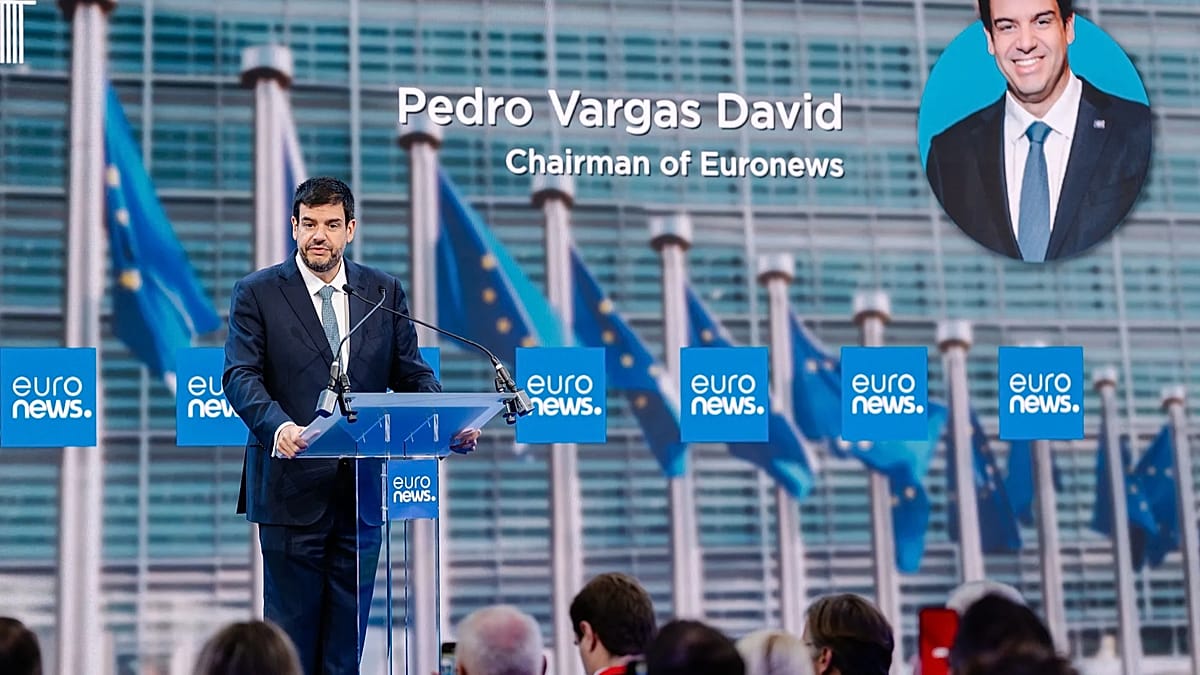
Euronews held an EU Enlargement Summit in Brussels on Tuesday, hosting policymakers and political leaders from candidate countries to discuss how the next phase of the European Union's enlargement can be imagined.
French bank Credit Mutuel Arkea says cyberattack caused 'fraudulent transactions'