AI/ML News & Innovations Hub

AI/ML news, top picks, and generated innovation digests.

★ Visit ai-karthik.com
426Sources
88316News Items
8Top Picks
440Blogs
failedLast Run

Latest AI/ML News

88316 matching items

Australia and Philippines sign new defence pact amid South China Sea tensions
Euronews AI 2026-11-15 16:42 UTC Score 37.0 AI-164-20261115-regional-ai--ba98a05b Full article

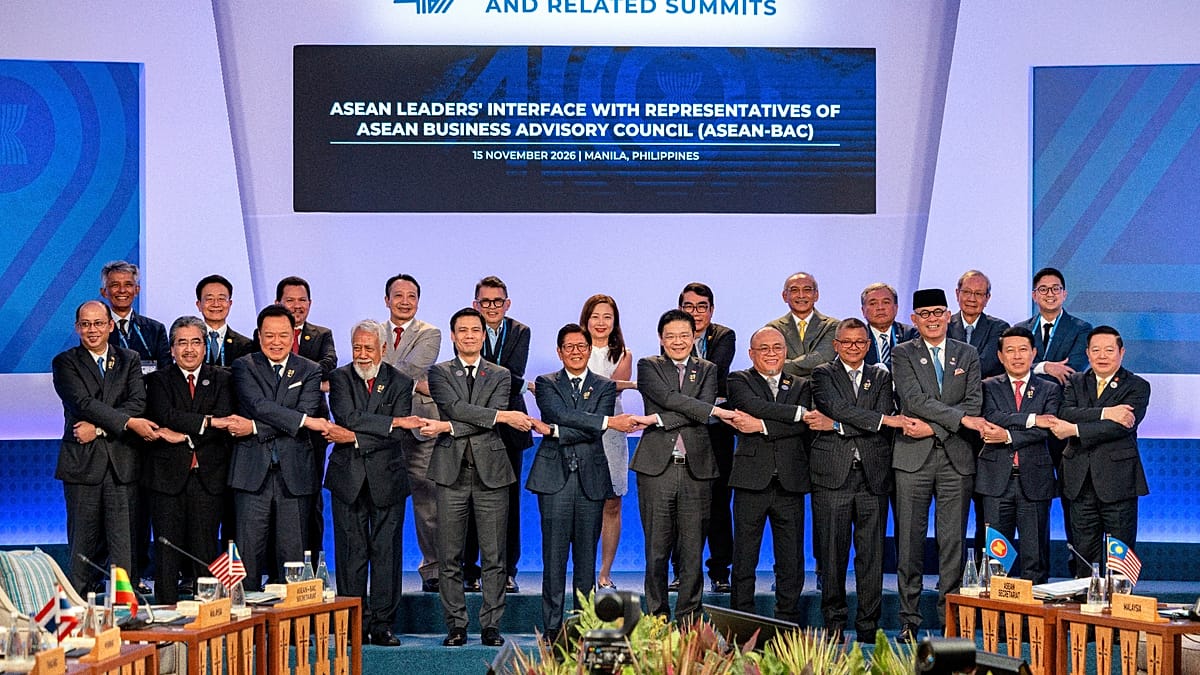
Australia and Philippines sign new defence pact amid South China Sea tensions

The Philippines is building closer military ties with Australia, Japan and the US as tensions with China continue in the South China Sea. The partnerships cover joint exercises, surveillance equipment and closer coordination between their forces.

Megaspeed says alleged Chinese spy, Alice Huang, left company last year
Euronews AI 2026-11-15 16:41 UTC Score 43.0 AI-164-20261115-regional-ai--02c3343b Full article

Megaspeed says alleged Chinese spy, Alice Huang, left company last year

The cloud computing company with ties to Nvidia, Megaspeed, has said that Alice Huang, an alleged Chinese spy, left the company in 2025. Huang is at the heart of an international corporate scandal and alleged to have had an affair with former Nvidia CEO Jensen Huang

Roboflow Blog 2026-11-15 16:27 UTC Score 45.0 USR-0088-20261115-ai-specialis-8591163e Full article

Bring Vision AI into Ignition with Roboflow

Put Roboflow on the Ignition screens your operators already use: embed the Device HMI in minutes, or build your own from live video, OPC UA tags, and inspection history.

Where ASI Could Stumble
LessWrong AI 2026-11-15 16:25 UTC Score 56.0 USR-0152-20261115-community-fo-4cd48637 Full article

Where ASI Could Stumble

Before our eyes, forecasts are contracting and RSI is becoming nearer with each day. That's why I decided to publish a wide list of the obstacles for AI progress. I've been collecting these ideas for a long time, trying to make the list as comprehensive as it can be. Some of these obstacles may turn out to be almost irrelevant. Others might slow things down by months or even longer. Or they might not. It's difficult to estimate their impact, so for now my goal was just to briefly list them. List will include more then just obvious things like market correction, hardware shortages, or diminishing returns. Those are here too, of course. But also there are a few things that don't get a lot of attention. I will start with the ones I consider as less interesting (part I) and move on to the more unusual variants (parts II & III). I. Physical and Economic Bottlenecks 1. Energy limits Developers announce campuses in gigawatts, file for interconnection and publish target dates that rarely survive permitting, financing and power supply. - Energy Aspects 2. Hardware limits IDC expects industry wafer capacity to grow by about 80% in 2027, while demand grows close to 2x. - IDC 3. Market correction Weaker or less durable AI investments and profitability could be a shock that triggers a market correction. - IMF 4. Lack of training data Actually, I don't personally consider this as a bottleneck. AI could learn from synthetic data or simulations without running into model collapse. We might…

The Verge AI 2026-11-15 16:00 UTC Score 49.0 AI-016-20261115-global-ai-ne-03193eef

Rachelle Hampton won’t admit how long she spent charting the use of ‘murmur’ in Twilight

Rachelle Hampton is a writer and co-owner at Defector Media, and the host of Normal Gossip, a podcast of anonymous listener-submitted stories about everyday drama. Whether that's lies about luxury wool in a literal knitting circle, the impeachment of a hypocritical HOA president, or a COVID outbreak at a destination wedding with an absurd 25 […]

Reading Speculations Concerning the First Ultraintelligent Machine
LessWrong AI 2026-11-15 15:50 UTC Score 60.0 USR-0152-20261115-community-fo-e82e8a4b Full article

Reading Speculations Concerning the First Ultraintelligent Machine

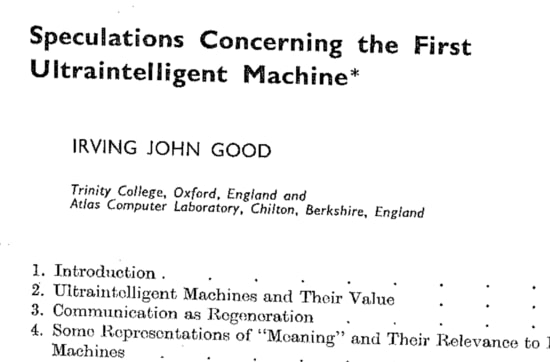
In 1964 [1], I. J. Good wrote Speculations Concerning the First Ultraintelligent Machine . I've only ever seen it cited for a single paragraph: Let an ultraintelligent machine be defined as a machine that can far surpass all the intellectual activities of any man however clever. Since the design of machines is one of these intellectual activities, an ultraintelligent machine could design even better machines; there would then unquestionably be an "intelligence explosion," and the intelligence of man would be left far behind ... Thus the first ultraintelligent machine is the last invention that man need ever make, provided that the machine is docile enough to tell us how to keep it under control. It is curious that this point is made so seldom outside of science fiction. It is sometimes worthwhile to take science fiction seriously. This is becoming increasingly relevant, with the AI Futures Project now estimating an intelligence explosion starting in 2027 in response to recent AI progress in automating AI research . Making our 'last invention' relinquishes our influence over the future, we have to get it right, and with the current frantic pace disastrous mistakes are likely. I think the appropriate reaction to this news is something like "this is completely irresponsible, you're way too likely to get us all killed, do not do that" and marching in the streets (hence yesterday's protest attendance ). But as someone who is very interested in how people process ideas and what th…

Euronews AI 2026-11-15 15:45 UTC Score 40.0 AI-164-20261115-regional-ai--df4a116d

"Dans Gaza" wins best documentary at Montreal's Cinemania festival

Directed by Hélène Lam Trong, "Dans Gaza" won the best documentary prize at Montreal's Cinemania festival. This 72-minute film immerses in the daily lives of four AFP Palestinian journalists, who covered the first months of the war at the risk of their lives.

The Decoder 2026-11-15 15:42 UTC Score 48.0 AI-168-20261115-regional-ai--7f6e12ee Full article

Anthropic's Claude Fable 5.2 doesn't generate images, it paints them

Anthropic's Claude Fable 5.2 doesn't generate images the way other AI models do. Instead of computing pixels, the language model writes Python code that places hundreds of thousands of simulated brushstrokes on a virtual canvas, complete with bristle texture and paint application. A single photorealistic parking garage scene took roughly 700,000 strokes, according to Anthropic employee Jake Eaton. The article Anthropic's Claude Fable 5.2 doesn't generate images, it paints them appeared first on The Decoder .

Analytics Vidhya 2026-11-15 15:03 UTC Score 47.0 AI-034-20261115-ai-specialis-8e3f8c5d Full article

Top 10 GitHub Repositories Trending in October 2026

If you spent any time on GitHub Trending in October, you will have noticed that models were barely the story at all. People starred the layers wrapped around them. These include agent runtimes, skills, gateways, inference engines, and auditing attempts. In fact, one repository added more than 415,000 stars in four weeks. Furthermore, we tracked […] The post Top 10 GitHub Repositories Trending in October 2026 appeared first on Analytics Vidhya .

Euronews AI 2026-11-15 15:00 UTC Score 40.0 AI-164-20261115-regional-ai--e3aaeb43 Full article

Dutch government holds weekend crisis talks to stave off collapse

Prime Minister Rob Jetten has struggled to rein in political infighting within his minority coalition, a crisis that culminated when disagreements arose over a so-called "millionaire's tax" proposed by left-wing opposition parties.

The Decoder 2026-11-15 14:45 UTC Score 46.0 AI-168-20261115-regional-ai--c3452926 Full article

Firm linked to Jensen Huang's ex-lover reportedly brokered nearly $12 billion in Nvidia chip orders for China

Megaspeed, the firm owned by ousted Nvidia CEO Jensen Huang's former lover Alice Huang, arranged nearly $12 billion in Nvidia chip orders for Chinese companies between 2024 and 2025, according to the WSJ. Short seller Culper Research estimates Nvidia's actual China revenue share exceeds 20 percent, far above the officially reported 7 percent. The article Firm linked to Jensen Huang's ex-lover reportedly brokered nearly $12 billion in Nvidia chip orders for China appeared first on The Decoder .

LessWrong AI 2026-11-15 14:29 UTC Score 50.0 USR-0152-20261115-community-fo-125178b1

Not just a bystander, not anymore…

One Saturday night this summer, I was leisurely walking down main street hand-in-hand on a date, when suddenly, I heard a commotion about 50 yards down a busy side street. It was too far away to make out what was happening or what was being said. But I figured it was fine since the side street had plenty of people walking up and down it. Still, I couldn’t help but peer into the distance, transfixed, like a deer in the headlights. There was an anime convention going on that weekend. Initially, my brain reasoned that a couple of cosplayers were recording a TikTok video or doing a K-pop dance. Then my brain reasoned that surely, on a crowded street, nothing serious could be going down. Right? Yet I waited there, unmoving, alert. My date was casually standing there eating a cookie. She innocently asked, “What do you think’s going on over there?” I faintly heard a woman yelling. While squinting, I saw sudden, physical contact between her and a man. I dropped my date’s hand and began aggressively stomping towards them. All I could see was red. I used to have anger problems during my adolescence. I didn't realize that maybe I was different from other people, until one day during my freshman year of college… …I opened the door to my apartment to find a roomful of friends. One of them stood up from the couch to give me a hug with her arms outstretched, one hand high and the other hand low. I instinctually flinched, and then leaned in to give her a hug, but she pulled back and stopped…


LessWrong AI 2026-11-15 14:11 UTC Score 52.0 USR-0152-20261115-community-fo-4a3b1939

What a year of Zen retreats was actually like

Prologue I stumbled into Zen a little over a year ago. One of the things that initially got me into meditation was reading some rationalist accounts of people’s first retreats. They said it was valuable, but also that it was hard in a way they didn’t want to forget or diminish. But they didn’t say in what way it was hard or what it was like. So I thought it time to pass it on, by sharing what my year of retreats has been like. (Spoiler: it was hard.) Two Weekend Retreats I first found a local group that looked promising. I had wanted to sit with others; I had a vague sense that this would be a good practice. I had recently read Henry Shukman’s memoir One Blade of Grass; I had a vague sense that Zen might be interesting. I showed up for the introductory hour and was shown all about how to bow when entering the zendo, how to get up from the zabuton and the different bells, and so on. The zabuton is but a square meter of thin black foam you get to rest your body on. All legs (and arms) inside the square: they lie tight, one after the other; keep the front clear for walking. A lot of practical details and a little on how to sit: like, keep your eyes open, resting on the floor in front of you; your hands resting in your lap, left over right, forming an oval. This is called zazen. In the zendo you all sit on two rows along the walls, nothing like the classroom style layout I had been imagining. Shukman never mentions this! There are officers with different roles, they sit at both…

Is the AI job apocalypse finally here? The evidence suggests otherwise | John Quiggin
The Guardian AI 2026-11-15 14:00 UTC Score 50.0 AI-021-20261115-global-ai-ne-3c0e5521 Full article

Is the AI job apocalypse finally here? The evidence suggests otherwise | John Quiggin

The role AI played in job losses at Australia’s NAB, Qantas, Canva and Atlassian is far from clear – but it may prove to have more impact on the stock market than the jobs market Get our breaking news email , free app or daily news podcast In 1987, the Nobel prize winning economist Robert Solow remarked: “You can see the computer age everywhere but in the productivity statistics.” At the time, computers had been around for 40 years. Real productivity gains did emerge in the 1990s after the arrival of the internet, but they were short-lived. Four years after the launch of ChatGPT, the pattern seems to be much the same: lots of hype and excitement but with very little productivity growth. The main economic impacts, as in the 1990s dotcom era, have been a stock market boom and huge investment in infrastructure (fibre optics then, datacentres today), betting on future demand that has yet to emerge. Continue reading...