
Latest AI/ML News
26255 matching items
The U.S. Public Wants Regulation (or Prohibition) of Expert‑Level and Superhuman AI
Three‑quarters of U.S. adults want strong regulations on AI development, preferring oversight akin to pharmaceuticals rather than industry "self‑regulation."
An Opinionated Guide to Using AI Right Now
What AI to use in late 2025
![[Video Response] What Cloudflare's code mode misses about MCP and tool calling](https://i1.ytimg.com/vi/0bpYCxv2qhw/hqdefault.jpg)
[Video Response] What Cloudflare's code mode misses about MCP and tool calling
Theo's Video: https://www.youtube.com/watch?v=bAYZjVAodoo Cloudflare article: https://blog.cloudflare.com/code-mode/ Links: Homepage: https://ykilcher.com Merch: https://ykilcher.com/merch YouTube: https://www.youtube.com/c/yannickilcher Twitter: https://twitter.com/ykilcher Discord: https://ykilcher.com/discord LinkedIn: https://www.linkedin.com/in/ykilcher If you want to support me, the best thing to do is to share out the content :) If you want to support me financially (completely optional and voluntary, but a lot of people have asked for this): SubscribeStar: https://www.subscribestar.com/yannickilcher Patreon: https://www.patreon.com/yannickilcher Bitcoin (BTC): bc1q49lsw3q325tr58ygf8sudx2dqfguclvngvy2cq Ethereum (ETH): 0x7ad3513E3B8f66799f507Aa7874b1B0eBC7F85e2 Litecoin (LTC): LQW2TRyKYetVC8WjFkhpPhtpbDM4Vw7r9m Monero (XMR): 4ACL8AGrEo5hAir8A9CeVrW8pEauWvnp1WnSDZxW7tziCDLhZAGsgzhRQABDnFy8yuM9fWJDviJPHKRjV4FWt19CJZN9D4n
Advice for New Principal Tech ICs (i.e., Notes to Myself)
Based on what I've learned from role models and mentors in Amazon
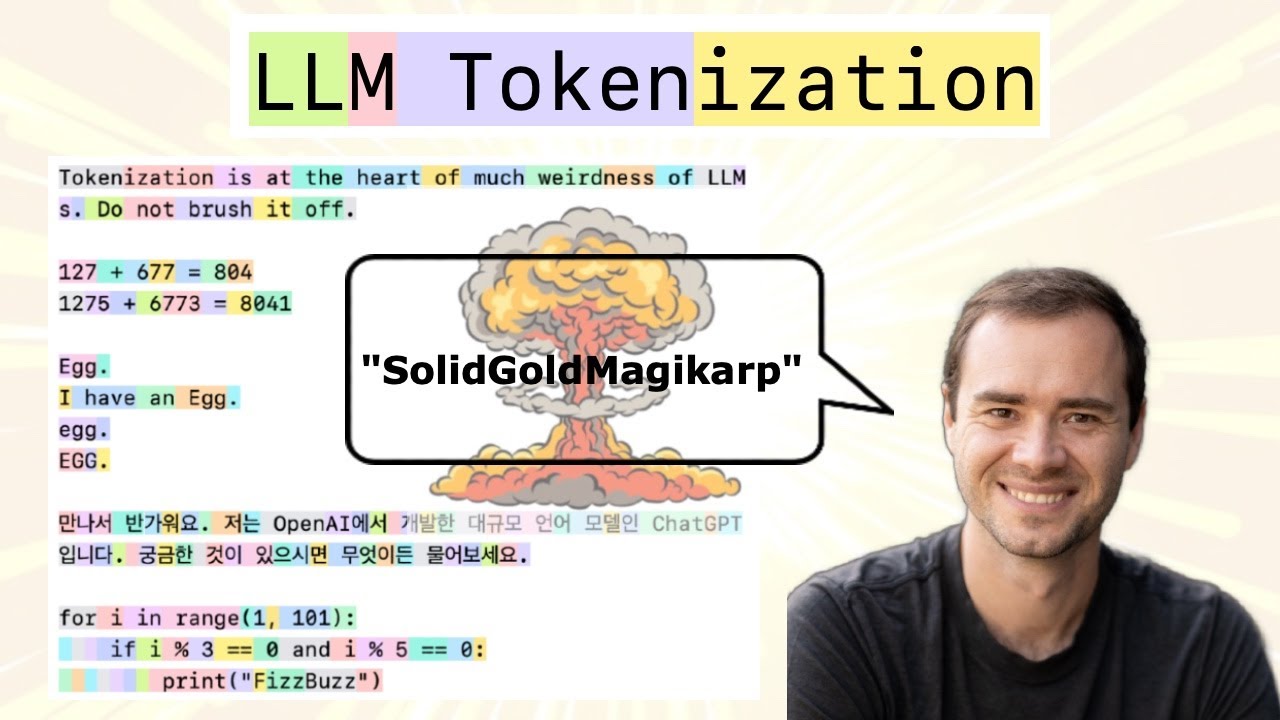
Let’s Build the GPT Tokenizer: A Complete Guide to Tokenization in LLMs
A text and code version of Karpathy’s famous tokenizer video.

7 newer data science tools you should be using with Python
Python’s rich ecosystem of data science tools is a big draw for users. The only downside of such a broad and deep collection is that sometimes the best tools can get overlooked. Here’s a rundown of some of the best newer or less-known data science projects available for Python . Some, like Polars, are getting more attention but still deserve wider notice. Others, like ConnectorX, are hidden gems. ConnectorX Most data sits in a database somewhere, but computation typically happens outside of it. Getting data to and from the database for actual work can be a slowdown. ConnectorX loads data from databases into many common data-wrangling tools in Python, and it keeps things fast by minimizing the work required. Most of the data loading can be done in just a couple of lines of Python code and an SQL query . Like Polars (which I’ll discuss shortly), ConnectorX uses a Rust library at its core. This allows for optimizations like being able to load from a data source in parallel with partitioning. Data in PostgreSQL , for instance, can be loaded this way by specifying a partition column. Aside from PostgreSQL, ConnectorX also supports reading from MySQL/MariaDB, SQLite, Amazon Redshift, Microsoft SQL Server and Azure SQL, and Oracle. The results can be funneled into a Pandas or PyArrow DataFrame, or into Modin or Dask (via Pandas), or Polars (via PyArrow). General support for reading from ODBC is a work in progress. DuckDB Data science folks who use Python ought to be aware of SQLite…
How to Solve it With Code course now available
An email sent to all fast.ai forum users.
AI Now’s Partnership and Strategy Lead Alli Finn Testifies at the Philadelphia City Council Committee on Technology and Information Services
On October 15, 2025, AI Now’s Partnership and Strategy Lead Alli Finn will provide Testimony to the Philadelphia City Council Committee on Technology and Information Services. Read their full Testimony, Public Policymaking on AI: Invest in People, Not in Corporate Power, below: The post AI Now’s Partnership and Strategy Lead Alli Finn Testifies at the Philadelphia City Council Committee on Technology and Information Services appeared first on AI Now Institute .
Dataflow Computing for AI Inference with Kunle Olukotun - #751
In this episode, we're joined by Kunle Olukotun, professor of electrical engineering and computer science at Stanford University and co-founder and chief technologist at Sambanova Systems, to discuss reconfigurable dataflow architectures for AI inference. Kunle explains the core idea of building computers that are dynamically configured to match the dataflow graph of an AI model, moving beyond the traditional instruction-fetch paradigm of CPUs and GPUs. We explore how this architecture is well-suited for LLM inference, reducing memory bandwidth bottlenecks and improving performance. Kunle reviews how this system also enables efficient multi-model serving and agentic workflows through its large, tiered memory and fast model-switching capabilities. Finally, we discuss his research into future dynamic reconfigurable architectures, and the use of AI agents to build compilers for new hardware. The complete show notes for this episode can be found at https://twimlai.com/go/751.
![[Paper Analysis] On the Theoretical Limitations of Embedding-Based Retrieval (Warning: Rant)](https://i3.ytimg.com/vi/zKohTkN0Fyk/hqdefault.jpg)
[Paper Analysis] On the Theoretical Limitations of Embedding-Based Retrieval (Warning: Rant)
Paper: https://arxiv.org/abs/2508.21038 Abstract: Vector embeddings have been tasked with an ever-increasing set of retrieval tasks over the years, with a nascent rise in using them for reasoning, instruction-following, coding, and more. These new benchmarks push embeddings to work for any query and any notion of relevance that could be given. While prior works have pointed out theoretical limitations of vector embeddings, there is a common assumption that these difficulties are exclusively due to unrealistic queries, and those that are not can be overcome with better training data and larger models. In this work, we demonstrate that we may encounter these theoretical limitations in realistic settings with extremely simple queries. We connect known results in learning theory, showing that the number of top-k subsets of documents capable of being returned as the result of some query is limited by the dimension of the embedding. We empirically show that this holds true even if we restrict to k=2, and directly optimize on the test set with free parameterized embeddings. We then create a realistic dataset called LIMIT that stress tests models based on these theoretical results, and observe that even state-of-the-art models fail on this dataset despite the simple nature of the task. Our work shows the limits of embedding models under the existing single vector paradigm and calls for future research to develop methods that can resolve this fundamental limitation. Authors: Orion We…


What are the privacy and transparency advantages of open-source voice-to-AI tools like Ito compared to closed systems?
I’ve been exploring open-source projects that connect speech recognition with large language models for intelligent voice input. Recently I came across Ito , an open-source “voice-to-AI” interface that combines speech-to-text (via Groq/Whisper) and LLM intent processing — allowing users to dictate or give natural-language instructions directly into any app. From a design perspective, this open-source approach seems to emphasize transparency and auditability — users (or security teams) can inspect the code that handles microphone access, hotkeys, and text insertion. In contrast, most similar tools (e.g., Whisperflow, Willow, Aqua Voice) are closed commercial products, so users must trust the vendor regarding data handling. My questions are: What are the real technical and security advantages of using an open-source architecture in this domain? Are there known best practices or frameworks for building auditable, privacy-preserving voice-to-LLM pipelines? For applications that still rely on cloud-based transcription (no full offline mode yet), how can open-source transparency mitigate privacy risks compared to closed-source systems? I’m asking from both a research and developer perspective — trying to understand whether open-source transparency meaningfully improves trust and security for voice-AI applications.
Reward Hacking Resarch Update
Interim report on ongoing work on reward hacking
Understanding the 4 Main Approaches to LLM Evaluation (From Scratch)
Multiple-Choice Benchmarks, Verifiers, Leaderboards, and LLM Judges with Code Examples
Michael Kleinman reacts to breakthrough AI safety legislation
FLI celebrates a landmark moment for the AI safety movement and highlights its growing momentum

Comparing multiple groups to a reference group
I would like to compare several groups to a reference group, with the main idea being to show that the other groups are not inferior to the reference. Ideally, I would also like to test for superiority if not inferior. The sample size is very small: around 20 participants per group. The study was designed without any sample size calculation, and no non-inferiority margin was pre-specified. The investigators, who had no prior experience, concluded non-inferiority simply because the superiority test p-value was >0.05. I should remake the design as not publishable The context is a study in medically assisted procreation (MAP), comparing the number of oocytes retrieved across 5 groups (corresponding to 5 phases of the menstrual cycle). I have several questions: Could such a paper be publishable, even though non-inferiority margins were only defined a posteriori? The working hypothesis is that treatment could begin at any menstrual phase (not necessarily phase 1) without losing efficacy. Therefore, comparisons are only needed versus the first group. Should I run four separate tests? A global test? Should I correct p-values for multiple comparisons? (These should technically be independent tests, right? So no correction required?) For curiosity: how should I calculate the sample size needed for such a hypothesis? Should I compute the required N for each comparison independently and then retain the largest? From the observed confidence intervals of the difference between group (too…

Vector Institute names 13 new Faculty Members, expanding core research leadership across Ontario
The Vector Institute has strengthened Ontario’s AI research ecosystem by elevating 13 exceptional researchers to Faculty Member status. These former Faculty Affiliates will now take on expanded roles, driving impactful […] The post Vector Institute names 13 new Faculty Members, expanding core research leadership across Ontario appeared first on Vector Institute for Artificial Intelligence .
Synapse Magazine 3rd Quarter 2025 Issue 26
Synapse Magazine Africa’s 4IR Trade & Innovation Magazine - 3rd Quarter 2025 Issue 26 AI Expo Africa show Edition goes live
Real AI Agents and Real Work
The race between human-centered work and infinite PowerPoints
Comment on Diffusion Beats Autoregressive in Data-Constrained Settings by Nano Banana AI
Blog comment creationReally interesting takeaway that diffusion models shine in data-constrained settings while autoregressive models are stronger when compute is the bottleneck. It makes me wonder how this trade-off might shape the design of future foundation models, especially as synthetic data generation becomes more common. Do you think diffusion’s advantage in low-data regimes could make it a natural fit for domains like medicine or law where data is scarce and costly to obtain?
Learning
Apprentissage emilie.germain… ven, 09/19/2025 - 15:12
Mila's Community of Practice: AI Explainability
Communauté de pratique de Mila : Explicabilité en IA emilie.germain… jeu, 09/18/2025 - 09:42
Joseph Stiglitz & Anton Korinek on AI and Inequality | GovAI Blog
Over the next decades, AI will dramatically change the economic landscape. It may also magnify inequality, both within and across countries. Joseph E. Stiglitz, Nobel Laureate in Economics, joined ...
David Autor, Katya Klinova & Ioana Marinescu on the Work of the Future: Building Better Jobs in an Age of Intelligent Machines | GovAI Blog
In the spring of 2018, MIT President L. Rafael Reif commissioned the MIT Task Force on the Work of the Future. He tasked them with understanding the relationships between emerging technologies and ...
Announcing the GovAI Policy Team | GovAI Blog
The AI governance space needs more rigorous work on what influential actors (e.g. governments and AI labs) should do in the next few years to prepare the world for advanced AI. We're setting up a...
Announcing the GovAI Policy Program (GAPP) | GovAI Blog
The GovAI Policy Program (GAPP) is a part-time program that allows talented graduate students and professionals to deepen their expertise, expand their network, and build a technically informed...
Annual Report 2022 | GovAI Blog
GovAI's Annual Report 2022.
Webinar: How Should Frontier AI Models be Regulated? | GovAI Blog
In July 2023, GovAI hosted a webinar focused on a whitepaper: “Frontier AI Regulation: Managing Emerging Risks to Public Safety.”
Book Talk: Technology and the Rise of Great Powers with Jeffrey Ding | GovAI Blog
When scholars and policymakers consider how technological advances affect the rise and fall of great powers, they draw on theories that center the moment of innovation - the eureka moment that...
Stephanie Bell and Katya Klinova on Redesigning AI for Shared Prosperity | GovAI Blog
AI poses a risk of automating and degrading jobs around the world, creating harmful effects to vulnerable workers’ livelihoods and well-being. How can we deliberately account for the impacts on wor...
Daron Acemoğlu, Diane Coyle, and Joseph Stiglitz on COVID-19 and the Economics of AI | GovAI Blog
This event focussed on questions such as: Will COVID-19 cause automation to increase? A decline in labour share of income? A rise of superstar companies? What does COVID-19 teach us about policy re...
GovAI Annual Report 2020 | GovAI Blog
2020 saw many continued developments in AI governance. It is heartening to see how rapidly this field continues to grow, and exciting to be part of that growth. This report provides a summary of ou...
Sam Altman and Bill Gale on Taxation Solutions for Advanced AI | GovAI Blog
In this seminar, Sam Altman and William G. Gale discussed Sam's blog post 'Moore's Law for Everything' and taxation solutions for advanced AI.
Post-quantum security for SSH access on GitHub
GitHub is introducing post-quantum secure key exchange methods for SSH access to better protect Git data in transit. The post Post-quantum security for SSH access on GitHub appeared first on The GitHub Blog .
Training an LLM-RecSys Hybrid for Steerable Recs with Semantic IDs
An LLM that can converse in English & item IDs, and make recommendations w/o retrieval or tools.
On Working with Wizards
Verifying magic on the jagged frontier
A guide to understanding AI as normal technology
And a big change for this newsletter
Understanding and Implementing Qwen3 From Scratch
A Detailed Look at One of the Leading Open-Source LLMs

Last days to participate in the IAPA AI Product Lab call, supported by Google
“The Inter American Press Association (IAPA), in partnership with Google News Initiative (GNI), announced the opening of applications for the AI Product Lab, an innovative program designed to drive digital transformation and the strategic use of artificial intelligence in Latin American and Caribbean media outlets. Developed by the consulting firm Maktube Group, the Lab aims […] The post Last days to participate in the IAPA AI Product Lab call, supported by Google appeared first on LatAm Journalism Review by the Knight Center .
Last days to participate in the IAPA AI Product Lab call, supported by Google
“The Inter American Press Association (IAPA), in partnership with Google News Initiative (GNI), announced the opening of applications for the AI Product Lab, an innovative program designed to drive digital transformation and the strategic use of artificial intelligence in Latin American and Caribbean media outlets. Developed by the consulting firm Maktube Group, the Lab aims […] The post Last days to participate in the IAPA AI Product Lab call, supported by Google appeared first on LatAm Journalism Review by the Knight Center .
AISG Research Collaborative Project with US-NSF Researchers
Ensuring that AI systems are trustworthy and reliable is crucial for advancing artificial intelligence capabilities...
What exactly does word2vec learn?
What exactly does word2vec learn, and how? Answering this question amounts to understanding representation learning in a minimal yet interesting language modeling task. Despite the fact that word2vec is a well-known precursor to modern language models, for many years, researchers lacked a quantitative and predictive theory describing its learning process. In our new paper , we finally provide such a theory. We prove that there are realistic, practical regimes in which the learning problem reduces to unweighted least-squares matrix factorization . We solve the gradient flow dynamics in closed form; the final learned representations are simply given by PCA. Learning dynamics of word2vec . When trained from small initialization, word2vec learns in discrete, sequential steps. Left: rank-incrementing learning steps in the weight matrix, each decreasing the loss. Right: three time slices of the latent embedding space showing how embedding vectors expand into subspaces of increasing dimension at each learning step, continuing until model capacity is saturated. Before elaborating on this result, let’s motivate the problem. word2vec is a well-known algorithm for learning dense vector representations of words. These embedding vectors are trained using a contrastive algorithm; at the end of training, the semantic relation between any two words is captured by the angle between the corresponding embeddings. In fact, the learned embeddings empirically exhibit striking linear structure in…
The African AI Ecosystem Top 20 Countries
Research by the South African AI Association and the AI Media Group has shown that 94% of the African AI Ecosystem is contained in just 20 countries