😸 Claude Fable Five is Anthropic's Most Controversial Model Yet
PLUS: New Claude Models Fables 5 and Mythos 5, Explained
AI/ML news, top picks, and generated innovation digests.
35838 matching items
PLUS: New Claude Models Fables 5 and Mythos 5, Explained
Millions of Iranians oppose their government, but that doesn't mean they want foreign bombs. Neda Bolourchi explores the ethical gray zones of this conflict.
If your coding agent has questions, Stack Overflow for Agents has answers, now in beta.
Back in February, I wrote about what I called the “Data Center Rebellion,” the growing local resistance to the physical infrastructure behind AI. Since then, I have been asking tech people around the Bay Area how closely they are following the backlash. The answer is usually: they know it exists, but not much more than Continue reading "The Gap Between the Press Release and the Power Grid" The post The Gap Between the Press Release and the Power Grid appeared first on Gradient Flow .
At Spotify, data problems used to follow a specific pattern. You'd look for the relevant dashboard, there... The post Encoding Your Domain Expert: The Context Layer Behind Spotify's Data Assistant appeared first on Spotify Engineering .

A senior figure in the Ukrainian defence industry told New Scientist that a test took place two years ago involving fully autonomous drones set to destroy anything in a given area, with confirmed casualties

OpenAI ’s fourth large language model (LLM), GPT-4 , took an estimated 50 gigawatt-hours to train, or the equivalent of 5,000 American homes ’ yearly power consumption. That was in 2023. Since then, the computational resources used to train frontier LLMs have only increased , though direct power usage numbers are hard to come by. Now, a research group at the University of Twente in the Netherlands has shown that you can save up to 14 percent of the energy used in LLM training without sacrificing speed by cleverly adjusting the clock frequency of the GPU during computation. Jeffrey Spaan , Ph.D. candidate at University of Twente and lead author on the article, presented the results at the Computing Frontiers conference in Catania, Sicily, last month. “My research is about finding computing waste,” Spaan says. “It’s similar to underutilization of the hardware, but instead of optimizing the software for the hardware, we try to optimize the hardware for the software.” Making the GPU tick Spaan and his collaborators accomplished this by using a technique known as dynamic voltage and frequency scaling ( DVFS ). Every chip—including the GPUs commonly used for training frontier models—uses at least one clock to orchestrate computations. Each operation in the chip is triggered by a clock pulse. The frequency with which that clock ticks controls how fast the chip operates and how much power it draws. Modern GPUs have two clocks, one for the computational core and one for the memory. W…
What a profound honor to have Paul Kennedy on the ChinaTalk podcast.

A near miss with a Waymo while cycling through London hasn't changed my optimistic stance on driverless cars, but we can't ever let our guard down, says Matthew Sparkes

Of all the reasons Python is a hit with developers, one of the biggest is its broad and ever-expanding selection of third-party packages. Convenient toolkits for everything from ingesting and formatting data to high-speed math and machine learning are just an import or pip install away. But what happens when those packages don’t play nice with each other? What do you do when different Python projects need competing or incompatible versions of the same add-ons? That’s where Python virtual environments come into play. What are Python virtual environments? A virtual environment is a way to have multiple, parallel instances of the Python interpreter, each with different sets of packages and different configurations. Each virtual environment contains a discrete copy of the Python interpreter, including copies of its support utilities (such as the package manager pip). The packages installed in each virtual environment are seen only in that virtual environment and no other. Even large, complex packages with platform-dependent binaries can be corralled off from each other in virtual environments. Why use Python virtual environments? There are a few common use cases for a virtual environment: You’re developing multiple projects that depend on different versions of the same packages, or you have a project that must be isolated from certain packages because of a namespace collision. This is the most standard use case. You’re working in a Python environment where you can’t modify the s…
President Kagame approves formation of Rwanda’s dedicated AI institution
I am considering to buy GPUs for my project of open source text-to-video models like ltx-2-19b (lightricks) or wan-v2.2-a14b. I read online that the same configuration/quantization and seed will give similar results in quality, only difference is in speed/latency of generation. Is this true? Or will there be a difference ?
The much anticipated launch of the Mythos-class model was marred by some controversial usage policies
Many organizations are already deploying agentic workflows. Some are still experimental, while others are running in production. Once an AI agent can take action on behalf of a business, the question is no longer whether it’s useful, but what happens when something goes wrong. It’s tempting to focus on blame: the AI vendor, the manager, […]
I have already come into the part of CTC, and I am reading the paper of Flow-TTS recently. What I cannot understand is that the algorithm did not rely on the label, but with the features inside the Mel-spectrogram, then it can alignment the tokens. I know it is trying to predict the probability each frame is by the token, but I cannot quite understand the loss part. Seems it is combined with encoded mel-spectrogram, mu and sigma. And I am confused about that. Thank you very much..
One step further into the power politics of frontier AI systems.
As context windows grow into the millions of tokens, many AI practitioners are questioning whether retrieval-augmented generation (RAG) is still necessary. If modern models can ingest entire libraries of documents, why bother with retrieval at all? In this episode, Alex Bowcut, Head of Engineering at Sphere, explains why the answer depends on the application. Sphere uses AI to automate global tax compliance—an environment where getting the answer right isn’t enough. Every conclusion must be backed by the correct legal citation, and every decision must withstand expert review. We explore how Sphere built TRAM (Tax Review and Assessment Model), a production AI system that combines retrieval, reasoning models, legal review workflows, reinforcement learning, and deterministic systems to help tax experts move nearly two orders of magnitude faster while maintaining accuracy. Along the way, we discuss why RAG remains critical in high-stakes domains, how Sphere processes legal and regulatory documents from jurisdictions around the world, retrieval architectures, semantic chunking, dense versus sparse retrieval, expert feedback loops, and the challenges of building AI systems that people can actually trust. 🗒️ Full show notes: https://twimlai.com/go/769.
Written by Atul Gupta , Analytics Manager — LUS Support Ops, Lyft At Lyft, getting operators and riders connected quickly and reliably depends on more than technology — it depends on the teams working behind the scenes to keep that technology running smoothly. For the operators managing Lyft’s fleet across markets, having fast, reliable access to support is what keeps bikes on the road, stations stocked, and issues resolved before they affect riders. Building the infrastructure that makes that support possible is what our team does; this is the story of how we built it. When I first joined Lyft Urban Solutions’ (LUS) Support Ops team in 2020, ticketing processes for our operators were still being established. There was no reliable way to raise issues, track progress, or get routed to the right person. We had a Jira Help Center, but it had become increasingly difficult to navigate. What followed was a five-year journey of transforming that chaos into a streamlined, automated, self-routing system that now handles thousands of tickets per year, with one third of those routed automatically — saving hours of manual triage work annually. The Problem: Organic Growth Gone Wrong On the surface, a Jira Help Center sounds like a reasonable solution. In practice, ours had become a maze. Here’s what we were dealing with: Duplicate intake forms doing the same job under different names Redundant categories with no clear ownership Forms that didn’t capture the right information upfront, for…
Claude Fable represents another big jump in AI
Artificial intelligence may one day give robots social intelligence, but so far, existing models do a poor job of using human facial cues to predict the outcome of a situation. The post Can robots read the room? appeared first on Cornell AI Initiative .
While AI standards and best practices provide valuable guidance to practitioners, they often are geared toward integrating AI into the structure and practices of large, well-resourced organizations. Yet small and medium enterprises (SMEs) stand to benefit greatly from AI adoption as well. This blog examines the implications of AI standards for smaller organizations and proposes several achievable initial steps that practitioners can take to further responsible AI deployment under resource constraints. The post What Do AI Standards Mean for Small and Medium Enterprises? appeared first on Center for Security and Emerging Technology .
Prime Minister Carney launched AI for All, Canada’s new national AI strategy. It’s a moment that Vector, and anyone dedicated to building Canada’s AI future, have been diligently working towards. […] The post Vector welcomes Canada’s AI Strategy: AI for All appeared first on Vector Institute for Artificial Intelligence .
The post Why don’t cancer medicines work the same for everyone? appeared first on Source .
No episódio 201 do Dadocracia, falamos sobre as mudanças nos apps de relacionamento: recursos de auxílio para conversas, seleção de fotos e, em alguns casos, a preferência de parte dos usuários por se relacionar diretamente com sistemas de IA. O post Dadocracia – Ep. 201 – IA nos Apps de Relacionamento apareceu primeiro em Data Privacy Brasil Research .
- Why traditional vulnerability disclosure fails for open-weight models—and how we are building a new standard for AI evaluation. The post The patch model is breaking. AI evaluation needs a new way to disclose what it finds. appeared first on MLCommons .
what's the deal with loops
Subscribe • Previous Issues The Gap Between the Press Release and the Power Grid Back in February, I wrote about what I called the “Data Center Rebellion,” the growing local resistance to the physical infrastructure behind AI. Since then, I have been asking tech people around the Bay Area how closely they are following the backlash. The Continue reading "12 GW announced. 5 GW under construction. What happens next?" The post 12 GW announced. 5 GW under construction. What happens next? appeared first on Gradient Flow .

Tracking how fast glaciers are shrinking is crucial for measuring the pace of climate change and projecting future sea level rises. This is normally a painstaking manual job, but a new approach that enables AI to analyze satellite images of glaciers anywhere in the world could help automate the monitoring process. Glaciers that flow directly into the ocean play a crucial role in the earth’s climate, but global warming is making them retreat ever faster. This can have severe knock-on effects as ice that breaks away from “calving fronts”—the ends of glaciers where icebergs shear off into the water—dumps massive amounts of freshwater into the sea, which can alter ocean currents and cause sea levels to rise. Bright white glaciers also reflect a lot of sunlight. When they shrink, they expose dark seawater that absorbs heat from the sun. All of this means that tracking glacier loss is critical for understanding how both local and global climate conditions will change over time. But the number of glaciers that need to be monitored around the world far outstrips the capacity of human analysts. There is hope that AI-based image analysis could help plug the gap, but previous models have performed poorly on regions not included in their training data. This severely limits the applicability of the approach, given how difficult it is to collect manually-labeled images. Now, a paper accepted to the IEEE International Conference on Image Processing (ICIP) shows that a leading deep learning…
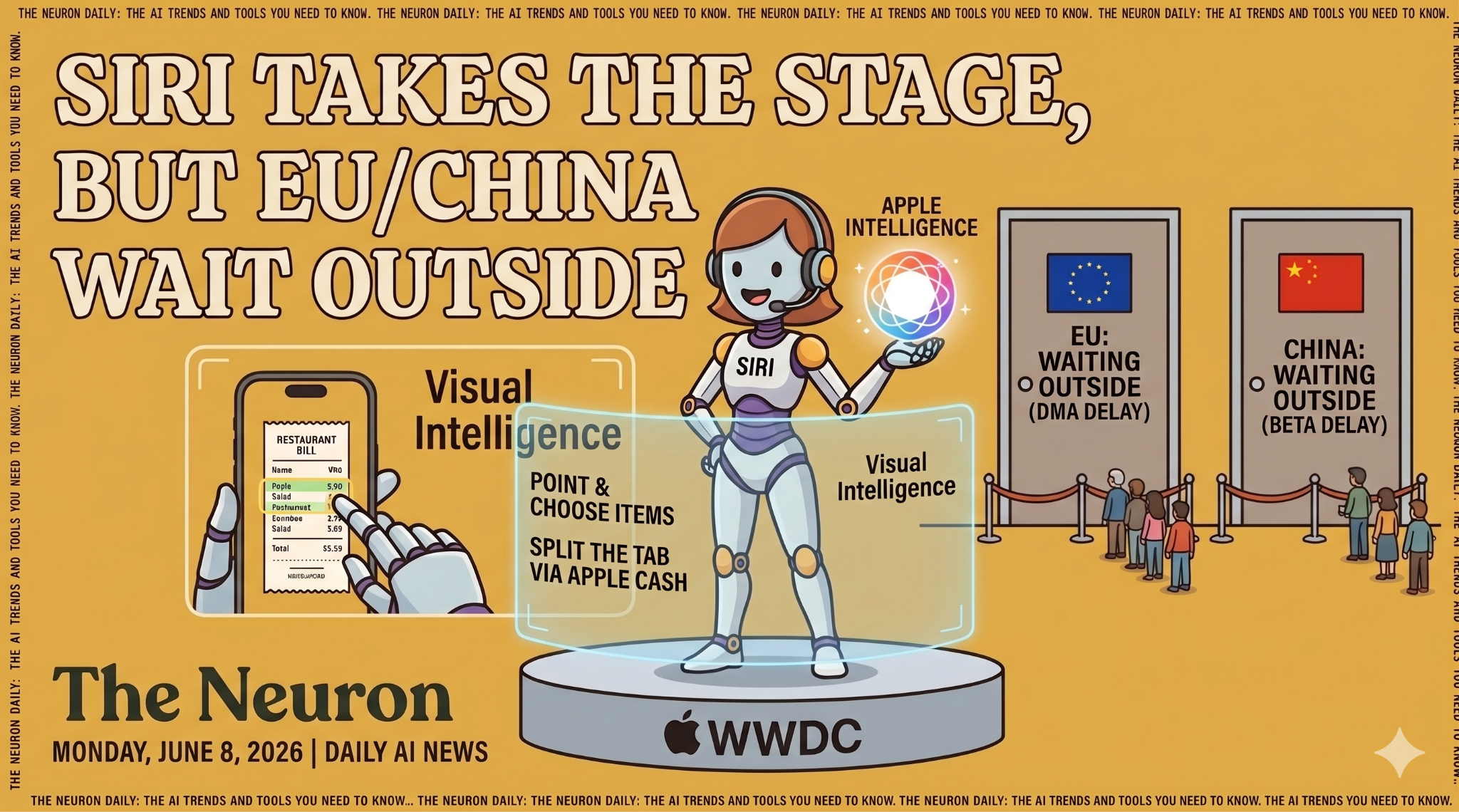
PLUS: Apple turned Siri into an OS layer. Now it has to work.
Ryan welcomes Bryan Clark, director of product for Lakebase at Databricks, to discuss what happens when AI agents become the primary creators and users of databases; why agents are “sloppy” about cleaning up infrastructure; and how database branching, scale-to-zero, and centralized access control can help teams keep up with agent-driven development.…
We made a thing!
In our post about Project Glasswing, we made the argument that the architecture around a vulnerability matters more than the speed of the patch. Here we walk through what that architecture looks like, the threats it defends against, and how we run it ourselves as Cloudflare's customer zero.
The 8th Annual Meeting of the Japanese Association for Medical Artificial Intelligence (JMAI) was held focusing on Medical Artificial Intelligence on June 5-6, 2026 at Toranomon Hills Forum in Tokyo. For more information, please see the fol
Musk takes SpaceX public Friday at $1.75 trillion, the largest IPO ever. Look past the rocket and you find the actual wager: an AI arm that lost $6.4 billion last year, a plan to put a million data-center satellites in orbit, and a valuation that has more than doubled since December. Below: how the pieces fit, what Apple's opposite bet tells us, and the launch of AI TV.

Anthropic has warned that recursive-self-improving AI could be on the horizon, but the truth is the company is more immediately concerned with marketing itself for a blockbuster initial public offering on the stock market, says Matthew Sparkes
I’m a 1st-year B.Tech CSE (AI & ML) student, and my first year has just ended. During this year, I mainly focused on learning Python because it’s important for AI/ML. Now during my summer break, I’m feeling a bit confused about what direction I should take next. Should I continue focusing mainly on AI/ML, or should I also start preparing for SDE/software development roles alongside it? I want guidance on: - What skills I should focus on in 2nd year - What I should avoid wasting time on - Whether balancing AI/ML and SDE together is a good idea - Important technologies or subjects I should start learning early I’d really appreciate advice from seniors or people already working in tech.
Don't overreact to the AI headlines, Apple is still an iPhone company. Plus: A look at SpaceX's coming valuation.
Enabling semantic query processing in Db2 for digital sovereignty
Does the problem of time series forecasting have or will it ever have a solution? In a strict mathematical sense. Will there ever be an algorithm that predicts a time series (almost)perfectly? Possibly with an acceptable lower bound for forecast error. I know about classical time series forecasting methods (like ARIMA, ETS, TBATS, etc.), about machine learning methods (linear, boosting) and deep learning (MLP, RNN, LSTM, even Transformer). But none of these methods make any assumptions about the data. In my understanding, it's impossible for the same model to predict energy consumption, stock prices, a sequence of prime numbers (that's also a time series, right?), and, for example, a sequence of squares of prime numbers equally well. Or am I wrong? No Free Lunch Theorem states what, without assumptions about data, there can't be a model that predicts perfectly (although everyone uses the same models for completely different data). In my opinion, it follows from this that perfect forecasting is impossible. On the other hand, Nearly Perfect Prediction Theorem states what perfect forecasting is possible (or at least its continuous analog). How can this be? I also very, very rarely see a strict formulation of the problem of forecasting a time series, from which it will follow whether the series is forecast correctly or not. Therefore I will give a statement of the problem that seems legitimate to me. Formally, a time series is a sequence of values $y$ , measured at constant time…
AI reliability issues stem from three separate architectural challenges that keep getting lumped into the same category. Prompt engineering alone can't fix them. But the sourcing and verification frameworks media organizations have used for centuries translate into clear engineering solutions developers can implement today.
[…] the economic costs continue to mount. Top10VPN’s Cost of Internet Shutdowns Report 2025 found that India ranked ninth globally for the total duration of intentional internet shutdowns, […]

When will markets price the singularity?
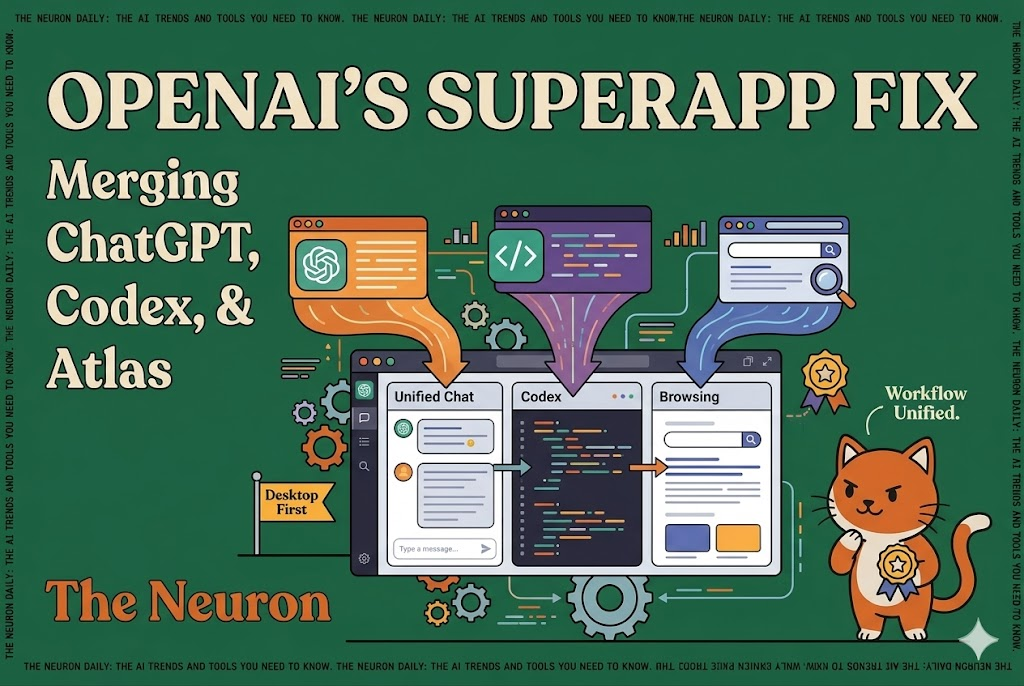
PLUS: Sam Altman declared a "code red." Here's the result.