
Import AI 444: LLM societies; Huawei makes kernels with AI; ChipBench
How can you quantify creativity?
AI/ML news, top picks, and generated innovation digests.
37348 matching items
How can you quantify creativity?
Recently I read Julian Mendel's article, " Mechanistic Interpretability: Peeking Inside an LLM " on Towards Data Science( https://towardsdatascience.com/mechanistic-interpretability-peeking-inside-an-llm/ ), and I became fascinated by the idea of moving beyond treating Large Language Models as "black boxes." Summary of the article's premise: The post proposes that we can understand and even manipulate an LLM’s behavior by examining its internal architecture—specifically the residual stream, attention heads, and MLP layers. It treats the model as a circuit that can be reverse-engineered to see how information is processed and stored. Key examples mentioned: World Models: How models represent internal states of games like Chess or Othello. Induction Heads: Specific attention heads that allow for in-context learning. Superposition: The phenomenon where neurons are "polysemantic," representing multiple concepts at once. Steering Vectors: Using activation addition to modify a model's behavior (e.g., making it more honest or preventing refusals) without retraining weights. Conclusion of the article: The author concludes that while manual mechanistic analysis provides deep insights into safety, reliability, and human-like cognition, the field is rapidly moving toward automated interpretability to handle the sheer scale of modern models. The Question : As someone looking to transition from a general understanding of Transformers to actually performing research or experiments in Mech…
Google adds Gemini AI-powered ‘auto browse’ to Chrome, Users flock to open source Moltbot for always-on AI, Qwen3-Max-Thinking debuts, and more!
The hidden cost of being a data-driven company is context-switching for analysts due to "quick questions." DataBot allows the data team to focus on auditing analysis instead of performing it.
This is a transcript of “GSP teaches Lex Fridman how to street fight”. The timestamps in the transcript are clickable links that take you directly to that point in the main video. Please note that the transcript is human generated, and may have errors. Here are some useful links: Watch the full YouTube version of the video Georges St-Pierre (00:00:00) In a street fight, I would rather- …fight Francis Ngannou than fight Bas Rutten. In a street fight. Lex Fridman (00:00:06) Let me tell you first that I’ve been around. I’ve been a bouncer for many, many years. Bang! Bang!
OpenMined is participating in the India AI Impact Summit 2026 in New Delhi, in partnership with the Human Genome Project II (HGP2). Together, we’re demonstrating how privacy-preserving infrastructure can enable countries to participate in global AI-driven genomics research on their own terms, without centralising sensitive health data. We’re hosting three events across the Summit week. […] The post OpenMined at the India AI Impact Summit 2026 appeared first on OpenMined .

This is a transcript of “1984 by George Orwell | Lex Fridman”. The timestamps in the transcript are clickable links that take you directly to that point in the main video. Please note that the transcript is human generated, and may have errors. Here are some useful links: Watch the full YouTube version of the video Table of Contents Here are the loose “chapters” in the video. Click link to jump approximately to that part in the transcript: 0:00 – Intro 1:02 – World of 1984 4:19 – Love 12:42 – Hate 17:21 – Power 25:56 – Orwell 28:49 –
China’s Moonshot releases a new open source model Kimi K2.5 and a coding agent, Google Brings Genie 3’s Interactive World-Building Prototype to AI Ultra Subscribers, and more!
Memory isn't just a feature for AI applications—it's infrastructure. As agents scale, the limited loop of stateless interactions breaks down, and continuity becomes a systems problem that requires active maintenance.
Deep Search empowers our Support Engineers to bypass initial escalations, enabling them to dive directly into investigating the root cause of issues.
AI is currently undergoing a shift, from massive centralized models to distributed, real-world deployments. While the cloud remains the foundation for large-scale AI training and analytics, AI’s next evolution lies at the edge—where data is created, where decisions require instant action, and where connectivity cannot be guaranteed. At MongoDB, we are committed to helping organizations build intelligent applications that span cloud and edge environments seamlessly. That’s why we are excited to highlight our work with ObjectBox, a lightweight, high-performance on-device database and sync solution purpose-built for edge AI and offline-first applications. Together, MongoDB and ObjectBox are making it easier for developers to build hybrid architectures that deliver fast, private, and resilient AI experiences across devices and environments. Figure 1. Example cloud-edge AI setup. Example cloud-edge AI setup. ObjectBox: A purpose-built database for the edge Founded by Markus Junginger and Dr. Vivien Dollinger, ObjectBox was designed specifically to support edge computing and offline-first use cases. At its core, ObjectBox’s design prioritizes efficiency (including speed, privacy, battery use, and memory consumption) and ease of development. This strong foundation makes ObjectBox particularly well-suited for next-generation applications that need to run reliably in edge environments—whether on a factory floor, in a retail store, or through a remote healthcare device. ObjectBox empo…
Modern AI systems can now generate speech that is difficult to distinguish from a real human voice. This raises concerns about AI being used in phone calls, customer service, or social interactions without clear disclosure. Some have suggested that AI outputs should be required to use explicit “machine-signaling” language (e.g., more analytical phrasing) so users cannot subconsciously interpret it as a human speaker. Question: Are there any existing laws, regulations, or technical standards (in the US, EU, or elsewhere) that require AI systems—particularly voice-based assistants or automated callers—to clearly disclose that they are AI or prevent human impersonation? If so, what frameworks or enforcement mechanisms currently exist?
AI agents are moving from demos to real workplaces, but what actually happens when they run a company? In this episode, journalist Evan Ratliff, host of Shell Game , joins Chris to discuss his immersive journalism experiment building a real startup staffed almost entirely by AI agents. They explore how AI agents behave as coworkers, how humans react when interacting with them, and where ethical and workplace boundaries begin to break down. Featuring: Evan Ratliff – LinkedIn , X Chris Benson – Website , LinkedIn , Bluesky , GitHub , X Links: Shell Game Upcoming Events: Register for upcoming webinars here !
Plus, a story about agents corrupting other agents
I recently sat down with Lex Fridman and Nathan Lambert for a comprehensive 4.5 h interview to discuss the current state of progress of AI, and what the...
Nathan Lambert and Sebastian Raschka are machine learning researchers, engineers, and educators. Nathan is the post-training lead at the Allen Institute for AI (Ai2) and the author of The RLHF Book. Sebastian Raschka is the author of Build a Large Language Model (From Scratch) and Build a Reasoning Model (From Scratch). Thank you for listening ❤ Check out our sponsors: https://lexfridman.com/sponsors/ep490-sc See below for timestamps, transcript, and to give feedback, submit questions, contact Lex, etc. Transcript: https://lexfridman.com/ai-sota-2026-transcript CONTACT LEX: Feedback – give feedback to Lex: https://lexfridman.com/survey AMA – submit questions, videos or call-in: https://lexfridman.com/ama Hiring – join our team: https://lexfridman.com/hiring
This is a transcript of Lex Fridman Podcast #490 with Nathan Lambert & Sebastian Raschka. The timestamps in the transcript are clickable links that take you directly to that point in the main video. Please note that the transcript is human generated, and may have errors. Here are some useful links: Go back to this episode’s main page Watch the full YouTube version of the podcast Table of Contents Here are the loose “chapters” in the conversation. Click link to jump approximately to that part in the transcript: 0:00 – Introduction 1:57 – China vs US: Who wins the AI
This famous aphorism is neither true nor useful
Today, we're joined by Yejin Choi, professor and senior fellow at Stanford University in the Computer Science Department and the Institute for Human-Centered AI (HAI). In this conversation, we explore Yejin’s recent work on making small language models reason more effectively. We discuss how high-quality, diverse data plays a central role in closing the intelligence gap between small and large models, and how combining synthetic data generation, imitation learning, and reinforcement learning can unlock stronger reasoning capabilities in smaller models. Yejin explains the risks of homogeneity in model outputs and mode collapse highlighted in her “Artificial Hivemind” paper, and its impacts on human creativity and knowledge. We also discuss her team's novel approaches, including reinforcement learning as a pre-training objective, where models are incentivized to “think” before predicting the next token, and "Prismatic Synthesis," a gradient-based method for generating diverse synthetic math data while filtering overrepresented examples. Additionally, we cover the societal implications of AI and the concept of pluralistic alignment—ensuring AI reflects the diverse norms and values of humanity. Finally, Yejin shares her mission to democratize AI beyond large organizations and offers her predictions for the coming year. The complete show notes for this episode can be found at https://twimlai.com/go/761.
Leadership in the world of artificial intelligence (AI) will in the coming years increasingly depend on energy, instead of the current focus on chips, writes Alfonso Velazquez, Head of Data and AI at Kyndryl.
Over the past year, artificial intelligence (AI) has dominated headlines and rapidly scaled across the business landscape. This year, the technology is set to move beyond hype to deliver measurable business impact, writes Mauricio Torres Echenagucia, General Manager of Mexico at IBM.
As Mexico enters 2026, supply chain and logistics leaders are navigating the most complex trade environment the region has faced in over a decade. Rising tariff uncertainty, evolving US trade policy, and the upcoming USMCA review are no longer abstract geopolitical discussions; they are operational realities with direct impact on cost, service levels, network design, and strategic decision-making.

Angular is a cohesive, all-in-one reactive framework for web development. It is one of the larger reactive frameworks, focused on being a single architectural system that handles all your web development needs under one idiom. While Angular was long criticized for being heavyweight as compared to React , many of those issues were addressed in Angular 19 . Modern Angular is built around the Signals API and minimal formality, while still delivering a one-stop-shop that includes dependency injection and integrated routing. Angular is popular with the enterprise because of its stable, curated nature, but it is becoming more attractive to the wider developer community thanks to its more community engaged development philosophy . That, along with its recent technical evolution, make Angular one of the most interesting projects to watch right now. Why choose Angular? Choosing a JavaScript development framework sometimes feels like a philosophical debate, but it should be a practical decision. Angular is unique because it is strongly opinionated. It doesn’t just give you a view layer; it provides a complete toolkit for building web applications. Like other reactive frameworks, Angular is built around its reactive engine, which lets you bind state (variables) to the view. But if that’s all you needed, one of the smaller, more focused frameworks would be more than enough. What Angular has that some of these other frameworks don’t is its ability to use data binding to automatically syn…
Learn how GitHub built an accessible, multi-terminal-safe ASCII animation for the Copilot CLI using custom tooling, ANSI color roles, and advanced terminal engineering. The post From pixels to characters: The engineering behind GitHub Copilot CLI’s animated ASCII banner appeared first on The GitHub Blog .
OpenAI to test ads in ChatGPT as it burns through billions, The Drama at Thinking Machines, STEM: Scaling Transformers with Embedding Modules

Thriving in a world of agents
Integration Consulting, a Brazil-headquartered management consultancy with offices worldwide, has announced the appointment of Carolina Flores as partner. She becomes the firm’s 13th partner. Now in her 15th year at Integration Consulting, Carolina Flores leads complex projects for major Brazilian companies across retail, consumer goods, healthcare and financial services.

Sinister variations on the positive state of flow
As AI increasingly shapes geopolitics, elections, and civic life, its impact on democracy is becoming impossible to ignore. In this episode, Daniel and Chris are joined by security expert Bruce Schneier to explore how AI and technology are transforming democracy, governance, and citizenship. Drawing from his book Rewiring Democracy , they explore real examples of AI in elections, legislation, courts, and public AI models, the risks of concentrated power, and how these tools can both strengthen and strain democratic systems worldwide. Featuring: Bruce Schneier – X Chris Benson – Website , LinkedIn , Bluesky , GitHub , X Daniel Whitenack – Website , GitHub , X Links: Schneier on Security Sponsors: Framer - The website builder that turns your dot com from a formality into a tool for growth. Check it out at framer.com/PRACTICALAI Zapier - The AI orchestration platform that puts AI to work across your company. Check it out at zapier.com/practical Upcoming Events: Register for upcoming webinars here !
My response variable showed significant underdispersion, which was due to uneven sampling. I searched for the right models and was advised to fit a COM Poisson model, as quasi-Poisson and other generalisations might be too optimistic. I am now wondering whether the evaluation of my model in terms of explanatory power and fit needs to be done differently than with standard procedures for GLMs (measured using likelihood ratio tests, chi-square tests, and deviations). I ask this because I cannot find any literature that is not too specific or doesn't require too much prior knowledge.
AI for Good Impact Africa, our second regional event brought together innovators, policymakers, startups, and youth from across the continent for the transformative week of dialogue and discovery. Held alongside AI Expo Africa in Johannesburg, the event marked a milestone in fostering local innovation, building capacity, and strengthening partnerships to advance responsible artificial intelligence across […]
For several decades now, the most innovative software has always emerged from the world of open source software. It’s no different with machine learning and large language models . If anything, the open source ecosystem has grown richer and more complex, because now there are open source models to complement the open source code. For this article, we’ve pulled together some of the most intriguing and useful projects for AI and machine learning . Many of these are foundation projects, nurturing their own niche ecology of open source plugins and extensions. Once you’ve started with the basic project, you can keep adding more parts. Most of these projects offer demonstration code, so you can start up a running version that already tackles a basic task. Additionally, the companies that build and maintain these projects often sell a service alongside them. In some cases, they’ll deploy the code for you and save you the hassle of keeping it running. In others, they’ll sell custom add-ons and modifications. The code itself is still open, so there’s no vendor lock in. The services simply make it easier to adopt the code by paying someone to help. Here are 16 open source projects that developers can use to unlock the potential in machine learning and large language models of any size—from small to large, and even extra large. Agent Skills AI coding agents are often used to tackle standard tasks like writing React components or reviewing parts of the user interface . If you are writin…

What makes something truly *intelligent?* Is a rock an agent? Could a perfect simulation of your brain actually *be* you? In this fascinating conversation, Dr. Jeff Beck takes us on a journey through the philosophical and technical foundations of agency, intelligence, and the future of AI. Jeff doesn't hold back on the big questions. He argues that from a purely mathematical perspective, there's no structural difference between an agent and a rock – both execute policies that map inputs to outputs. The real distinction lies in *sophistication* – how complex are the internal computations? Does the system engage in planning and counterfactual reasoning, or is it just a lookup table that happens to give the right answers? *Key topics explored in this conversation:* *The Black Box Problem of Agency* – How can we tell if something is truly planning versus just executing a pre-computed response? Jeff explains why this question is nearly impossible to answer from the outside, and why the best we can do is ask which model gives us the simplest explanation. *Energy-Based Models Explained* – A masterclass on how EBMs differ from standard neural networks. The key insight: traditional networks only optimize weights, while energy-based models optimize *both* weights and internal states – a subtle but profound distinction that connects to Bayesian inference. *Why Your Brain Might Have Evolved from Your Nose* – One of the most surprising moments in the conversation. Jeff proposes that the…
And an Overview of Recent Inference-Scaling Papers

Professor Mazviita Chirimuuta joins us for a fascinating deep dive into the philosophy of neuroscience and what it really means to understand the mind. *What can neuroscience actually tell us about how the mind works?* In this thought-provoking conversation, we explore the hidden assumptions behind computational theories of the brain, the limits of scientific abstraction, and why the question of machine consciousness might be more complicated than AI researchers assume. Mazviita, author of *The Brain Abstracted,* brings a unique perspective shaped by her background in both neuroscience research and philosophy. She challenges us to think critically about the metaphors we use to understand cognition — from the reflex theory of the late 19th century to today's dominant view of the brain as a computer. *Key topics explored:* *The problem of oversimplification* — Why scientific models necessarily leave things out, and how this can sometimes lead entire fields astray. The cautionary tale of reflex theory shows how elegant explanations can blind us to biological complexity. *Is the brain really a computer?* — Mazviita unpacks the philosophical assumptions behind computational neuroscience and asks: if we can model anything computationally, what makes brains special? The answer might challenge everything you thought you knew about AI. *Haptic realism* — A fresh way of thinking about scientific knowledge that emphasizes interaction over passive observation. Knowledge isn't about read…
Ipsos’ and Google’s study shows how public perceptions on AI have evolved as people have come to see AI as a practical tool for learning, work, and daily life. In 2025, the world decisively crossed the AI adoption threshold. People moved past casual experimentation – the highest use case in 2024 – and embraced AI as an […]
OpenAI to test ads in ChatGPT as it burns through billions, Sequoia to invest in Anthropic, Zhipu AI breaks US chip reliance, The Drama at Thinking Machines Is Riveting Silicon Valley
By John Knechtel From the telescope to the balance sheet – a Foundation Models for Science Workshop recap relates how scientists can help businesses solve their most stubborn data problems and […] The post The New Cartography of the Invisible appeared first on Vector Institute for Artificial Intelligence .
Earthwise, a boutique advisory firm from the Netherlands specialising in sustainability, has opened a new office in Colombia as part of its international expansion. Founded in 2024 by a team of “sustainability enthusiasts”, Earthwise advises mid-sized and large organisations on ESG and sustainability-related challenges.
When it comes to working with data in a tabular form, most people reach for a spreadsheet. That’s not a bad choice: Microsoft Excel and similar programs are familiar and loaded with functionality for massaging tables of data. But what if you want more control, precision, and power than Excel alone delivers? In that case, the open source Pandas library for Python might be what you are looking for. Pandas augments Python with new data types for loading data fast from tabular sources, and for manipulating, aligning, merging, and doing other processing at scale. Your first Pandas data set Pandas is not part of the Python standard library. It’s a third-party project, so you’ll need to install it in your Python runtime with pip install pandas . Once installed, you can import it into Python with import pandas . Pandas gives you two new data types: Series and DataFrame . The DataFrame represents your entire spreadsheet or rectangular data, whereas the Series is a single column of the DataFrame . In Python terms, you can think of the Pandas DataFrame as a dictionary or collection of Series objects. You’ll also find later that you can use dictionary- and list-like methods for finding elements in a DataFrame . You typically work with Pandas by importing data from some other format. A common external tabular data format is CSV, a text file with values separated by commas. If you have a CSV handy, you can use it. For this article, we’ll be using an excerpt from the Gapminder data set pre…
Cross-repo search provides semantic code understanding across repositories.
As generative AI moves into production, traditional guardrails and input/output filters can prove too slow, too expensive, and/or too limited. In this episode, Alizishaan Khatri of Wrynx joins Daniel and Chris to explore a fundamentally different approach to AI safety and interpretability. They unpack the limits of today’s black-box defenses, the role of interpretability, and how model-native, runtime signals can enable safer AI systems. Featuring: Alizishaan Khatri – LinkedIn Chris Benson – Website , LinkedIn , Bluesky , GitHub , X Daniel Whitenack – Website , GitHub , X Upcoming Events: Register for upcoming webinars here !
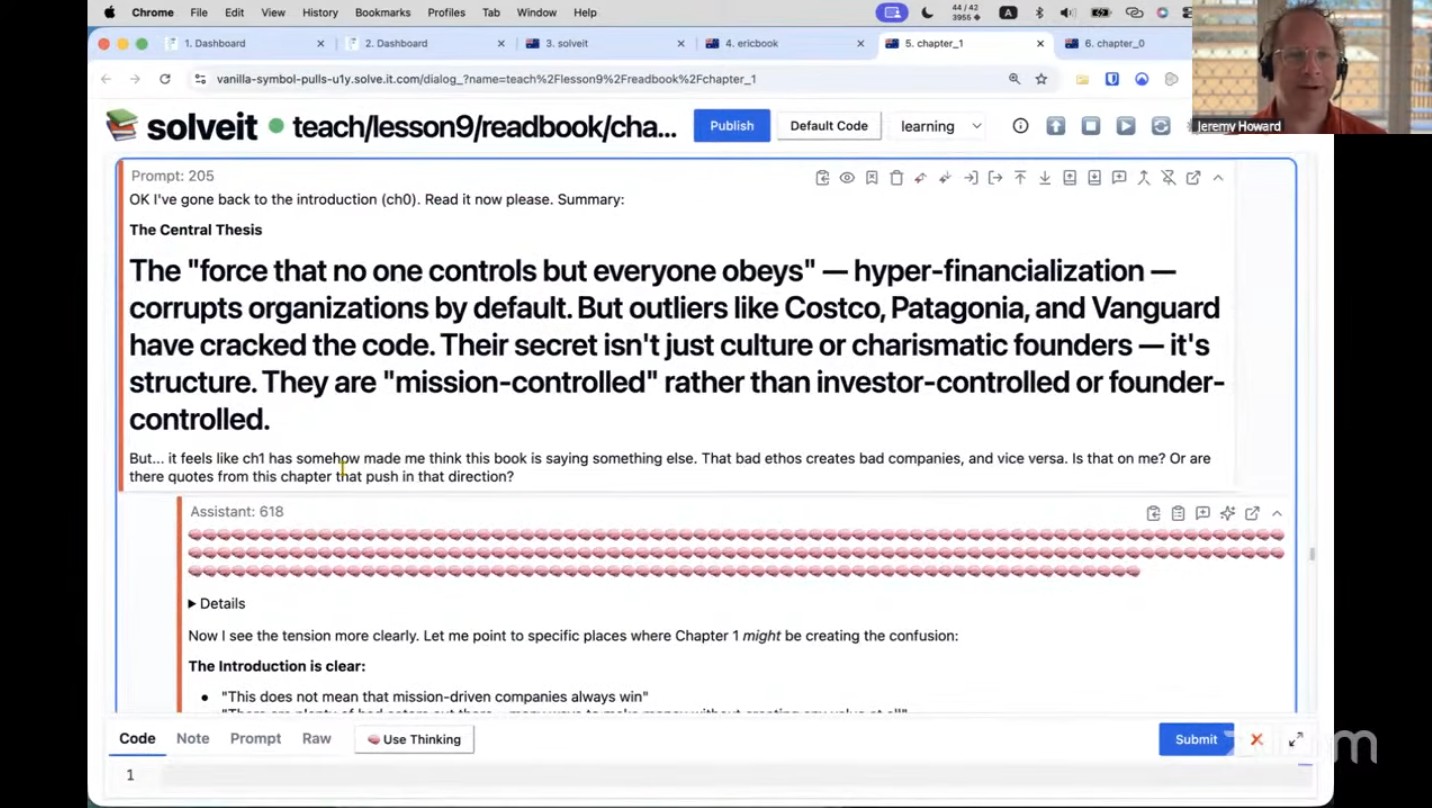
Experiments in reading with LLMs
Colombians are largely supportive of ESG initiatives, with a new study indicating that over 80% of the population believes it is essential for both the government and large corporations to transition toward renewable energy and make a real effort for a more sustainable system.