BBVA puts AI at the core of banking with OpenAI
Learn how BBVA scaled ChatGPT Enterprise to 100,000 employees and partnered with OpenAI to accelerate AI-powered banking transformation worldwide.
AI/ML news, top picks, and generated innovation digests.
8510 matching items
Learn how BBVA scaled ChatGPT Enterprise to 100,000 employees and partnered with OpenAI to accelerate AI-powered banking transformation worldwide.
Diffusion AI is most common in image generation, but it can make text outputs much faster.
Herrera, despite constant threats, spent two decades reporting on crime and corruption near Colombia’s border with Venezuela. The post Cristian Herrera reported where fear tried to silence others. Then he was killed appeared first on LatAm Journalism Review by the Knight Center .
The panelists considered three key issues facing colleges and universities: rapidly advancing technology; an altered relationship with the federal government; and an erosion of public trust in higher education. The post Alumni college leaders explore the future of higher ed appeared first on Cornell AI Initiative .
Cornell computer scientists will lead the development of safety protocols to shore up AI agents and the code they produce. The post Amazon partnership establishes Cornell AI security initiative appeared first on Cornell AI Initiative .
Microsoft Build sit-down with Mustafa Suleyman on Microsoft’s 7-model AI flex
El Centro Nacional de Inteligencia Artificial (CENIA) es una corporación público-privada, financiada por la Agencia Nacional de Investigación y Desarrollo (ANID) desde noviembre de 2021. Nuestro propósito es poner la Inteligencia Artificial al servicio de las personas y transformar a Chile en un referente en el desarrollo científico y tecnológico de la IA en Latinoamérica […] The post ¡Trabaja en CENIA! appeared first on CENIA .

Written by Rohit Channe and Simran Mirchandani at Lyft. Motivation At Lyft, data isn’t just a resource — it’s woven into everything we do. Metrics drive key forecasts, steer operational decisions, and put our boldest hypotheses to the test. But as Lyft scaled, products launched and evolved, and team members came and went, we found ourselves at risk of different teams using different definitions for a given metric. What did “Metric ABC” actually mean? The answer often depended on the context and application of the team you asked. The consequences were predictable. Without centralized version control or a shared standard, outdated metric definitions crept into decision-making. Our solution was to build an internal Metric Semantic Layer (MSL) : a centralized repository that serves as a single, authoritative home for every metric’s definition — providing both a clear, plain-English description and the definitive SQL code. No more hunting across codebases or tribal knowledge — just one place to store and access a standardized, agreed-upon definition. With MSL, we have a single source of truth — consistent terminology and assumptions across every team, so everyone is genuinely speaking the same language. We achieve this through three key principles: Simplified onboarding and change management — update a metric definition once, and the change automatically and frictionlessly flows through every downstream application that depends on it Intentional governance — clarified ownership,…
A Data Privacy Brasil participou da trilha online sobre segurança digital em campanhas eleitorais promovida pelo RenovaBR, iniciativa voltada à formação de lideranças políticas e equipes de campanha para os desafios do ambiente digital contemporâneo. A atividade reuniu especialistas para discutir riscos, responsabilidades e boas práticas relacionadas ao uso de tecnologias, dados pessoais e inteligência artificial durante os processos eleitorais. O post Campanhas eleitorais inteligentes: Data Privacy Brasil contribui para trilha do RenovaBR sobre segurança digital apareceu primeiro em Data Privacy Brasil Research .
TL;DR Helion kernels were integrated into vLLM for FP8 inference using Qwen3 models and evaluated across NVIDIA H100 and B200 GPUs. The experiments show that Helion provides a productive PyTorch-native...
Install and configure LSP servers for GitHub Copilot CLI, replacing brute-force grep/decompile with real code intelligence. The post Give GitHub Copilot CLI real code intelligence with language servers appeared first on The GitHub Blog .
This working draft of AI Now’s upcoming report traces corporate power in the data center industry in the United States, focusing on the flows of money and power that determine who both drives and benefits from the current data center boom. The aim of this research is to help local communities and their advocates fight […] The post Report and Community Resources: Corporate Power Players in the Data Center Industry appeared first on AI Now Institute .
PLUS: New Claude Models Fables 5 and Mythos 5, Explained
If your coding agent has questions, Stack Overflow for Agents has answers, now in beta.
Millions of Iranians oppose their government, but that doesn't mean they want foreign bombs. Neda Bolourchi explores the ethical gray zones of this conflict.
Back in February, I wrote about what I called the “Data Center Rebellion,” the growing local resistance to the physical infrastructure behind AI. Since then, I have been asking tech people around the Bay Area how closely they are following the backlash. The answer is usually: they know it exists, but not much more than Continue reading "The Gap Between the Press Release and the Power Grid" The post The Gap Between the Press Release and the Power Grid appeared first on Gradient Flow .
At Spotify, data problems used to follow a specific pattern. You'd look for the relevant dashboard, there... The post Encoding Your Domain Expert: The Context Layer Behind Spotify's Data Assistant appeared first on Spotify Engineering .

OpenAI ’s fourth large language model (LLM), GPT-4 , took an estimated 50 gigawatt-hours to train, or the equivalent of 5,000 American homes ’ yearly power consumption. That was in 2023. Since then, the computational resources used to train frontier LLMs have only increased , though direct power usage numbers are hard to come by. Now, a research group at the University of Twente in the Netherlands has shown that you can save up to 14 percent of the energy used in LLM training without sacrificing speed by cleverly adjusting the clock frequency of the GPU during computation. Jeffrey Spaan , Ph.D. candidate at University of Twente and lead author on the article, presented the results at the Computing Frontiers conference in Catania, Sicily, last month. “My research is about finding computing waste,” Spaan says. “It’s similar to underutilization of the hardware, but instead of optimizing the software for the hardware, we try to optimize the hardware for the software.” Making the GPU tick Spaan and his collaborators accomplished this by using a technique known as dynamic voltage and frequency scaling ( DVFS ). Every chip—including the GPUs commonly used for training frontier models—uses at least one clock to orchestrate computations. Each operation in the chip is triggered by a clock pulse. The frequency with which that clock ticks controls how fast the chip operates and how much power it draws. Modern GPUs have two clocks, one for the computational core and one for the memory. W…
What a profound honor to have Paul Kennedy on the ChinaTalk podcast.
President Kagame approves formation of Rwanda’s dedicated AI institution
I am considering to buy GPUs for my project of open source text-to-video models like ltx-2-19b (lightricks) or wan-v2.2-a14b. I read online that the same configuration/quantization and seed will give similar results in quality, only difference is in speed/latency of generation. Is this true? Or will there be a difference ?
The much anticipated launch of the Mythos-class model was marred by some controversial usage policies
Many organizations are already deploying agentic workflows. Some are still experimental, while others are running in production. Once an AI agent can take action on behalf of a business, the question is no longer whether it’s useful, but what happens when something goes wrong. It’s tempting to focus on blame: the AI vendor, the manager, […]
I have already come into the part of CTC, and I am reading the paper of Flow-TTS recently. What I cannot understand is that the algorithm did not rely on the label, but with the features inside the Mel-spectrogram, then it can alignment the tokens. I know it is trying to predict the probability each frame is by the token, but I cannot quite understand the loss part. Seems it is combined with encoded mel-spectrogram, mu and sigma. And I am confused about that. Thank you very much..
One step further into the power politics of frontier AI systems.
As context windows grow into the millions of tokens, many AI practitioners are questioning whether retrieval-augmented generation (RAG) is still necessary. If modern models can ingest entire libraries of documents, why bother with retrieval at all? In this episode, Alex Bowcut, Head of Engineering at Sphere, explains why the answer depends on the application. Sphere uses AI to automate global tax compliance—an environment where getting the answer right isn’t enough. Every conclusion must be backed by the correct legal citation, and every decision must withstand expert review. We explore how Sphere built TRAM (Tax Review and Assessment Model), a production AI system that combines retrieval, reasoning models, legal review workflows, reinforcement learning, and deterministic systems to help tax experts move nearly two orders of magnitude faster while maintaining accuracy. Along the way, we discuss why RAG remains critical in high-stakes domains, how Sphere processes legal and regulatory documents from jurisdictions around the world, retrieval architectures, semantic chunking, dense versus sparse retrieval, expert feedback loops, and the challenges of building AI systems that people can actually trust. 🗒️ Full show notes: https://twimlai.com/go/769.
Written by Atul Gupta , Analytics Manager — LUS Support Ops, Lyft At Lyft, getting operators and riders connected quickly and reliably depends on more than technology — it depends on the teams working behind the scenes to keep that technology running smoothly. For the operators managing Lyft’s fleet across markets, having fast, reliable access to support is what keeps bikes on the road, stations stocked, and issues resolved before they affect riders. Building the infrastructure that makes that support possible is what our team does; this is the story of how we built it. When I first joined Lyft Urban Solutions’ (LUS) Support Ops team in 2020, ticketing processes for our operators were still being established. There was no reliable way to raise issues, track progress, or get routed to the right person. We had a Jira Help Center, but it had become increasingly difficult to navigate. What followed was a five-year journey of transforming that chaos into a streamlined, automated, self-routing system that now handles thousands of tickets per year, with one third of those routed automatically — saving hours of manual triage work annually. The Problem: Organic Growth Gone Wrong On the surface, a Jira Help Center sounds like a reasonable solution. In practice, ours had become a maze. Here’s what we were dealing with: Duplicate intake forms doing the same job under different names Redundant categories with no clear ownership Forms that didn’t capture the right information upfront, for…
Claude Fable represents another big jump in AI
Artificial intelligence may one day give robots social intelligence, but so far, existing models do a poor job of using human facial cues to predict the outcome of a situation. The post Can robots read the room? appeared first on Cornell AI Initiative .
While AI standards and best practices provide valuable guidance to practitioners, they often are geared toward integrating AI into the structure and practices of large, well-resourced organizations. Yet small and medium enterprises (SMEs) stand to benefit greatly from AI adoption as well. This blog examines the implications of AI standards for smaller organizations and proposes several achievable initial steps that practitioners can take to further responsible AI deployment under resource constraints. The post What Do AI Standards Mean for Small and Medium Enterprises? appeared first on Center for Security and Emerging Technology .
Prime Minister Carney launched AI for All, Canada’s new national AI strategy. It’s a moment that Vector, and anyone dedicated to building Canada’s AI future, have been diligently working towards. […] The post Vector welcomes Canada’s AI Strategy: AI for All appeared first on Vector Institute for Artificial Intelligence .

The post Why don’t cancer medicines work the same for everyone? appeared first on Source .
No episódio 201 do Dadocracia, falamos sobre as mudanças nos apps de relacionamento: recursos de auxílio para conversas, seleção de fotos e, em alguns casos, a preferência de parte dos usuários por se relacionar diretamente com sistemas de IA. O post Dadocracia – Ep. 201 – IA nos Apps de Relacionamento apareceu primeiro em Data Privacy Brasil Research .
- Why traditional vulnerability disclosure fails for open-weight models—and how we are building a new standard for AI evaluation. The post The patch model is breaking. AI evaluation needs a new way to disclose what it finds. appeared first on MLCommons .
what's the deal with loops
Subscribe • Previous Issues The Gap Between the Press Release and the Power Grid Back in February, I wrote about what I called the “Data Center Rebellion,” the growing local resistance to the physical infrastructure behind AI. Since then, I have been asking tech people around the Bay Area how closely they are following the backlash. The Continue reading "12 GW announced. 5 GW under construction. What happens next?" The post 12 GW announced. 5 GW under construction. What happens next? appeared first on Gradient Flow .

Tracking how fast glaciers are shrinking is crucial for measuring the pace of climate change and projecting future sea level rises. This is normally a painstaking manual job, but a new approach that enables AI to analyze satellite images of glaciers anywhere in the world could help automate the monitoring process. Glaciers that flow directly into the ocean play a crucial role in the earth’s climate, but global warming is making them retreat ever faster. This can have severe knock-on effects as ice that breaks away from “calving fronts”—the ends of glaciers where icebergs shear off into the water—dumps massive amounts of freshwater into the sea, which can alter ocean currents and cause sea levels to rise. Bright white glaciers also reflect a lot of sunlight. When they shrink, they expose dark seawater that absorbs heat from the sun. All of this means that tracking glacier loss is critical for understanding how both local and global climate conditions will change over time. But the number of glaciers that need to be monitored around the world far outstrips the capacity of human analysts. There is hope that AI-based image analysis could help plug the gap, but previous models have performed poorly on regions not included in their training data. This severely limits the applicability of the approach, given how difficult it is to collect manually-labeled images. Now, a paper accepted to the IEEE International Conference on Image Processing (ICIP) shows that a leading deep learning…
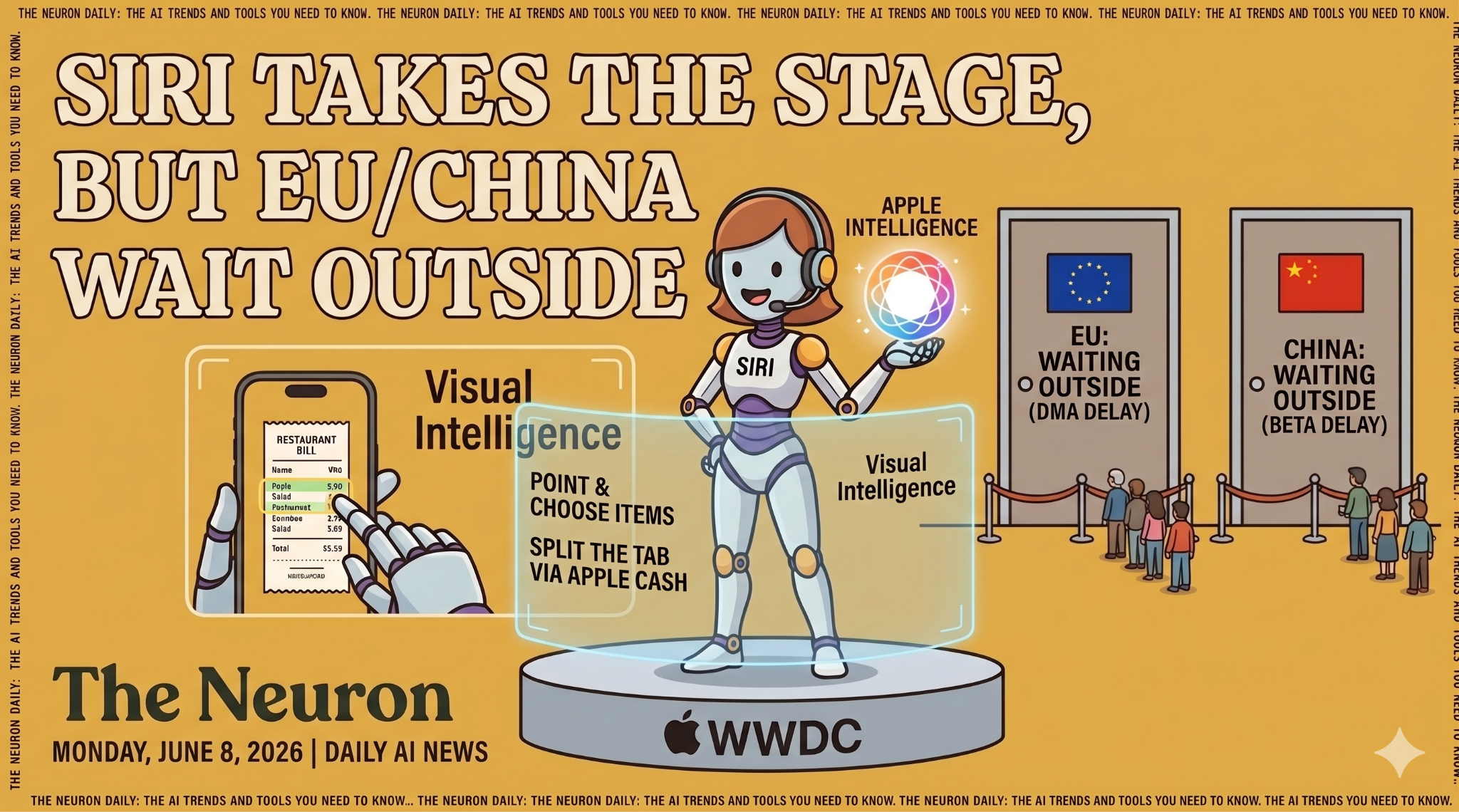
PLUS: Apple turned Siri into an OS layer. Now it has to work.
Ryan welcomes Bryan Clark, director of product for Lakebase at Databricks, to discuss what happens when AI agents become the primary creators and users of databases; why agents are “sloppy” about cleaning up infrastructure; and how database branching, scale-to-zero, and centralized access control can help teams keep up with agent-driven development.…
We made a thing!
In our post about Project Glasswing, we made the argument that the architecture around a vulnerability matters more than the speed of the patch. Here we walk through what that architecture looks like, the threats it defends against, and how we run it ourselves as Cloudflare's customer zero.
The 8th Annual Meeting of the Japanese Association for Medical Artificial Intelligence (JMAI) was held focusing on Medical Artificial Intelligence on June 5-6, 2026 at Toranomon Hills Forum in Tokyo. For more information, please see the fol
Musk takes SpaceX public Friday at $1.75 trillion, the largest IPO ever. Look past the rocket and you find the actual wager: an AI arm that lost $6.4 billion last year, a plan to put a million data-center satellites in orbit, and a valuation that has more than doubled since December. Below: how the pieces fit, what Apple's opposite bet tells us, and the launch of AI TV.