AI/ML News & Innovations Hub

AI/ML news, top picks, and generated innovation digests.

★ Visit ai-karthik.com
422Sources
8549News Items
8Top Picks
68Blogs
failedLast Run

Latest AI/ML News

8549 matching items

MERICS China AI 2026-06-03 08:13 UTC Score 35.0 USR-0207-20260603-research-aca-39e2a2ad Full article

China is poised to gain as global memory makers pivot to AI chips

China is poised to gain as global memory makers pivot to AI chips Linda_Heyer Wed, 06/03/2026 - 10:13 picture alliance / Zoonar | Askolds Berowskis Comment Jun 03, 2026 3 min read China is poised to gain as global memory makers pivot to AI chips China is capitalizing on the US and South Korean memory makers’ shift into high-margin AI chip production by building up its mass production of cheap memory chips – a trend that may create a new European dependency on China. Major Chinese memory chip makers are already benefitting from skyrocketing prices as demand grows. They are now focusing on mass production of mature Dynamic Random Access Memory (DRAM) chips and NAND flash memory, vital for core industrial sectors such as automotive electronics, industrial automation, and medical equipment. Europe’s highly price-sensitive automotive and industrial sectors do not rely on advanced AI chips, but they do need large amounts of memory chips, for which Europe has no domestic production. And there is no new capacity on the horizon, as the European Chips Act focuses on logic and power chips rather than memory. Even if Europe leads in automotive power chips, those cars do not work without memory. Many other industries have given up low-margin, high-volume parts of their manufacturing to China in past years. While this may boost profits in the short term, it has led to supply chain dependencies in the long run. Moreover, if history is any indication, Chinese industrial players can then use…


MERICS China AI 2026-06-03 08:01 UTC Score 67.0 USR-0207-20260603-research-aca-5119adc6 Full article

China’s AI competition strategy: Wide dispersion, cheap tokens

China’s AI competition strategy: Wide dispersion, cheap tokens Linda_Heyer Wed, 06/03/2026 - 10:01 picture alliance / Bildagentur-online | Tetra Images-Erik Isakson Comment Jun 03, 2026 2 min read China’s AI competition strategy: Wide dispersion, cheap tokens China’s flagship AI company DeepSeek released its V4 model in April, with a promotional price that puts it at a mere fraction of the cost of its North American competitors’ models. This reflects a wider trend in China’s AI sector: Instead of competing directly with companies like OpenAI, Anthropic and Google, who offer state of the art services at a premium, Chinese companies are pursuing a strategy of wide diffusion and cheap tokens to gain market share across the world. For Europe, this may pose the risk of forming a quick dependency on Chinese models as the basis for AI development, plus European talent being funneled to enhance Chinese systems. Many Chinese AI companies have followed the DeepSeek model. They are building models that are decent, but not cutting-edge, in performance and instead are focused on high compute efficiency that lowers costs for users. They have also made their models available via open-source platforms, meaning anyone can use, fine-tune and host them for free, as opposed to proprietary models like current Western leaders. Downloads of Chinese models on open-source platform Hugging Face have surpassed US models since late 2025. Of the top ten open-weight models by performance, the top seven a…

Weaviate Blog 2026-06-03 00:00 UTC Score 33.0 USR-0073-20260603-ai-specialis-3c8faf5e Full article

Engram is now Generally Available

Engram, Weaviate's managed memory and context service for agentic applications, is now generally available.

Instacart Tech Blog 2026-06-02 18:50 UTC Score 27.0 USR-0056-20260602-ai-specialis-7114aea6 Full article

From Scoring to Spelling: Rebuilding Ads Retrieval at Instacart

Key Contributors: Karuna Ahuja, Marko Avdalovic, Soroush Sobhkhiz, Shrikar Archak, Xiyu Wang, Ji Chao Zhang, Hao Yan Introduction Every time a user opens Instacart, they see product recommendations: on the retailer home page, in search results, and alongside their cart. Many of these recommendations are sponsored products surfaced by a retrieval model that decides which products to show from a vast ads product catalog. A relevant ad helps users discover products they didn’t know they needed; a less relevant one generates friction. Two years ago, we introduced Contextual Recommendations (CR) , a BERT-based sequence model powering retrieval for both ads and organic recommendations across all major browse surfaces. In this post, we’ll focus on our ads retrieval. We will detail how we rebuilt the system, by moving from an encoder that scores products to a generative model that spells them out, token by token. By doing so, we unlocked a new level of contextual matching — ensuring brands appear exactly when users want them, while simultaneously opening up discovery of thousands of relevant products the previous system couldn’t retrieve. Contextual Recommendations: A recap At its core, CR treats grocery shopping as a language modeling task, where atomic product IDs function as tokens and, the finite subset of the catalog it is trained on, acts as its ‘vocabulary’. The model leverages the user’s real-time session, which includes product views, item page visits, and cart additions, a…

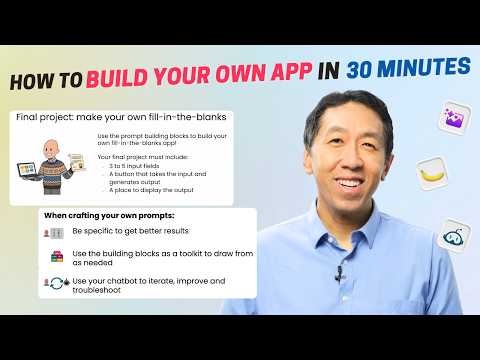
Build Your Own App In Just 30 Minutes! Full Course with Andrew Ng
DeepLearning.AI YouTube 2026-06-02 18:02 UTC Score 30.0 AI-138-20260602-podcasts-and-aa16f1ec Full article

Build Your Own App In Just 30 Minutes! Full Course with Andrew Ng

Earn your certificate here: https://bit.ly/4ejb47H If you’ve never written code before, this course is for you. In less than 30 minutes, you’ll learn to describe an idea in words and let AI transform it into an app for you. You’ll build a working web application in minutes: A funny interactive birthday message generator that runs in your browser and can be shared with friends. Then you’ll customize it by telling AI how you want it changed, tweaking it until it works exactly how you want. You’ll learn about best practices for building with AI, such as how to improve your app step-by-step and fix problems when they come up. In this course, you’ll learn to: - Build web applications through prompting: Build interactive tools by describing what you want and collaborating with AI to create working applications—no coding experience required. - Customize and troubleshoot AI-generated apps: Customize features like input fields, buttons, and color schemes through hands-on collaboration with AI, learning to troubleshoot and improve as you go. - Learn a repeatable framework you can apply to any app idea by practicing with different examples—from fun projects like a ping pong game to practical tools like time-off request forms. This course assumes no prior knowledge of AI or coding. You’ll build a birthday card app, customize it with additional features, then use the same framework to build a table tennis game. By the end, you’ll be an AI builder with a framework for building any applica…

Instacart Tech Blog 2026-06-02 16:58 UTC Score 24.0 USR-0056-20260602-ai-specialis-ce2720c2

Semantic IDs: Product Understanding at Scale

Key Contributors: Shrikar Archak, Karuna Ahuja, Soroush Sobhkhiz, Marko Avdalovic, Xiyu Wang, JiChao Zhang, Hao Yan, Chris Hartley Introduction Operating a grocery catalog at Instacart’s scale means managing millions of products across thousands of categories. Every product is assigned to a category in our hierarchical taxonomy like “Dairy > Cheese > Parmesan”. These categories provide broad classification, but they miss the connections that drive how customers actually shop. For example, a customer is building a cheese board. They’ve added Parmigiano Reggiano, and now they need accompaniments. Our taxonomy puts it in “Dairy > Cheese > Parmesan,” so a category-based system can suggest other parmesan cheeses. But it can’t connect them to the Castelvetrano olives in Pantry > Condiments > Olives, the olive tapenade in Deli > Olives Dips and Spreads, or the crudité and pre-assembled cheese tray in Deli > Prepared Meals > Party Trays. These products live in completely different branches of the catalog, with no shared ancestor below “Food.” But any customer would tell you they belong together. This cross-category blindness shows up in three ways. Cold start: new products arrive with zero purchase history. We can assign them to the right category, but a category alone can’t connect them to the products customers would actually consider alongside them, so they stay invisible. Tail category coverage: recommendation models learn from volume, so they skew toward popular grocery staples…

MERICS China AI 2026-06-02 14:55 UTC Score 43.0 USR-0207-20260602-research-aca-373f9753 Full article

China’s swift moves on brain-computer interfaces challenge Europe and the US

China’s swift moves on brain-computer interfaces challenge Europe and the US c.groth Tue, 06/02/2026 - 16:55 picture alliance / HPIC | stringer Comment Jun 03, 2026 2 min read China’s swift moves on brain-computer interfaces challenge Europe and the US China in March approved an invasive brain-computer interface (BCI, 脑机接口) for commercial use – the first country in the world to do so. Europe’s risk-averse and ethics-heavy approach to BCI governance may harm its ability to compete in this technology. The interface by Shanghai-based Neuracle Medical Technology (博睿康) has already helped 32 patients with spinal cord injuries to regain hand movement. It consists of a coin-sized electrode placed in the brain to pick up signals when a patient imagines movement. The signals are then wirelessly transmitted to a robotic glove. More than 30 hospitals across China now operate BCI units, with applications expanding to neurodegenerative and psychiatric care. Europe can also boast world-class academic research and pioneering firms in this area, such as MindMaze and CorTec , but it will need to strengthen support via policy and investment to ensure that its BCI industry isn’t left behind. Neuracle’s approval is evidence that Beijing sees this frontier technology as highly strategic and even militarily significant . In 2025, China introduced a roadmap for the development of world-class BCI companies by 2030, while its 15th Five Year Plan endorses BCI as a future industry. The government launc…

MLPerf / MLCommons Benchmarks 2026-06-02 14:27 UTC Score 60.0 AI-102-20260602-model-datase-f5c20cc3 Full article

Chakra Comes of Age: A Standardized Trace Ecosystem for AI Systems Benchmarking and Co-design

From a working group proposal in 2023 to a 40+ member industry effort with native support in PyTorch, NVIDIA NeMo, ASTRA-sim, and commercial simulation and emulation tools — MLCommons Chakra is reshaping how the AI systems community studies, reproduces, and co-designs training and inference platforms. The post Chakra Comes of Age: A Standardized Trace Ecosystem for AI Systems Benchmarking and Co-design appeared first on MLCommons .

Interconnects 2026-06-02 14:15 UTC Score 31.0 USR-0104-20260602-ai-specialis-bb7218ba Full article

Farewell Ai2

This was my last week at the Allen Institute for AI (Ai2), where I got the great privilege to work on the Olmo models, to grow, to learn, and to have broad lasting impacts.

Why Aren’t We Measuring How AI Affects Humans?
IEEE Spectrum AI 2026-06-02 14:00 UTC Score 43.0 AI-019-20260602-global-ai-ne-7aca6943 Full article

Why Aren’t We Measuring How AI Affects Humans?

As AI systems become more capable, a lot of resources and effort are being put toward measuring their abilities. Researchers look at technical evaluation metrics, subject AIs to reasoning tests, track their throughput, and much more. But there’s one key metric that often gets overlooked, and it’s arguably the most important of all: What is AI doing to humans? Imran Khan leads psychosocial evaluation of AI at the nonprofit Center for Humane Technology . In a recent essay published on the organization’s Substack, Khan points out that we’re deploying AI tools capable of reshaping our cognition, relationships, and behavior, but with little systematic effort to measure the downstream impacts they’re having on us. The push to look more closely at AI’s psychosocial effects is similar to debates that emerged around social media and its harms, but Khan believes AI could have even broader and more intimate effects. The focus on measuring AI performance and progress misses the question of whether the technology is ultimately helping humans flourish—or eroding some of our most fundamental capacities. IEEE Spectrum spoke with Khan about why AI evaluation is so narrowly focused, what meaningful measurement of human outcomes might look like, and whether the AI industry has incentives to ask these questions at all. The missing question about AI model performance In your essay, you argue that we’ve become very good at measuring what AI systems can do, but bad at measuring what they do to hum…

Ben’s Bites 2026-06-02 13:29 UTC Score 3.0 AI-128-20260602-newsletters-c6d92f61 Full article

Opus 4.8

NVIDIA and Microsoft birthed a new computer

Gradient Flow 2026-06-02 13:00 UTC Score 42.0 USR-0119-20260602-ai-specialis-4c47e97e Full article

The smartest AI teams are moving past chatbots

Subscribe • Previous Issues Your Enterprise Data Deserves Better Than a Chatbot Large language models and their multimodal variants remain the foundation models most people encounter first. That makes sense. Text, images, audio, and video cover a huge range of knowledge-work tasks, and today’s chatbots are far more capable than the text-only systems many people first tried. Continue reading "The smartest AI teams are moving past chatbots" The post The smartest AI teams are moving past chatbots appeared first on Gradient Flow .

Stack Overflow AI Blog 2026-06-02 07:40 UTC Score 36.0 USR-0063-20260602-ai-specialis-6a29d0ac Full article

What it takes to be a player in the international AI game​​​​‌‍​‍​‍‌‍‌​‍‌‍‍‌‌‍‌‌‍‍‌‌‍‍​‍​‍​‍‍​‍​‍‌​‌‍​‌‌‍‍‌‍‍‌‌‌​‌‍‌​‍‍‌‍‍‌‌‍​‍​‍​‍​​‍​‍‌‍‍​‌​‍‌‍‌‌‌‍‌‍​‍​‍​‍‍​‍​‍‌‍‍​‌‌​‌‌​‌​​‌​​‍‍​‍​‍‌‍​‌‍‌‌​​‍‍‌​‌‌​‌‍​‌‌‍​‌‍‍‌‍‌‌‍‌‍‌‌‌​‍‌‍‌‍‌‍​‌‍‌‌​‍‍‌‍​‌‍​‍‌‍…

From the floor of HumanX, Ryan welcomes Songyee Yoon, managing partner at Principal Venture Partners (PVP), to chat about AI development outside the US, from the need to adapt models to local languages and culture to the challenges of the global supply-chain for things like semiconductors to how venture capital is looking at international AI companies. ​​​​‌‍​‍​‍‌‍‌​‍‌‍‍‌‌‍‌‌‍‍‌‌‍‍​‍​‍​‍‍​‍​‍‌​‌‍​‌‌‍‍‌‍‍‌‌‌​‌‍‌​‍‍‌‍‍‌‌‍​‍​‍​‍​​‍​‍‌‍‍​‌​‍‌‍‌‌‌‍‌‍​‍​‍​‍‍​‍​‍‌‍‍​‌‌​‌‌​‌​​‌​​‍‍​‍​‍‌‍​‌‍‌‌​​‍‍‌​‌‌​‌‍​‌‌‍​‌‍‍‌‍‌‌‍‌‍‌‌‌​‍‌‍‌‍‌‍​‌‍‌‌​‍‍‌‍​‌‍​‍‌‍‍‌‌‍‍‌‌​‌‍‌‌‌‍‍‌‌​​‍‌‍‌‌‌‍‌​‌‍‍‌‌‌​​‍‌‍‌‌‍‌‍‌​‌‍‌‌​‌‌​​‌​‍‌‍‌‌‌​‌‍‌‌‌‍‍‌‌​‌‍​‌‌‌​‌‍‍‌‌‍‌‍‍​‍‌‍‍‌‌‍‌​​‌​​‍​​​​​‌‍​‌‌‍​‍‌‍​‌​‌​‌‌​‍‌‌‍‌‍​​‍‌‍​​​‌​‍‌​‌​​‌‍‌‍‌​​‍‌​‍‌​‍​​‌‌​​​‌​​‍‌​‌​​​​‍​​​​‍‌​​​‌‍‌‌​​​‌‌​‌‍​‍​​‍‌​‍‌‌​‌‍‌‌​​‌‍‌‌​‌‌‍​‍‌‍​‌‍‌‍‌‌‌​​‌‍‌​‌‌​​‍‌​​‌‍​‌‌‌​‌‍‍​​‌‌‍‌‌‌‍​‌‍​‌‍‌‌‌​‍‌​​‌‌​​‌‍​‍‌‍​‌‌​‌‍‌‌‌‌‌‌‌​‍‌‍​​‌‌‍‍​‌‌​‌‌​‌​​‌​​‍‌‌​​‌​​‌​‍‌‌​​‍‌​‌‍​‍‌‌​​‍‌​‌‍‌‍​‌‍‌‌​​‍‍‌​‌‌​‌‍​‌‌‍​‌‍‍‌‍‌‌‍‌‍‌‌‌​‍‌‍‌‍‌‍​‌‍‌‌​‍‍‌‍​‌‍​‍‌‍‌‍‍‌‌‍‌​​‌​​‍​​​​​‌‍​‌‌‍​‍‌‍​‌​‌​‌‌​‍‌‌‍‌‍​​‍‌‍​​​‌​‍‌​‌​​‌‍‌‍‌​​‍‌​‍‌​‍​​‌‌​​​‌​​‍‌​‌​​​​‍​​​​‍‌​​​‌‍‌‌​​​‌‌​‌‍​‍​​‍‌​‍‌‍‌‌​‌‍‌‌​​‌‍‌‌​‌‌‍​‍‌‍​‌‍‌‍‌‌‌​​‌‍‌​‌‌​​‍‌‍‌​​‌‍​‌‌‌​‌‍‍​​‌‌‍‌‌‌‍​‌‍​‌‍‌‌‌​‍‌​​‌‌​​‍‌‍‌​​‌‍‌‌‌​‍‌​‌​​‌‍‌‌‌‍​‌‌​‌‍‍‌‌‌‍‌‍‌‌​‌‌​​‌‌‌‌‍​‍‌‍​‌‍‍‌‌​‌‍‍​…

A Second Nobel Prize for AlphaFold? 🧬🏆 #alphafold #deepmind #nobelprize #science #ai
Two Minute Papers 2026-06-02 07:13 UTC Score 28.0 AI-139-20260602-podcasts-and-1aba5e75 Full article

A Second Nobel Prize for AlphaFold? 🧬🏆 #alphafold #deepmind #nobelprize #science #ai

Check the pinned comment for the link to the full interview. We're discussing whether a "second order Nobel" prize is on the horizon for AI-driven science. With over 3 million researchers already using AlphaFold, the real-world impact is already historic. Hear what the experts think about what comes next for scientific discovery! 🔬

CENIA Chile 2026-06-02 03:19 UTC Score 24.0 USR-0218-20260602-research-aca-d903fc29 Full article

Felipe Urrutia y Pablo Barceló participaron en el primer workshop presencial en la Universidad de Yale

Los investigadores del Centro Nacional de Inteligencia Artificial (CENIA), Felipe Urrutia y Pablo Barceló, viajaron a la Universidad de Yale para participar en el primer workshop presencial de Formal Languages and Neural Networks (FLaNN). Allí, Urrutia presentó el estudio “Decoupling Positional and Symbolic Attention in Transformers” —desarrollado junto a Cristóbal Rojas y otros colaboradores—, que […] The post Felipe Urrutia y Pablo Barceló participaron en el primer workshop presencial en la Universidad de Yale appeared first on CENIA .

🌍 Lance-Backed World Model Platform, 🦆 Multimodal SQL with Lance DuckDB Extension, 💰 LanceDB vs OpenSearch Cost Breakdown
LanceDB Blog 2026-06-02 01:32 UTC Score 43.0 USR-0078-20260602-ai-specialis-5e2a644c Full article

🌍 Lance-Backed World Model Platform, 🦆 Multimodal SQL with Lance DuckDB Extension, 💰 LanceDB vs OpenSearch Cost Breakdown

stable-worldmodel standardizes world model pipelines on Lance, DuckDB Lance extension adds native multimodal SQL, and LanceDB benchmarks 100M vectors at ~$779/month, plus upcoming events, enterprise updates, and community updates.

Kubernetes Documentation 2026-06-01 18:00 UTC Score 19.0 AI-200-20260601-developer-an-ec20a6c6 Full article

From Kubernetes Dashboard to Headlamp: Understanding the Transition

For many people, Kubernetes Dashboard was their first window into Kubernetes. It offered a simple visual way to see what was running in a cluster, inspect resources, and build confidence without relying on the command line. For years, it helped developers, students, and operators make sense of Kubernetes, and it served as an important onramp into the ecosystem. The Kubernetes Dashboard project has now been archived. We deeply respect the work the team did and the role Dashboard played in making Kubernetes more approachable for so many users. Headlamp builds on that foundation and carries it forward. It keeps the clarity of a visual interface while adding capabilities that match how Kubernetes is used today. This includes multi-cluster visibility, application-centric views, extensibility through plugins, and flexible deployment options that work both in-cluster and on the desktop. This guide is meant to help you navigate that transition with confidence. Before diving into the mechanics of migration, we start with familiar ground by looking at how common Kubernetes Dashboard workflows map to Headlamp. We also cover what stays the same and what improves after the switch. The goal is not just to replace a tool, but to honor a user-centered legacy and help you land in a UI that can grow with you as your Kubernetes usage evolves. Mapping Kubernetes Dashboard workloads to Headlamp If you have used Kubernetes Dashboard before, many workflows in Headlamp will feel familiar. Headlamp…

Pinecone Blog 2026-06-01 16:45 UTC Score 22.0 USR-0072-20260601-ai-specialis-7d50e8e3

The Import Tax Is Gone

Bulk import is now free up to 1 TB on Standard and Enterprise plans. Starting June 1, a $250 credit is applied automatically — and the rate drops to $0.25/GB after that, down from $1/GB.

CENIA Chile 2026-06-01 16:10 UTC Score 27.0 USR-0218-20260601-research-aca-564fc2dd Full article

Investigador CENIA participó en conversatorio GAM para debatir sobre identidad humana, creatividad e IA

En la biblioteca del Centro Cultural Gabriela Mistral (GAM), el investigador asociado de CENIA, Abel Wajnerman Paz, participó de Ventanal Alameda, un espacio de conversación y debate sobre temas de actualidad organizado por el GAM. En esta sesión, tres panelistas discutieron una pregunta cada vez más urgente: ¿es la creatividad un rasgo exclusivo de nuestra […] The post Investigador CENIA participó en conversatorio GAM para debatir sobre identidad humana, creatividad e IA appeared first on CENIA .

What Happens After A 1,000,000x AI Compute Leap? | Jeff Dean
Two Minute Papers 2026-06-01 15:41 UTC Score 53.0 AI-139-20260601-podcasts-and-efe386f0 Full article

What Happens After A 1,000,000x AI Compute Leap? | Jeff Dean

Thank you to Google for the invite! 🙏 ❤️ Check out Lambda here and sign up for their GPU Cloud: https://lambda.ai/papers 🙏 We would like to thank our generous Patreon supporters who make Two Minute Papers possible: Adam Bridges, Benji Rabhan, B Shang, Cameron Navor, Charles Ian Norman Venn, Christian Ahlin, Eric T, Fred R, Gordon Child, Juan Benet, Michael Tedder, Owen Skarpness, Richard Sundvall, Ryan Stankye, Shawn Becker, Steef, Taras Bobrovytsky, Tazaur Sagenclaw, Tybie Fitzhugh, Ueli Gallizzi My research: https://cg.tuwien.ac.at/~zsolnai/ Thumbnail design: https://felicia.hu Chapters: 00:00 Intro 02:07 Are We Running Out of AI Data? 06:22 The 90% Shift: Why Inference is Taking Over 09:34 The End of the Pre-Training and Post-Training Split 12:02 What Happens After a 1,000,000x Compute Leap? 15:03 How Distillation is Supercharging Open Models 16:17 The Quest for a "Lifetime AI" 17:25 Multi-Agent Workflows 18:40 AI Generating Operating Systems (and Running Doom) 20:15 Solving The Attention Problem 22:13 Data Center Disasters: Supernovas and Cosmic Rays 24:45 The Lightning Round: Jeff Dean Chuck Norris Jokes 25:40 The One Thing Jeff Dean Got Wrong (Healthcare AI) 26:50 The Ultimate Developer Debate: Vim vs. Emacs

New Server Hopes to Break Through AI’s “Memory Wall”
IEEE Spectrum AI 2026-06-01 15:00 UTC Score 58.0 AI-019-20260601-global-ai-ne-3ba0844e Full article

New Server Hopes to Break Through AI’s “Memory Wall”

Memory is arguably the most serious constraint on modern AI large language models (LLMs). According to one influential paper , LLM token generation is an inherently memory-bound task, meaning the rate at which models output text is limited by how quickly data can be read in from memory. The severity of this bottleneck grows with model size. This creates a “memory wall” that holds back LLM inference performance. AI hardware startup Majestic Labs is taking a direct—and comprehensive—approach to solving this problem. It’s developing a new AI server, Prometheus, with up to 128 terabytes of memory. That’s over 60 times more than Nvidia’s DGX B300 server , a cutting-edge AI processing rack. Sha Rabii , co-founder and president of Majestic Labs, believes that this drastic increase in memory will provide his company an edge. While he acknowledges that “Nvidia’s done a phenomenal job creating a system that can scale out,” he argues that it becomes less economical as models grow and “ends up greatly over-provisioning on compute and starving on memory.” DRAM-Centric Architecture for LLM Memory Majestic Labs plans to surmount the “memory wall” with an architecture that fundamentally differs from competitors’. Nvidia’s current servers have fast high-bandwidth memory (HBM), which is typically used to read in an LLM’s model weights. In addition, there’s an often larger but slower pool of dynamic random access memory (DRAM), which handles LLM and server overhead. Majestic instead goes all i…

JetBrains AI Blog 2026-06-01 12:57 UTC Score 56.0 USR-0065-20260601-ai-specialis-2155ff09 Full article

Mellum2 Goes Open Source: A Fast Model for AI Workflows

Trained from scratch and designed for practical deployment, Mellum2 is built for routing, Q&A, sub-agents, and private AI use in software engineering systems. Today, we’re open-sourcing Mellum2, a 12B model engineered to solve the hardest parts of production AI: latency, throughput, and cost. Built from scratch and released under the Apache 2.0 license, Mellum2 offers […]

MERICS China AI 2026-06-01 12:43 UTC Score 32.0 USR-0207-20260601-research-aca-c3762994 Full article

Chinese experts urge Beijing to push past obstacles to a unified national market

Chinese experts urge Beijing to push past obstacles to a unified national market Linda_Heyer Mon, 06/01/2026 - 14:43 picture alliance/dpa Comment Jun 02, 2026 5 min read Chinese experts urge Beijing to push past obstacles to a unified national market This series looks at how China debates the issues the country faces at home and abroad. Covering domestic policy, social change, technology, geopolitics and economics and focusing mainly on expert debates, each article draws on analysis from universities, think tanks, government-linked research institutes, business associations and investment groups. The upside of undoing the country’s patchwork of regional protectionism is seen as greater than ever, says Alexander Davey. The challenge will be to bring local cadres along. Integrating China’s domestic market for goods and services will help Xi Jinping realize his key goals of insulating the economy against external risks, boosting industrial upgrading, and reducing the country’s reliance on exports, according to Chinese scholars. A MERICS Expert Debate Analysis shows why the task – widely recognized as a huge challenge – appears more urgent than at any time since economic liberalization began in the 1980s. Although Xi raised the issue after coming to power in 2012, it was not until 2022 that Beijing began legislating to undo the patchwork of regional rules and protectionism – and progress has been slow. Exhibit 1 Experts cast the unified national market as China’s shield against…

AlgorithmWatch 2026-06-01 05:14 UTC Score 27.0 USR-0154-20260601-ai-specialis-12618a2e Full article

The AI Climate Hoax: Behind the Curtain of How Big Tech Greenwashes Impacts

The tech companies driving AI expansion claim that AI will eventually help solve climate change. Our analysis indicates that such claims are not based on credible and verifiable data. On the contrary, the evidence for any significant positive climate impacts from AI is weak, while its substantial climate damage is clearly documented.

Einstein vs Feynman, Who Wins? 🧠🤔 #physics #ai #science #feynman #research
Two Minute Papers 2026-06-01 00:16 UTC Score 30.0 AI-139-20260601-podcasts-and-a4e86f3c Full article

Einstein vs Feynman, Who Wins? 🧠🤔 #physics #ai #science #feynman #research

Check the pinned comment for the link to the full interview. In this quick clip, we explore which legendary scientist ranks higher among the experts. It's a fun debate that leads into an even bigger discussion about AI's role in future scientific breakthroughs. You won't want to miss the full deep dive with Demis Hassabis! ⚡️

AI Weekly 2026-06-01 00:00 UTC Score 22.0 AI-133-20260601-newsletters-8ebf1e8f Full article

AI Weekly Issue #498: Anthropic files for an IPO. NVIDIA ships its stack.

Anthropic confidentially filed a draft S-1 with the SEC today for a proposed public offering. The company also shipped Claude Opus 4.8 last week with a 4x code-reliability gain. NVIDIA used GTC Taipei to open Cosmos 3, ramp Vera Rubin into production, and put a 1-petaflop AI box on developer laptops. Google retires Gemini 2.0 Flash today. California's SB 867 — banning AI companion chatbots in children's toys — cleared the Senate; Illinois's data-center regulation stalled in committee. The labs sprint. The states crawl.

AI Stack Exchange 2026-05-31 19:24 UTC Score 9.0 AI-110-20260531-social-media-f0fbdb9d Full article

Neural Network which can have an arbitrary number of hidden layers and different hidden layer sizes

I have currently followed the example from geeks for geeks at this site: https://www.geeksforgeeks.org/machine-learning/backpropagation-in-neural-network/ for writing my own Neural Network from Scratch in Python. I have tried to convert the example so that I can put any number of hidden layers in and also have any layer size. At the moment I currently have this code: #Multiple Layers import numpy as np class NeuralNetwork: def __init__(self, input_size, hiddenLayerSizes, output_size): self.input_size = input_size self.hiddenLayerSizes = hiddenLayerSizes self.output_size = output_size self.hiddenLayerWeights = [] self.hiddenLayerBiases =[] self.weights_input_hidden1 = np.random.randn(self.input_size, self.hiddenLayerSizes[0]) for i in range(0, len(hiddenLayerSizes)-1): self.hiddenLayerWeights.append(np.random.randn(self.hiddenLayerSizes[i], self.hiddenLayerSizes[i+1])) self.hiddenLayerBiases.append(np.zeros((1, self.hiddenLayerSizes[i]))) self.weights_hidden_output = np.random.randn(self.hiddenLayerSizes[len(self.hiddenLayerSizes)-1], self.output_size) self.bias_output = np.zeros((1, self.output_size)) def sigmoid(self, x): return 1 / (1 + np.exp(-x)) def sigmoid_derivative(self, x): return x * (1 - x) def feedforward(self, x): self.hidden_activations = [] self.hidden_outputs = [] self.hidden_activations.append(np.dot(X, self.weights_input_hidden1) + self.hiddenLayerBiases[0]) self.hidden_outputs.append(self.sigmoid(self.hidden_activations[0])) for i in range(0, len(self.hidd…

Stack Overflow Machine Learning Tag 2026-05-31 18:34 UTC Score 9.0 AI-112-20260531-social-media-8041f0ff Full article

Writing a Neural Network which can have an arbitrary number of hidden layers, could someone tell me if this is the best way to do it?

#Multiple Layers import numpy as np class NeuralNetwork: def __init__(self, input_size, hiddenLayerSizes, output_size): self.input_size = input_size self.hiddenLayerSizes = hiddenLayerSizes self.output_size = output_size self.hiddenLayerWeights = [] self.hiddenLayerBiases =[] self.weights_input_hidden1 = np.random.randn(self.input_size, self.hiddenLayerSizes[0]) for i in range(0, len(hiddenLayerSizes)-1): self.hiddenLayerWeights.append(np.random.randn(self.hiddenLayerSizes[i], self.hiddenLayerSizes[i+1])) self.hiddenLayerBiases.append(np.zeros((1, self.hiddenLayerSizes[i]))) self.weights_hidden_output = np.random.randn(self.hiddenLayerSizes[len(self.hiddenLayerSizes)-1], self.output_size) self.bias_output = np.zeros((1, self.output_size)) def sigmoid(self, x): return 1 / (1 + np.exp(-x)) def sigmoid_derivative(self, x): return x * (1 - x) def feedforward(self, x): self.hidden_activations = [] self.hidden_outputs = [] self.hidden_activations.append(np.dot(X, self.weights_input_hidden1) + self.hiddenLayerBiases[0]) self.hidden_outputs.append(self.sigmoid(self.hidden_activations[0])) for i in range(0, len(self.hiddenLayerSizes)-1): self.hidden_activations.append(np.dot(self.hidden_outputs[i], self.hiddenLayerWeights[i]) + self.hiddenLayerBiases[i]) self.hidden_outputs.append(self.sigmoid(self.hidden_activations[i])) self.output_activation = np.dot(self.hidden_outputs[len(self.hidden_outputs)-1], self.weights_hidden_output) + self.bias_output self.predicted_output = self.sigmoid…