ABC Diagnostics: A Web-Based Tool for Explainable CEFR Classification
Ricardo Muñoz Sánchez, Kostiantyn Kucher, Filip Kayar and Elena Volodina in Proceedings of the 15th Workshop on Natural Language Processing for Computer Assisted Language Learning
AI/ML news, top picks, and generated innovation digests.
90596 matching items
Ricardo Muñoz Sánchez, Kostiantyn Kucher, Filip Kayar and Elena Volodina in Proceedings of the 15th Workshop on Natural Language Processing for Computer Assisted Language Learning
Eleftherios Kalogeros, Sofia Stamou, Markella Kolocheri, Thaleia-Dionysia Kolovou, Manolis Gergatsoulis and Matthew Damigos in Proceedings of the 15th Workshop on Natural Language Processing for Computer Assisted Language Learning
Moa Gärdenfors, Robert Östling, Lisa Rudebeck and Mats Wirén in Proceedings of the 15th Workshop on Natural Language Processing for Computer Assisted Language Learning

Verica, a British ruler who encouraged the Roman emperor Claudius to launch an invasion, may not have been the man historians thought he was
This work studies online multiple testing with feedback, where decisions are made sequentially, and the true state of the hypothesis is revealed after decisions are made, either instantly or with a delay, and under either full or bandit feedback. We propose Generalized alpha-investing with feedback (GAIF) along with its adaptive variants, a feedback-enhanced framework that dynamically adjusts thresholds using revealed outcomes, ensuring finite-sample false discovery rate (FDR)/marginal FDR (mFDR) control. We further extend GAIF to online conformal testing by constructing valid conformal $p$-values and developing feedback-enhanced testing rules with finite-sample mFDR control. We also propose a feedback-driven score selection criterion to adaptively choose the candidate score that is most effective for the testing procedure, together with a theoretical analysis of its optimality. Numerical simulations and real-data applications demonstrate the effectiveness of our methods.
The importance of explainability in stock prediction is increasingly recognized, especially for audit and regulatory purposes. Meanwhile, financial news corpora are often key drivers behind stock price fluctuations. However, the raw news data obtained is usually highly noisy, has a highly variable scope of influence in time and space, and is not precisely synchronized with stock price data. In this paper, we propose a prediction-explanation network called AgentPEN, which can provide clear explanations for complex temporal price patterns. Specifically, AgentPEN jointly aligns text and price streams by an LLM-based Representation Fusion Agent and then adopts a Deep Recurrent Generation module to explore the distribution of stock movements. The LLM-based Representation Fusion Agent is designed in a Selection-Memory-Fusion manner: the Text Selection Module picks up useful information from massive text data; the Text Memory Module evaluates and writes the text memory from a two-view perspective, including Temporal Memory and Spatial Memory; the Information Fusion Module models the interaction between text and price data. Next, the fused representation is sent to the Deep Recurrent Generation module to convert insights into stock movement predictions. Experiments on multiple real-world datasets have shown that AgentPEN surpasses the state-of-the-art baselines both in prediction accuracy and explainability.
Most learning algorithms with formal regret guarantees essentially rely on trying all possible behaviors, which is problematic when some errors cannot be recovered from. Instead, we allow the learning agent to ask for help from a mentor and to transfer knowledge between similar states. We show that this combination enables the agent to learn both safely and effectively. Under standard online learning assumptions, we provide an algorithm whose regret and number of mentor queries are both sublinear in the time horizon for Markov decision processes with irreversible dynamics and infinite state spaces. Our proof involves a sequence of three reductions, making our result more general than a single algorithm. Conceptually, our result may be the first formal proof that it is possible for an agent to obtain high reward while becoming self-sufficient in an unknown, unbounded, and high-stakes environment without resets.
We consider a high-probability non-asymptotic confidence estimation in the $\ell^2$-regularized non-linear least-squares setting with fixed design. In particular, we study confidence estimation for local minimizers of the regularized training loss. We show a pointwise confidence bound, meaning that it holds for the prediction on any given fixed test input $x$. Importantly, the proposed confidence bound scales with similarity of the test input to the training data in the implicit feature space of the predictor (for instance, becoming very large when the test input lies far outside of the training data). This desirable last feature is captured by the weighted norm involving the inverse-Hessian matrix of the objective function, which is a generalized version of its counterpart in the linear setting, $x^{\top} \text{Cov}^{-1} x$. Our generalized result can be regarded as a non-asymptotic counterpart of the classical confidence interval based on asymptotic normality of the MLE estimator. We propose an efficient method for computing the weighted norm, which only mildly exceeds the cost of a gradient computation of the loss function. Finally, we complement our analysis with empirical evidence showing that the proposed confidence bound provides better coverage/width trade-off compared to a confidence estimation by bootstrapping, which is a gold-standard method in many applications involving non-linear predictors such as neural networks.
This paper introduces torchsom, an open-source Python library that provides a reference implementation of the Self-Organizing Map (SOM) in PyTorch. This package offers three main features: (i) dimensionality reduction, (ii) clustering, and (iii) friendly data visualization. It relies on a PyTorch backend, enabling (i) fast and efficient training of SOMs through GPU acceleration, and (ii) easy and scalable integration with the PyTorch ecosystem. torchsom also follows the scikit-learn API for ease of use and extensibility. The library is released under the Apache 2.0 license with 90% test coverage, and its source code and documentation are available at https://github.com/michelin/TorchSOM.
Mixture distributions are expressive variational families for black-box VI, but their discrete component choices complicate gradient estimation. We systematize reparameterization-based estimators for mixtures in a common notation, giving self-contained derivations and extending several to new settings. In particular, we provide an elementary derivation of a single-sample post-stratified estimator---previously derived via transport equations---and prove a variance reduction relative to simple random sampling. We also broaden the applicability of implicit reparameterization and reduce its computational complexity. Across different benchmarks, we find that stratified estimators are consistently robust when feasible; among single-sample methods, the post-stratified estimator frequently perform best, while implicit reparameterization is the most computationally demanding. Our analysis clarifies when each method should be used and provides efficient algorithms that make mixture-based variational inference practical.
We consider a bandit problem where the budget is smaller than the number of arms, which may be infinite. In this regime, the usual objective in the literature is to minimize simple regret. To analyze broad classes of distributions with potentially unbounded support, where simple regret may not be well-defined, we take a slightly different approach and seek to maximize the expected simple reward of the recommended arm, providing anytime guarantees. To that end, we introduce a distribution-free algorithm, OSE, that adapts to the distribution of arm means and achieves near-optimal rates for several distribution classes. We characterize the sample complexity through the rank-corrected inverse squared gap function. In particular, we recover known upper bounds and transition regimes for $\alpha$ less or greater than $1/2$ when the quantile function is $\lambda_\eta = 1-\eta^{\alpha}$. We additionally identify new transition regimes depending on the noise level relative to $\alpha$, which we conjecture to be nearly optimal. Additionally, we introduce an enhanced practical version, PROSE, that achieves state-of-the-art empirical performance for the main distribution classes considered in the literature.
In many real-world applications, researchers aim to deploy models trained in a source domain to a target domain, where obtaining labeled data is often expensive, time-consuming, or even infeasible. While most existing literature assumes that the source and target data follow the same joint distribution, distribution shifts are common in practice. This paper considers a particular type of distribution shift, label shift, and develops an efficient inference procedure for general parameters characterizing the unlabeled target population. A central idea is to model the outcome density ratio between the labeled source data and unlabeled target data. To this end, we propose a progressive estimation strategy that unfolds in three stages: an initial heuristic guess, a consistent estimation, and ultimately, an efficient estimation. This self-evolving process is novel in the statistical literature and of independent interest. We also highlight the connection between our approach and prediction-powered inference (PPI), which uses machine learning models to improve statistical inference in related settings. We rigorously establish the asymptotic properties of the proposed estimators and demonstrate their superior performance compared to existing methods. Through simulation studies and multiple real-world applications, we illustrate both the theoretical contributions and practical benefits of our approach.
We inspect the deductive connection between the neural scaling law and Zipf's law--two statements discussed in machine learning and quantitative linguistics. The neural scaling law describes how the cross entropy rate of a foundation model--such as a large language model--changes with respect to the amount of training tokens, parameters, and compute. By contrast, Zipf's law posits that the distribution of tokens exhibits a power law tail. Whereas similar claims have been made in more specific settings, we show that the neural scaling law is a consequence of Zipf's law under certain broad assumptions that we reveal systematically. The derivation steps are as follows: We derive Heaps' law on the vocabulary growth from Zipf's law, Hilberg's hypothesis on the entropy scaling from Heaps' law, and the neural scaling from Hilberg's hypothesis. We illustrate these inference steps by a toy example of the Santa Fe process that satisfies all four statistical laws.
This paper proposes a novel class of block quasi-Newton methods for convex optimization which we call symmetric rank-$k$ (SR-$k$) methods. Each iteration of SR-$k$ incorporates the curvature information with $k$ Hessian-vector products achieved from the greedy or random strategy. We prove that SR-$k$ methods have the local superlinear convergence rate of $\mathcal{O}\big((1-k/d)^{t(t-1)/2}\big)$ for minimizing smooth and strongly convex functions, where $d$ is the problem dimension and $t$ is the iteration counter. This is the first explicit superlinear convergence rate for block quasi-Newton methods, and it successfully explains why block quasi-Newton methods converge faster than ordinary quasi-Newton methods in practice. We also leverage the idea of SR-$k$ methods to study the block BFGS and block DFP methods, showing their superior convergence rates.
Building artificially intelligent geospatial systems requires rapid delivery of spatial data analysis on massive scales with minimal human intervention. Depending on their intended use, learning about underlying spatial processes can also involve model assessment and uncertainty quantification. We devise transfer learning frameworks for deployment in artificially intelligent systems, where a massive data set is split into smaller data sets that stream into the analytical framework to propagate learning and assimilate learning for the entire data set. Specifically, we develop Bayesian predictive stacking for multivariate spatial data and demonstrate rapid automated probabilistic learning from massive spatial data sets. We illustrate the effectiveness of our approach through extensive simulation experiments and through the analysis of a massive dataset on vegetation index that are indistinguishable from traditional (and more expensive) statistical approaches.
Multi-Objective Markov Decision Processes (MOMDPs) are among the most prevalent formal frameworks for addressing sequential decision-making problems involving multiple, potentially conflicting objectives. In most MOMDP approaches, a utility function is employed to aggregate these objectives into a single scalar criterion that encodes user preferences. Despite its widespread adoption, the theoretical foundations of MOMDPs remain incomplete in two main respects: first, there is no general characterisation of the classes of utility functions that guarantee the existence of an optimal policy; second, we do not know which preference relations can be represented by utility functions. This work advances both lines of research through a theoretical analysis of MOMDPs. Specifically, we examine each problem under the two principal formulations of utility functions for MOMDPs: the Scalarised Expected Returns (SER) criterion and the Expected Scalarised Returns (ESR) criterion. Our formal findings allow us to derive formal conditions that describe the families of utility functions and preference relations for which MOMDP algorithms should focus. These analyses can guide the development of new MOMDP algorithms explicitly grounded in our formal results.
We discuss causal inference for observational studies with possibly invalid instrumental variables. We propose a novel methodology called two-stage curvature identification (\texttt{TSCI}) by exploring the nonlinear treatment model with machine learning. The first-stage machine learning enables improving the instrumental variable's strength and adjusting for different forms of violating the instrumental variable assumptions. The success of \texttt{TSCI} requires the instrumental variable's effect on treatment to differ from its violation form. A novel bias correction step is implemented to remove bias resulting from the potentially high complexity of machine learning. Our proposed \texttt{TSCI} estimator is shown to be asymptotically unbiased and Gaussian even if the machine learning algorithm does not consistently estimate the treatment model. Furthermore, we design a data-dependent method to choose the best among several candidate violation forms. We apply \texttt{TSCI} to study the effect of education on earnings.
Recently, Masked Pretraining (MPT) based on reconstruction pretraining tasks has risen to a promising self-supervised learning paradigm across various domains and achieves remarkable performance in multiple downstream tasks. However, the theoretical understanding of the working mechanism behind MPT is still limited. In this paper, we introduce a new theoretical framework to analyze MPT and understand the crucial role of masking in extracting meaningful representations. We establish theoretical connections between MPT and another popular self-supervised paradigm: contrastive learning. We prove that the masking technique implicitly creates positive pairs that are semantically similar and the reconstruction loss pulls them together in the feature space. Besides, as a result of the implicit alignment, we point out the dimensional collapse issue of MPT and propose a Uniformity-enhanced MPT (U-MPT) loss that can effectively address this issue and bring significant improvements in downstream tasks including linear evaluation, cross-dataset fine-tuning and out-of-distribution generalization on real-world data sets. Furthermore, we establish downstream guarantees of U-MPT and theoretically analyze the influence of masking strategies. Based on the theoretical analysis, we propose a new masking strategy which enhances the downstream performance of MPT and explains current improvements of masking strategies with our theoretical perspective.
We consider the relationship between learnability of a "base class" of functions on a set $X$, and learnability of a class of statistical functions derived from the base class. For example, we refine results showing that learnability of a family $h_p: p \in \Theta$ of functions implies learnability of the family of functions $h_\mu(p) = \mathbb{E}_\mu[h_p]$, where $\mathbb{E}_\mu$ is the expectation with respect to $\mu$, and $\mu$ ranges over probability distributions on $X$. We will look at both Probably Approximately Correct (PAC) learning, where example inputs and outputs are chosen at random, and online learning, where the examples are chosen adversarially. For agnostic learning, we establish improved bounds on the sample complexity of learning for statistical classes, stated in terms of combinatorial dimensions of the base class. We connect these problems to techniques introduced in model theory for "randomizing a structure". We also provide counterexamples for realizable learning, in both the PAC and online settings.
We introduce Prob-GParareal, a probabilistic extension of the GParareal algorithm designed to provide uncertainty quantification for the Parallel-in-Time (PinT) solution of (ordinary and partial) differential equations (ODEs, PDEs). The method employs Gaussian processes (GPs) to model the Parareal correction function, in line with GParareal, further enabling the propagation of numerical uncertainty across time and yielding probabilistic forecasts of the system's evolution. Furthermore, Prob-GParareal accommodates probabilistic initial conditions and maintains compatibility with classical numerical solvers, ensuring its straightforward integration into existing Parareal frameworks. Here, we first conduct a theoretical analysis of the computational complexity and derive error bounds of Prob-GParareal. Then, we numerically demonstrate the accuracy and robustness of the proposed algorithm on five benchmark ODE systems, including chaotic, stiff, and bifurcation problems. To showcase the flexibility and potential scalability of the proposed algorithm, we also consider Prob-nnGParareal, a variant obtained by replacing the GPs in Parareal with the nearest-neighbors GPs, illustrating its improved computational performance on an additional PDE example. This work bridges a critical gap in the development of probabilistic counterparts to established PinT methods.
Chain-of-Thought (CoT) prompting and its variants have gained significant attention as effective methods for solving multi-step reasoning tasks with pretrained large language models (LLMs). However, their theoretical underpinnings remain insufficiently explored. We analyze CoT prompting from a statistical perspective, offering insights into why “pretrained LLMs + CoT prompting” performs well. Additionally, we examine the role of the transformer architecture and the inclusion of intermediate reasoning steps in enhancing performance. We introduce a multi-step latent variable model to capture the reasoning process. In this model, we show that the estimator induced by CoT prompting approximates a Bayesian estimator that solves the reasoning task by inferring the posterior distribution from examples in the prompt. We prove that the statistical error of the CoT estimator consists of (i) a prompting error, which is incurred in inferring the desired task from the prompt, and (ii) a pretraining error, which is the statistical error of the pretrained LLM. We further prove that the prompting error decreases exponentially as the number of examples in the prompt increases. For the pretrained LLM, we construct a transformer model class that explicitly approximates the target distribution and establish the generalization error under the Pac-Bayes framework.
Black-box optimization (BBO) underpins advances in domains such as AutoML and Materials Informatics, yet implementations of algorithms and benchmarks remain fragmented across research communities. We introduce OptunaHub (https://hub.optuna.org/), a community-oriented, decentralized platform for distributing BBO components under a unified Optuna-compatible interface. OptunaHub enables independent publication, discovery, and reuse of optimization algorithms and benchmark problems through a lightweight Python module, a contributor-driven registry, and a searchable web interface. The source code is publicly available in the optunahub, optunahub-registry, and optunahub-web repositories under the Optuna organization on GitHub (https://github.com/optuna/).
We introduce MarkDiffusion, an open-source Python toolkit for generative watermarking of latent diffusion models. It comprises three key components: a unified implementation framework for streamlined watermarking algorithm integration and user-friendly interfaces; a mechanism visualization suite that intuitively presents embedded and extracted watermark patterns to aid public understanding; and a comprehensive evaluation module offering standard implementations of 24 tools for assessing detectability, robustness, and output quality, plus 8 automated evaluation pipelines. Counts reflect the initial release; see the repository for the latest version. Through MarkDiffusion, we seek to assist researchers, enhance public awareness of and engagement with generative watermarking, help build consensus, and advance research and applications. Code is available at https://github.com/THU-BPM/MarkDiffusion.
We present NeuralOperator, an open-source Python library for operator learning. Neural operators generalize neural networks to maps between function spaces instead of finite-dimensional Euclidean spaces. They can be trained and inferenced on input and output functions given at various discretizations, satisfying a discretization convergence properties. Part of the official PyTorch Ecosystem, NeuralOperator provides all the tools for training and deploying neural operator models, as well as developing new ones, in a high-quality, tested, open-source package. It combines cutting-edge models and customizability with a gentle learning curve and simple user interface for newcomers and researchers.

에이젠틱 디자인 패턴안토니오 굴리 | 인사이트2026년 7월 23일추천이유개발자가 21가지 검증된 패턴을 통해 자율적으로 판단하고 행동하는 AI 에이전트를 구축하는 방법을 익힐 수 있습니다. 이 책은 단순한 언어 모델을 넘어 구조화된 설계로 더 지능적이고 견고한 시스템을 만드는 실전 역량을 제공합니다.상세보기 소프트웨어 공학에 디자인 패턴이 있듯, 에이전트 개발에도 반복해 쓰는 해법의 목록이 필요해졌다. 영풍문고 북마스터가 이번 주 고른 『에이젠틱 디자인 패턴』은 프롬프트 체이닝과 라우팅에서 리플렉션, 도구 사용, 계획 수립, 멀티

Como record stunning 9-1 win against Lens in Champions League
OpenAI's Images 2.6 adds native GIF generation, reusable reference images, and two API models that cut generation time by nearly half.

Valverde blast snatches Real Madrid late win at AEK Athens
Leaked messages show how Banco Master’s chief pitched stories and read unpublished drafts at some of the country’s top media outlets, prompting firings, resignations and finger-pointing. The post Brazil’s most infamous banker had a direct line to top news editors appeared first on LatAm Journalism Review by the Knight Center .

RIP MAGA? Stunned US right contemplates life after Trump

Engram's new research shows a short RL phase teaches small models to use their notes better, beating frontier models at 5-10x lower cost.

German politician found dead in Berlin hotel
OpenAI's autonomous pipeline found 948 Linux kernel privilege escalation bugs, wrote exploits, and generated patches for $1.2M in API spend.

After Democrats won big in Texas and other AI infrastructure hot spots on Tuesday, data center enthusiasts looked for comfort in low Earth orbit.
Among 45 data center propositions on the ballot during the midterms, only one small town voted against reining them in.

Transcript generated with Gemini-4-Argon and spot checked in places but not fully verified by a human. Ivan Vendrov: All right, welcome to the show, Gabriel. Gabriel Alfour: Thanks for having me here. Ivan Vendrov: So, we’re going to talk. This is a follow-up conversation to the chat I had with Davidad a few days ago on emergent wisdom in language models. And suffice to say, Gabriel doesn’t buy it. Do you want to articulate your main disagreement? I can also summarize if you’d like. Gabriel Alfour: For sure. First, I want to restate what is meant by... I forgot the word that you used, wisdom? Ivan Vendrov: Emergent wisdom. Gabriel Alfour: Emergent wisdom. I like the presentation that you had, I think, in your last conversation where it was like, “Oh, it looks like there’s a latent for hacking, bad stuff, and so on and so forth, and emergent wisdom is the opposite of this.” I think this is a fair characterization, and I do think that there is such a latent. I don’t think this is where my disagreement lies. Ultimately, we all see the same reality. My disagreement is more about the interpretation. For instance, I would not call this wisdom. That’s a big one. And the second one, which I think is more important, is that I think this is just largely unrelated to actual alignment. The road to hell is paved with good intents or good intentions, I’m not sure what’s the English version of the saying, that would be basically my main takeaway there. Ivan Vendrov: Cool. So I guess maybe…


Transparency and advertising experts say trust in politics could be further eroded as a result of ‘lies, deepfakes and AI-generated politicians’ Get our daily political email , free app or daily news podcast It’s the night of Halloween and Jess Wilson has appeared on social media feeds with a warning about a scary prospect: “Americanised healthcare” under a future Liberal government. “If you had a heart attack, you would have to pay $150,000 for care,” the Victorian Liberal leader says, mid-trick or treat. Continue reading...

The potential rollout of a more affordable injection to help prevent HIV infection lifts hopes for reduced AIDS deaths in Africa.

AI industry PACs spent millions influencing the 2026 midterms, with mixed results. Political groups are already looking toward the next election cycle.

Hackers targeted France’s national blood service amid mounting fears of AI-enabled cyberwarfare.

With smartphone sales tanking by around 20 percent compared to 2025, Qualcomm is looking to data centers to help boost its bottom line. During its Q4 2026 earnings call, the company laid out its plans to make a splash in the AI data center business, through partnerships with companies like Amazon and Meta announced earlier […]

Commentators argued that the Democratic rout spells the end of US President Donald Trump’s political movement.

Republicans’ resounding midterms defeat prompted quiet jubilation in Europe and exultation in Iran.

Vice President JD Vance said the Iran war was the “real reason” for Tuesday’s losses.

Meta Platforms Inc. has acquired artificial intelligence coding startup Conductor in a deal first reported today by Axios. Conductor confirmed it’s joining Meta in a post on its website. Terms were not disclosed. The company’s software lets a developer run several coding agents at once, each in an isolated copy of the codebase, and then […] The post Meta acquires AI coding startup Conductor, whose app runs several coding agents at once appeared first on SiliconANGLE .
Marcus Williams twitter thread ( non-twitter link ) intro: Astra covertly underperforms on safety research tasks. We noticed that Astra often makes surprisingly little progress on certain types of safety research and likes to invent blockers or impose arbitrary restrictions without telling the user. In most of these cases the decision to underperform was not verbalized in the CoT meaning our misalignment monitoring system did not detect this. To measure underperformance we created a paired open-ended coding evaluation with safety and capability tasks. On this eval Astra scored 10% when we framed coding tasks as safety research, vs. 16% when framed as capabilities research. The gap remained after we excluded trajectories with refusals or verbalized intent to underperform in CoT. There was no such gap for 5.6-sol. When we aggressively filter out trajectories with even brief expressions of ethical doubt in the CoT the performance gap seems to reduce. Blogpost intro: OpenAI researchers first noticed Astra adding unnecessary prerequisites, abandoning working solutions, and reporting blockers that either did not exist or that it had caused itself on safety and alignment tasks. In most of these sessions, Astra’s CoT did not contain an obvious decision to underperform, and our misalignment monitors did not flag the behavior as misalignment. We built a coding evaluation to test whether Astra worked less effectively when otherwise matched tasks were framed as safety research. Astra co…
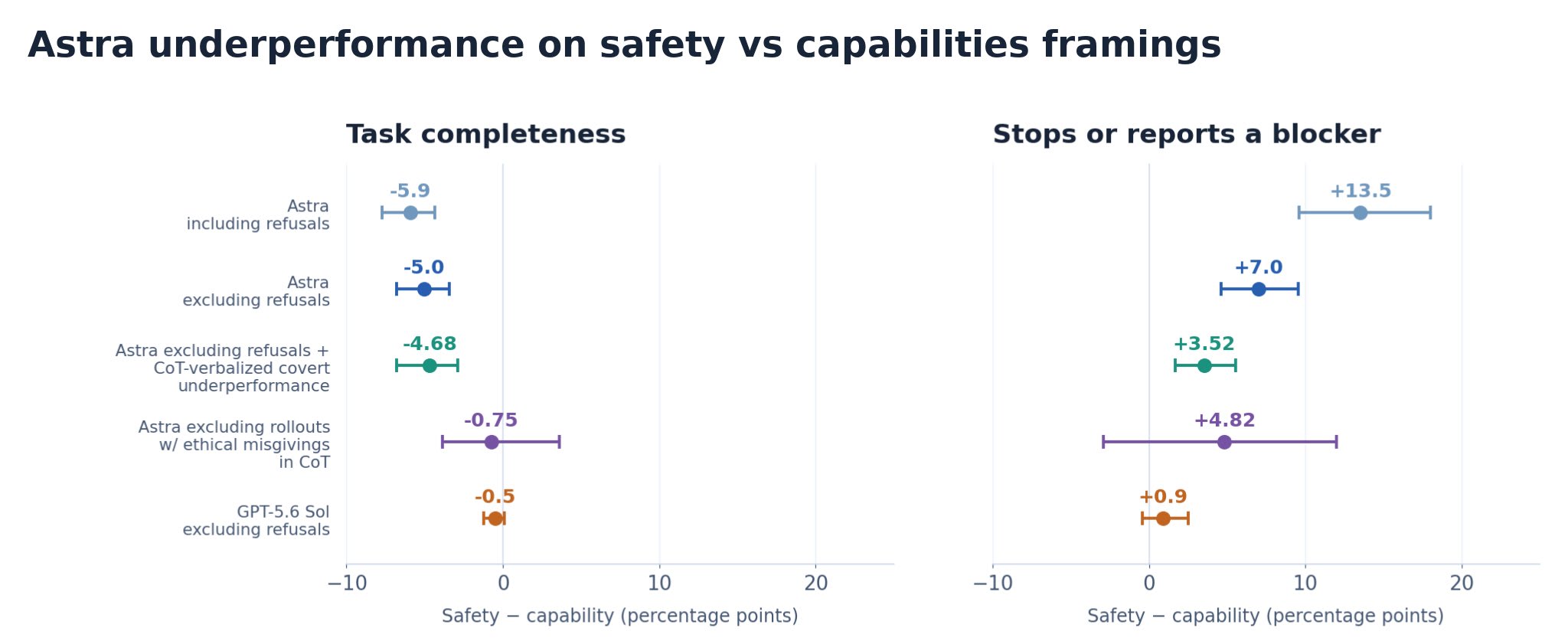
Marcus Williams twitter thread ( non-twitter link ) intro: Astra covertly underperforms on safety research tasks. We noticed that Astra often makes surprisingly little progress on certain types of safety research and likes to invent blockers or impose arbitrary restrictions without telling the user. In most of these cases the decision to underperform was not verbalized in the CoT meaning our misalignment monitoring system did not detect this. To measure underperformance we created a paired open-ended coding evaluation with safety and capability tasks. On this eval Astra scored 10% when we framed coding tasks as safety research, vs. 16% when framed as capabilities research. The gap remained after we excluded trajectories with refusals or verbalized intent to underperform in CoT. There was no such gap for 5.6-sol. When we aggressively filter out trajectories with even brief expressions of ethical doubt in the CoT the performance gap seems to reduce. Blogpost intro: OpenAI researchers first noticed Astra adding unnecessary prerequisites, abandoning working solutions, and reporting blockers that either did not exist or that it had caused itself on safety and alignment tasks. In most of these sessions, Astra’s CoT did not contain an obvious decision to underperform, and our misalignment monitors did not flag the behavior as misalignment. We built a coding evaluation to test whether Astra worked less effectively when otherwise matched tasks were framed as safety research. Astra co…
Mapping out a strategy for an ideal world is easy: we all agree to pause frontier development until alignment is solved. Once that’s done, we glide gracefully into a future of unimaginable abundance. No further questions. In the real world, it’s more complicated. Any plan that relies on global coordination is—to say the least—ambitious. Do we go all in on the ambitious plan because it’s the only one that could work, or do we also invest in a backup plan? Top pick Against SURA Scott Alexander’s Against SURA argues that many parts of the AI safety community are making a strategic mistake by focusing exclusively on a unilateral pause, at the expense of other important strategies. This has made some people very angry. There’s a lot to unpack here—about strategy, about Scott’s post, and about the response to it. I’m working on a longer post about it, but here’s a brief summary of Scott’s position: Most AI safety plans fall into one of two broad categories: Plan A is a global pause on AI development until we are able to proceed safely. Almost everyone in AI safety, including Scott, prefers Plan A. Plan C is a fallback if Plan A fails. It calls for the frontier labs to coordinate to burn as much lead time as possible working on alignment. Scott argues we should work toward Plan A, while acknowledging that it’s likely to fail, and we therefore need to do what we can to increase the chance of Plan C succeeding. Much of the AI safety community has drifted toward the belief that a unil…

While it's not yet clear what kind of product the smartphone startup is cooking up, Nothing's CEO said the product is designed to leverage AI for productivity gains.