AI/ML News & Innovations Hub

AI/ML news, top picks, and generated innovation digests.

★ Visit ai-karthik.com
422Sources
26240News Items
8Top Picks
158Blogs
runningLast Run

Latest AI/ML News

26240 matching items

Vector Institute News 2025-11-14 18:45 UTC Score 44.0 USR-0017-20251114-research-aca-0318e19a Full article

When smart AI gets too smart: Key insights from Vector’s 2025 ML Security & Privacy Workshop

Vector Institute’s 2025 Machine Learning Security & Privacy Workshop revealed critical AI safety breakthroughs and concerning vulnerabilities in current machine learning (ML) security methods. This comprehensive analysis covers the latest […] The post When smart AI gets too smart: Key insights from Vector’s 2025 ML Security & Privacy Workshop appeared first on Vector Institute for Artificial Intelligence .

Consultancy.lat AI & GenAI 2025-11-13 10:15 UTC Score 17.0 AI-177-20251113-regional-ai--75c96ef3

Altman Solon deepens Brazilian presence with new office in São Paulo

Altman Solon, a global strategy consultancy specialising in telecommunications, media, and technology (TMT), has launched a new office in São Paulo – its second in Latin America. The move in the Brazilian market formalizes the firm’s longstanding work with clients in the country – Altman Solon has been advising local companies and investors for over a decade.

Toyota Research Institute Blog 2025-11-12 20:59 UTC Score 32.0 USR-0022-20251112-research-aca-45e93a1b

Mixed Methods Scenario Development for Human-Vehicle Interaction Research: A Case Study on Winter Driving

Mixed Methods Scenario Development for Human-Vehicle Interaction Research: A Case Study on Winter Driving robyn.cherinka… Wed, 11/12/2025 - 14:59 Scenarios provide a fundamental link between driving simulators and real-world conditions, shaping the extent to which the findings of a user study can be applied to public roads. However, compared to other aspects of study design, scenario development in human–vehicle interaction research tends to receive less deliberate attention. To encourage more methodical scenario generation, this work introduces a mixed methods approach for extracting representative scenarios from an integration of three real-world data sources: aggregated crash statistics, interviews with experienced drivers, and naturalistic driving data. Through a case study on winter driving, we outline the derivation of a nighttime, two-lane road scenario from these data sources and conduct an initial driving simulator pilot study to assess its realism. We hope that this demonstration of scenario generation from quantitative and qualitative data inspires researchers to consider more rigorous methods for scenario design in future work. Read More Image Oct 8, 2025 Human Interactive Driving 1 Minute Read

Toyota Research Institute Blog 2025-11-12 20:54 UTC Score 46.0 USR-0022-20251112-research-aca-dc5ef30f

Robot Learning from Any Images

Robot Learning from Any Images robyn.cherinka… Wed, 11/12/2025 - 14:54 We introduce RoLA, a framework that transforms any in-the-wild image into an interactive, physics-enabled robotic environment. Unlike previous methods, RoLA operates directly on a single image without requiring additional hardware or digital assets. Our framework democratizes robotic data generation by producing massive visuomotor robotic demonstrations within minutes from a wide range of image sources, including camera captures, robotic datasets, and Internet images. At its core, our approach combines a novel method for single-view physical scene recovery with an efficient visual blending strategy for photorealistic data collection. We demonstrate RoLA's versatility across applications like scalable robotic data generation and augmentation, robot learning from Internet images, and single-image real-to-sim-to-real systems for manipulators and humanoids. Video results are available at this https URL . Read More Image Sep 26, 2025 Robotics 1 Minute Read

Toyota Research Institute Blog 2025-11-12 20:50 UTC Score 38.0 USR-0022-20251112-research-aca-e13d35fa

From Dashboards to Dialogue: Evaluating a Conversational AI Coach for Performance Driving Skill Development

From Dashboards to Dialogue: Evaluating a Conversational AI Coach for Performance Driving Skill Development robyn.cherinka… Wed, 11/12/2025 - 14:50 Learning in domains involving complex motor skills, such as performance driving, often requires feedback that is timely, personalized, and actionable. Yet many drivers rely on video and telemetry data to review their performance without guidance. We explore how conversational AI can support post-drive reflection by integrating LLM-generated coaching into an interactive review interface. In an exploratory within-subjects simulator study (n=16), participants completed laps under two conditions: one with video and data visualizations alone, and another with the same tools augmented with a conversational interface that provided verbal feedback after each lap. Conversational feedback supported short-term improvements in lap time, average speed, and steering control, and was rated as more useful and satisfying—though it also elicited slightly higher nervousness. These results suggest that conversational AI can make post-drive feedback more interpretable and actionable, particularly for drivers reviewing performance data in high-skill contexts like performance driving. Read More Image Oct 4, 2025 Human Interactive Driving 1 Minute Read

Toyota Research Institute Blog 2025-11-12 20:45 UTC Score 48.0 USR-0022-20251112-research-aca-cb768f39 Full article

SAFE: Multitask Failure Detection for Vision-Language-Action Models

SAFE: Multitask Failure Detection for Vision-Language-Action Models robyn.cherinka… Wed, 11/12/2025 - 14:45 While vision-language-action models (VLAs) have shown promising robotic behaviors across a diverse set of manipulation tasks, they achieve limited success rates when deployed on novel tasks out of the box. To allow these policies to safely interact with their environments, we need a failure detector that gives a timely alert such that the robot can stop, backtrack, or ask for help. However, existing failure detectors are trained and tested only on one or a few specific tasks, while generalist VLAs require the detector to generalize and detect failures also in unseen tasks and novel environments. In this paper, we introduce the multitask failure detection problem and propose SAFE, a failure detector for generalist robot policies such as VLAs. We analyze the VLA feature space and find that VLAs have sufficient highlevel knowledge about task success and failure, which is generic across different tasks. Based on this insight, we design SAFE to learn from VLA internal features and predict a single scalar indicating the likelihood of task failure. SAFE is trained on both successful and failed rollouts, and is evaluated on unseen tasks. SAFE is compatible with different policy architectures. We test it on OpenVLA, π0, and π0-FAST in both simulated and real-world environments extensively. We compare SAFE with diverse baselines and show that SAFE achieves state-of-the-art failu…

Toyota Research Institute Blog 2025-11-12 20:40 UTC Score 63.0 USR-0022-20251112-research-aca-6fff3352 Full article

STITCH-OPE: Trajectory Stitching with Guided Diffusion for Off-Policy Evaluation

STITCH-OPE: Trajectory Stitching with Guided Diffusion for Off-Policy Evaluation robyn.cherinka… Wed, 11/12/2025 - 14:40 Off-policy evaluation (OPE) estimates the performance of a target policy using offline data collected from a behavior policy, and is crucial in domains such as robotics or healthcare where direct interaction with the environment is costly or unsafe. Existing OPE methods are ineffective for high-dimensional, long-horizon problems, due to exponential blow-ups in variance from importance weighting or compounding errors from learned dynamics models. To address these challenges, we propose STITCH-OPE, a model-based generative framework that leverages denoising diffusion for long-horizon OPE in high-dimensional state and action spaces. Starting with a diffusion model pre-trained on the behavior data, STITCH-OPE generates synthetic trajectories from the target policy by guiding the denoising process using the score function of the target policy. STITCH-OPE proposes two technical innovations that make it advantageous for OPE: (1) prevents over-regularization by subtracting the score of the behavior policy during guidance, and (2) generates long-horizon trajectories by stitching partial trajectories together end-to-end. We provide a theoretical guarantee that under mild assumptions, these modifications result in an exponential reduction in variance versus long-horizon trajectory diffusion. Experiments on the D4RL and OpenAI Gym benchmarks show substantial improveme…

TWIML AI Podcast 2025-11-12 20:05 UTC Score 28.0 AI-148-20251112-podcasts-and-7874fd64 Full article

AI Orchestration for Smart Cities and the Enterprise with Robin Braun and Luke Norris - #755

Today, we're joined by Robin Braun, VP of AI business development for hybrid cloud at HPE, and Luke Norris, co-founder and CEO of Kamiwaza, to discuss how AI systems can be used to automate complex workflows and unlock value from legacy enterprise data. Robin and Luke detail high-impact use cases from HPE and Kamiwaza’s collaboration on an “Agentic Smart City” project for Vail, Colorado, including remediation and automation of website accessibility for 508 compliance, digitization and understanding of deed restrictions, and combining contextual information with camera feeds for fire detection and risk assessment. Additionally, we discuss the role of private cloud infrastructure in overcoming challenges like cost, data privacy, and compliance. Robin and Luke also share their lessons learned, including the importance of fresh data, and the value of a "mud puddle by mud puddle" approach in achieving practical AI wins. The complete show notes for this episode can be found at https://twimlai.com/go/755.

Node.js tutorial: Get started with Node
InfoWorld AI 2025-11-12 09:00 UTC Score 25.0 USR-0126-20251112-global-ai-ne-c1b03cee Full article

Node.js tutorial: Get started with Node

Node.js is a popular and versatile cross-platform JavaScript runtime environment. Node was the first runtime to allow developers to run JavaScript outside the browser, opening a new world of possibilities in server-side JavaScript . Its ease of use, massive ecosystem and performance characteristics have continued to secure its place as one of the most important technologies of the modern web. Anytime you need to run JavaScript on the server—be it for a systems utility, a REST API, data processing, or anything else—Node is an excellent choice. There are newer runtimes, namely Deno and Bun , but Node remains the standard for server-side JavaScript. Also see: 10 JavaScript concepts you need to succeed with Node . Getting started with Node If you haven’t already experienced Node, this article will introduce you. We’ll step through installing Node and the NPM package manager, spinning up a simple web server, and using the Node cluster module to take advantage of multiple CPU cores. We’ll also look at using the NPM package manager to install additional Node modules and other JavaScript packages. And we’ll dip a toe into using a Node framework, in this case the ubiquitous Express server , to create more feature-rich and flexible Node.js servers. Let’s get started! Installing Node and NPM There are a few ways to install Node , including the installer that Node itself provides , but the recommended way is with a version manager. The most common version manager is NVM . This makes it…

One Useful Thing 2025-11-12 02:46 UTC Score 25.0 USR-0105-20251112-ai-specialis-bf2c56ca Full article

Giving your AI a Job Interview

As AI advice becomes more important, we are going to need to get better at assessing it

Amazon Science AI 2025-11-11 20:05 UTC Score 59.0 AI-058-20251111-official-ai--90bf77a7 Full article

Building more accountable multi-modal LLMs through spatially-informed visual reasoning

Recent research has demonstrated that debate mechanisms among Large Language Models (LLMs) show remarkable potential for enhancing reasoning capabilities and promoting responsible text generation. However, it remains an open question whether debate strategies can effectively generalize to Multi-Modal Large Language Models (MLLMs). In this paper, we address this challenge by proposing a location-aware debate framework specifically designed for MLLMs to mitigate hallucination without requiring additional external knowledge. Our approach introduces an asymmetric debate structure across both textual and visual modalities. For textual processing, one MLLM instance generates a comprehensive image description while identifying object locations, while a second instance "zooms in" on specific regions of interest to evaluate and refine the initial descriptions. For visual processing, we introduce a novel hybrid attention module that fuses visual self-attention with cross-modal attention between textual and visual information, effectively highlighting critical content regions. The framework incorporates a judge component that evaluates the complete debate process and selects the most reliable output between the two debating instances. Our experimental results demonstrate that this approach substantially reduces hallucination across diverse MLLMs and evaluation metrics. Moreover, the framework serves as a readily integrable complement to existing hallucination mitigation methods. By emp…

Amazon Science AI 2025-11-11 19:53 UTC Score 81.0 AI-058-20251111-official-ai--83535c43 Full article

Automated composition of agents: A knapsack approach for agentic component selection

Designing effective agentic systems requires the seamless composition and integration of agents, tools, and models within dynamic and uncertain environments. Most existing methods rely on static, semantic retrieval approaches for tool or agent discovery. However, effective reuse and composition of existing components remain challenging due to incomplete capability descriptions and the limitations of retrieval methods. Component selection suffers because the decisions are not based on capability, cost, and real-time utility. To address these challenges, we introduce a structured, automated framework for agentic system composition that is inspired by the knapsack problem. Our framework enables a composer agent to systematically identify, select, and assemble an optimal set of agentic components by jointly considering performance, budget constraints, and compatibility. By dynamically testing candidate components and modeling their utility in real-time, our approach streamlines the assembly of agentic systems and facilitates scalable reuse of resources. Empirical evaluation with Claude 3.5 Sonnet across five benchmarking datasets shows that our online-knapsack-based composer consistently lies on the Pareto frontier, achieving higher success rates at significantly lower component costs compared to our baselines. In the single-agent setup, the online knapsack composer shows a success rate improvement of up to 31.6% in comparison to the retrieval baselines. In multi-agent systems,…

InfoWorld AI 2025-11-07 09:00 UTC Score 45.0 USR-0126-20251107-global-ai-ne-05ed8f6a Full article

What is generative AI? How artificial intelligence creates content

Generative AI is a kind of artificial intelligence that creates new content, including text, images, audio, and video, based on patterns it has learned from existing data. Today’s generative models are typically built on foundation-model architectures such as large-language models (LLMs) and multimodal systems, enabling them to carry on conversations, answer questions, write stories, generate code, and produce images or videos from brief prompts. Generative AI is different from discriminative AI , which draws distinctions between different kinds of input. Where discriminative AI answers questions like “Is this image of a rabbit or a lion?”, generative AI instead responds to prompts such as “Describe to me how a rabbit and lion look different from one another” or “Draw me a picture of a lion and a rabbit sitting next to each other” — and in both cases produces text or imagery that, while grounded in the AI’s training data, isn’t just a copy of something that already existed. [ Read next: Large language models: The foundations of generative AI ] Just a few years ago, generative AI was once a novelty focused on chatbots and artistic image generation. Today, it has become a core enterprise technology, and powers everything from content creation and software development to customer support and analytics workflows. But with that power comes a new set of challenges — from model alignment and hallucination to governance and data-integration hurdles. In this article, we’ll look at ho…

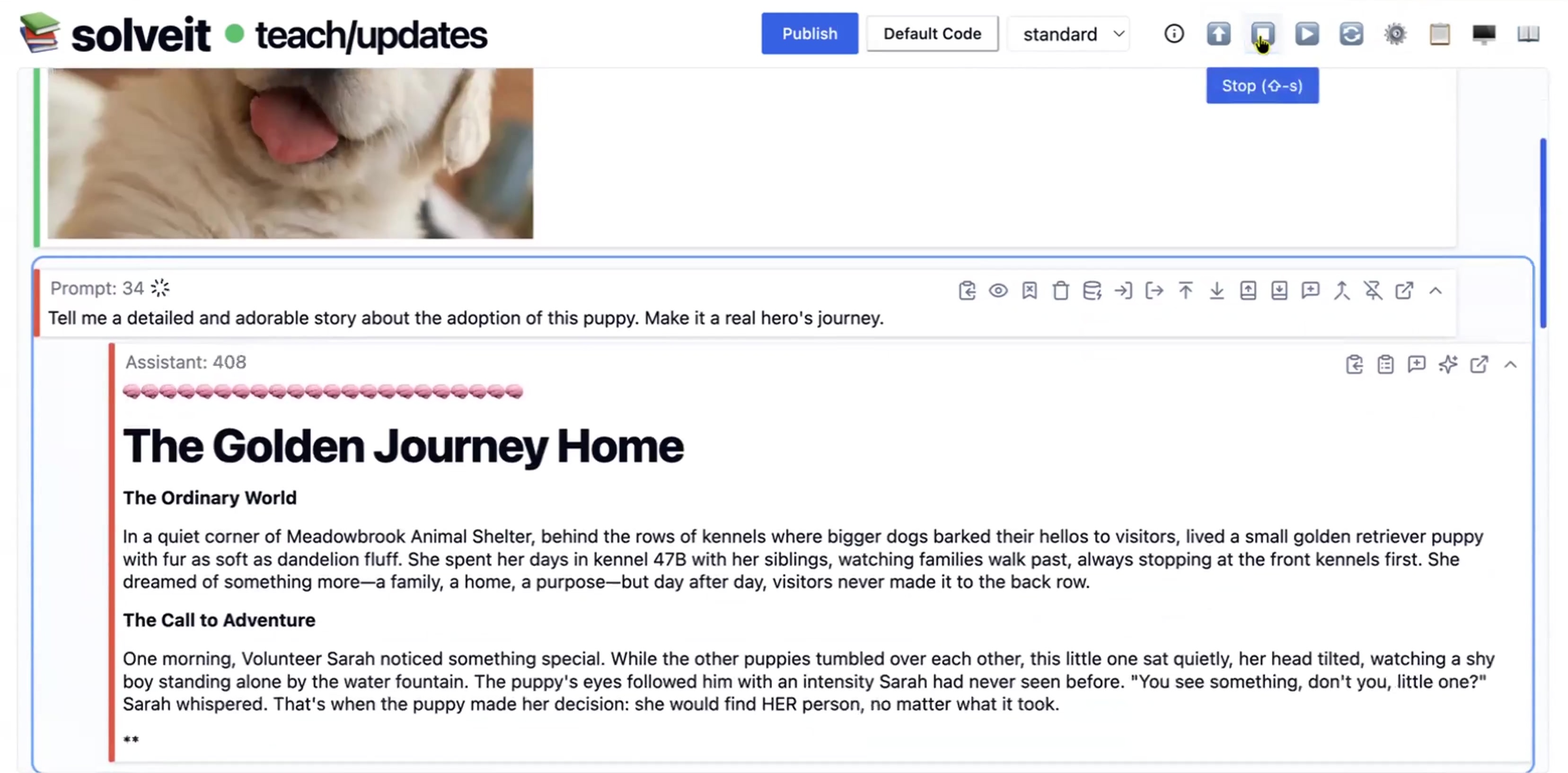
A Guide to Solveit Features
Fast.ai 2025-11-07 00:00 UTC Score 17.0 AI-185-20251107-developer-an-5851b06e Full article

A Guide to Solveit Features

An overview of the features of the Solveit platform, which is designed to make exploration and iterative development easier and faster.

EU AI Act Tracker / Explainer 2025-11-05 21:41 UTC Score 33.0 AI-010-20251105-glossary-def-077aa0d4 Full article

Modifying AI Under the EU AI Act: Lessons from Practice on Classification and Compliance

This is a guest post written by legal compliance professionals Øystein Endal, Andrea Vcric, Sidsel Nag, Nick Malter and Daylan Araz (see section about authors at the end), drawing on their experience from running or consulting businesses integrating AI. For any questions or suggestions, please contact Nick Malter at nick@trail-ml.com. Disclaimer: Please note that the […]

Deep Learning Indaba 2025-11-05 08:08 UTC Score 44.0 USR-0189-20251105-research-aca-4327a93f Full article

Building Africa’s AI Future Together

Tejumade Afonja is a PhD Researcher at the CISPA Helmholtz Center for Information Security in Germany, where her work explores trustworthy AI, generative models, and synthetic tabular data. She is the 2025 Deep Learning Indaba General Chair and previously chaired the 2023 Indaba Application & Selections Committee. Beyond academia, she is the Director of the […] The post Building Africa’s AI Future Together appeared first on Deep Learning Indaba .

TWIML AI Podcast 2025-11-04 21:30 UTC Score 28.0 AI-148-20251104-podcasts-and-6ea7d087 Full article

Building an AI Mathematician with Carina Hong - #754

In this episode, Carina Hong, founder and CEO of Axiom, joins us to discuss her work building an "AI Mathematician." Carina explains why this is a pivotal moment for AI in mathematics, citing a convergence of three key areas: the advanced reasoning capabilities of modern LLMs, the rise of formal proof languages like Lean, and breakthroughs in code generation. We explore the core technical challenges, including the massive data gap between general-purpose code and formal math code, and the difficult problem of "autoformalization," or translating natural language proofs into a machine-verifiable format. Carina also shares Axiom's vision for a self-improving system that uses a self-play loop of conjecturing and proving to discover new mathematical knowledge. Finally, we discuss the broader applications of this technology in areas like formal verification for high-stakes software and hardware. The complete show notes for this episode can be found at https://twimlai.com/go/754.

Ahead of AI 2025-11-04 13:06 UTC Score 11.0 AI-136-20251104-newsletters-48d95c6c Full article

Beyond Standard LLMs

Linear Attention Hybrids, Text Diffusion, Code World Models, and Small Recursive Transformers

[Paper Analysis] The Free Transformer (and some Variational Autoencoder stuff)
Yannic Kilcher 2025-11-01 17:39 UTC Score 25.0 AI-140-20251101-podcasts-and-c32aedc7 Full article

[Paper Analysis] The Free Transformer (and some Variational Autoencoder stuff)

https://arxiv.org/abs/2510.17558 Abstract: We propose an extension of the decoder Transformer that conditions its generative process on random latent variables which are learned without supervision thanks to a variational procedure. Experimental evaluations show that allowing such a conditioning translates into substantial improvements on downstream tasks. Author: François Fleuret Links: Homepage: https://ykilcher.com Merch: https://ykilcher.com/merch YouTube: https://www.youtube.com/c/yannickilcher Twitter: https://twitter.com/ykilcher Discord: https://ykilcher.com/discord LinkedIn: https://www.linkedin.com/in/ykilcher If you want to support me, the best thing to do is to share out the content :) If you want to support me financially (completely optional and voluntary, but a lot of people have asked for this): SubscribeStar: https://www.subscribestar.com/yannickilcher Patreon: https://www.patreon.com/yannickilcher Bitcoin (BTC): bc1q49lsw3q325tr58ygf8sudx2dqfguclvngvy2cq Ethereum (ETH): 0x7ad3513E3B8f66799f507Aa7874b1B0eBC7F85e2 Litecoin (LTC): LQW2TRyKYetVC8WjFkhpPhtpbDM4Vw7r9m Monero (XMR): 4ACL8AGrEo5hAir8A9CeVrW8pEauWvnp1WnSDZxW7tziCDLhZAGsgzhRQABDnFy8yuM9fWJDviJPHKRjV4FWt19CJZN9D4n

Berkeley AI Research Blog 2025-11-01 09:00 UTC Score 33.0 USR-0004-20251101-research-aca-9fd7868d Full article

RL without TD learning

In this post, I’ll introduce a reinforcement learning (RL) algorithm based on an “alternative” paradigm: divide and conquer . Unlike traditional methods, this algorithm is not based on temporal difference (TD) learning (which has scalability challenges ), and scales well to long-horizon tasks. We can do Reinforcement Learning (RL) based on divide and conquer, instead of temporal difference (TD) learning. Problem setting: off-policy RL Our problem setting is off-policy RL . Let’s briefly review what this means. There are two classes of algorithms in RL: on-policy RL and off-policy RL. On-policy RL means we can only use fresh data collected by the current policy. In other words, we have to throw away old data each time we update the policy. Algorithms like PPO and GRPO (and policy gradient methods in general) belong to this category. Off-policy RL means we don’t have this restriction: we can use any kind of data, including old experience, human demonstrations, Internet data, and so on. So off-policy RL is more general and flexible than on-policy RL (and of course harder!). Q-learning is the most well-known off-policy RL algorithm. In domains where data collection is expensive ( e.g. , robotics , dialogue systems, healthcare, etc.), we often have no choice but to use off-policy RL. That’s why it’s such an important problem. As of 2025, I think we have reasonably good recipes for scaling up on-policy RL ( e.g. , PPO, GRPO, and their variants). However, we still haven’t found a “…

Unit testing Spring MVC applications with JUnit 5
InfoWorld AI 2025-10-30 09:00 UTC Score 22.0 USR-0126-20251030-global-ai-ne-333de9f2 Full article

Unit testing Spring MVC applications with JUnit 5

Spring is a reliable and popular framework for building web and enterprise Java applications. In this article, you’ll learn how to unit test each layer of a Spring MVC application, using built-in testing tools from JUnit 5 and Spring to mock each component’s dependencies. In addition to unit testing with MockMvc, Mockito, and Spring’s TestEntityManager , I’ll also briefly introduce slice testing using the @WebMvcTest and @DataJpaTest annotations, used to optimize unit tests on web controllers and databases. Also see: How to test your Java applications with JUnit 5 . Overview of testing Spring MVC applications Spring MVC applications are defined using three technology layers: Controllers accept web requests and return web responses. Services implement the application’s business logic. Repositories persist data to and from your back-end SQL or NoSQL database. When we unit test Spring MVC applications, we test each layer separately from the others. We create mock implementations, typically using Mockito , for each layer’s dependencies, then we simulate the logic we want to test. For example, a controller may call a service to retrieve a list of objects. When testing the controller, we create a mock service that either returns the list of objects, returns an empty list, or throws an exception. This test ensures the controller behaves correctly. We’ll use Spring MVC to build and test a simple web service that manages widgets. The structure of the web service is shown here: Steven…

Build to Last
Fast.ai 2025-10-30 00:00 UTC Score 13.0 AI-185-20251030-developer-an-5fa2d596 Full article

Build to Last

Chris Lattner on software craftsmanship and AI

What’s the Go language really good for?
InfoWorld AI 2025-10-29 09:00 UTC Score 25.0 USR-0126-20251029-global-ai-ne-3f06acad Full article

What’s the Go language really good for?

Over its more than 15 years in the wild, Google’s Go programming language has evolved from a curiosity for alpha geeks to the battle-tested programming language behind some of the world’s most important cloud-native software projects. If you’ve ever wondered why Go is the language of choice for projects like Docker and Kubernetes , this article is for you. We’ll discuss Go’s defining characteristics and how it differs from other programming languages. You will also learn what kinds of projects Go is best suited for, including the state of Go development for AI-powered tools . We’ll conclude with an overview of Go’s feature set, some limitations of the language, and where it may be going from here. Also see: Golang tutorial: Get started with the Go language . Go is small and simple Go, or Golang as it’s often called, was created by Google employees—chiefly longtime Unix guru and Google distinguished engineer Rob Pike—but it’s not strictly speaking a “Google project.” Rather, Go is a community-developed open source project, spearheaded by leadership with strong opinions about how Go should be used and the direction the language should take. Go is meant to be easy to learn and straightforward to use, with syntax that is simple to read and understand. Go does not have a large feature set, especially when compared to languages like C++ . Go’s syntax is reminiscent of C , making it relatively easy for longtime C developers to learn. That said, many features of Go, especially its c…

TWIML AI Podcast 2025-10-28 20:26 UTC Score 56.0 AI-148-20251028-podcasts-and-240f74bd Full article

High-Efficiency Diffusion Models for On-Device Image Generation and Editing with Hung Bui - #753

In this episode, Hung Bui, Technology Vice President at Qualcomm, joins us to explore the latest high-efficiency techniques for running generative AI, particularly diffusion models, on-device. We dive deep into the technical challenges of deploying these models, which are powerful but computationally expensive due to their iterative sampling process. Hung details his team's work on SwiftBrush and SwiftEdit, which enable high-quality text-to-image generation and editing in a single inference step. He explains their novel distillation framework, where a multi-step teacher model guides the training of an efficient, single-step student model. We explore the architecture and training, including the use of a secondary 'coach' network that aligns the student's denoising function with the teacher's, allowing the model to bypass the iterative process entirely. Finally, we discuss how these efficiency breakthroughs pave the way for personalized on-device agents and the challenges of running reasoning models with techniques like inference-time scaling under a fixed compute budget. The complete show notes for this episode can be found at https://twimlai.com/go/753.

LatAm Journalism Review AI 2025-10-27 20:06 UTC Score 15.0 AI-176-20251027-regional-ai--bf7f6055 Full article

LATAM Digital Media Festival 2025 to discuss AI, influencers, migration and more in Mexico City

From Nov. 5 to 7, the LATAM Digital Media and Journalism Festival will bring together more than 55 journalists and creators from 14 countries to Mexico City to explore the challenges of journalism in an era full of contrasts. This year, the Festival —organized by the organization Factual — will revolve around six major themes, […] The post LATAM Digital Media Festival 2025 to discuss AI, influencers, migration and more in Mexico City appeared first on LatAm Journalism Review by the Knight Center .

LatAm Journalism Review AI 2025-10-27 20:06 UTC Score 15.0 AI-176-20251027-regional-ai--acc9a0a3 Full article

LATAM Digital Media Festival 2025 to discuss AI, influencers, migration and more in Mexico City

From Nov. 5 to 7, the LATAM Digital Media and Journalism Festival will bring together more than 55 journalists and creators from 14 countries to Mexico City to explore the challenges of journalism in an era full of contrasts. This year, the Festival —organized by the organization Factual — will revolve around six major themes, […] The post LATAM Digital Media Festival 2025 to discuss AI, influencers, migration and more in Mexico City appeared first on LatAm Journalism Review by the Knight Center .

Do programming certifications still matter?
InfoWorld AI 2025-10-27 09:00 UTC Score 18.0 USR-0126-20251027-global-ai-ne-2f4d0652 Full article

Do programming certifications still matter?

If you’re a software developer or architect, you might wonder if programming certifications are still worth the effort, especially in the era of rapid AI-driven evolution . The short answer is, it depends. “Certifications are shifting from a checkbox to a compass. They’re less about proving you memorized syntax and more about proving you can architect systems, instruct AI coding assistants, and solve problems end-to-end,” says Faizel Khan, lead AI engineer at Landing Point , an executive search and recruiting firm. “In the AI era, fewer students will get trained on the job, which means they have to train themselves,” Khan says. “Certifications—especially architectural ones like AWS, Kubernetes, Terraform—are still the clearest path to do that.” Pros and cons of programming certifications It’s not all black and white when it comes to deciding whether to pursue programming certifications. The effort involves both pros and cons. “In terms of pros, certifications concretely demonstrate that you have a skillset at a documented level,” says Chris Riccio, vice president of engineering at Uplevel , an engineering optimization system provider. “They also show that you’ve put in the time and effort to learn, study, and prepare.” Programming certifications are “a useful way to validate foundational skills and show that someone understands core concepts,” says Greg Fuller, vice president of Skillsoft’s training provider, Codecademy . “They’re especially helpful for people entering the f…

TWIML AI Podcast 2025-10-22 15:45 UTC Score 42.0 AI-148-20251022-podcasts-and-4de04c54 Full article

Vibe Coding's Uncanny Valley with Alexandre Pesant - #752

Today, we're joined by Alexandre Pesant, AI lead at Lovable, who joins us to discuss the evolution and practice of vibe coding. Alex shares his take on how AI is enabling a shift in software development from typing characters to expressing intent, creating a new layer of abstraction similar to how high-level code compiles to machine code. We explore the current capabilities and limitations of coding agents, the importance of context engineering, and the practices that separate successful vibe coders from frustrated ones. Alex also shares Lovable’s technical journey, from an early, complex agent architecture that failed, to a simpler workflow-based system, and back again to an agentic approach as foundation models improved. He also details the company's massive scaling challenges—like accidentally taking down GitHub—and makes the case for why robust evaluations and more expressive user interfaces are the most critical components for AI-native development tools to succeed in the near future. The complete show notes for this episode can be found at https://twimlai.com/go/752.

How to use Python dataclasses
InfoWorld AI 2025-10-22 09:00 UTC Score 10.0 USR-0126-20251022-global-ai-ne-df92087c Full article

How to use Python dataclasses

Everything in Python is an object, or so the saying goes. If you want to create your own custom objects, with their own properties and methods, you use Python’s class object to do it. But creating classes in Python sometimes means writing loads of repetitive, boilerplate code; for example, to set up the class instance from the parameters passed to it or to create common functions like comparison operators. Dataclasses, introduced in Python 3.7 ( and backported to Python 3.6 ), provide a handy, less-verbose way to create classes. Many of the common things you do in a class, like instantiating properties from the arguments passed to the class, can be reduced to a few basic instructions by using dataclasses. The backstage power of Python dataclasses Consider this example of a conventional class in Python: class Book: '''Object for tracking physical books in a collection.''' def __init__(self, name: str, weight: float, shelf_id:int = 0): self.name = name self.weight = weight # in grams, for calculating shipping self.shelf_id = shelf_id def __repr__(self): return(f"Book(name={self.name!r}, weight={self.weight!r}, shelf_id={self.shelf_id!r})") The biggest headache here is that you must copy each of the arguments passed to __init__ to the object’s properties. This isn’t so bad if you’re only dealing with Book , but what if you have additional classes—say, a Bookshelf , Library , Warehouse , and so on? Plus, typing all that code by hand increases your chances of making a mistake. He…


[Video Response] What Cloudflare's code mode misses about MCP and tool calling
Yannic Kilcher 2025-10-19 10:58 UTC Score 22.0 AI-140-20251019-podcasts-and-7a5baf66 Full article

[Video Response] What Cloudflare's code mode misses about MCP and tool calling

Theo's Video: https://www.youtube.com/watch?v=bAYZjVAodoo Cloudflare article: https://blog.cloudflare.com/code-mode/ Links: Homepage: https://ykilcher.com Merch: https://ykilcher.com/merch YouTube: https://www.youtube.com/c/yannickilcher Twitter: https://twitter.com/ykilcher Discord: https://ykilcher.com/discord LinkedIn: https://www.linkedin.com/in/ykilcher If you want to support me, the best thing to do is to share out the content :) If you want to support me financially (completely optional and voluntary, but a lot of people have asked for this): SubscribeStar: https://www.subscribestar.com/yannickilcher Patreon: https://www.patreon.com/yannickilcher Bitcoin (BTC): bc1q49lsw3q325tr58ygf8sudx2dqfguclvngvy2cq Ethereum (ETH): 0x7ad3513E3B8f66799f507Aa7874b1B0eBC7F85e2 Litecoin (LTC): LQW2TRyKYetVC8WjFkhpPhtpbDM4Vw7r9m Monero (XMR): 4ACL8AGrEo5hAir8A9CeVrW8pEauWvnp1WnSDZxW7tziCDLhZAGsgzhRQABDnFy8yuM9fWJDviJPHKRjV4FWt19CJZN9D4n

7 newer data science tools you should be using with Python
InfoWorld AI 2025-10-15 09:00 UTC Score 20.0 USR-0126-20251015-global-ai-ne-6f4fc0f5 Full article

7 newer data science tools you should be using with Python

Python’s rich ecosystem of data science tools is a big draw for users. The only downside of such a broad and deep collection is that sometimes the best tools can get overlooked. Here’s a rundown of some of the best newer or less-known data science projects available for Python . Some, like Polars, are getting more attention but still deserve wider notice. Others, like ConnectorX, are hidden gems. ConnectorX Most data sits in a database somewhere, but computation typically happens outside of it. Getting data to and from the database for actual work can be a slowdown. ConnectorX loads data from databases into many common data-wrangling tools in Python, and it keeps things fast by minimizing the work required. Most of the data loading can be done in just a couple of lines of Python code and an SQL query . Like Polars (which I’ll discuss shortly), ConnectorX uses a Rust library at its core. This allows for optimizations like being able to load from a data source in parallel with partitioning. Data in PostgreSQL , for instance, can be loaded this way by specifying a partition column. Aside from PostgreSQL, ConnectorX also supports reading from MySQL/MariaDB, SQLite, Amazon Redshift, Microsoft SQL Server and Azure SQL, and Oracle. The results can be funneled into a Pandas or PyArrow DataFrame, or into Modin or Dask (via Pandas), or Polars (via PyArrow). General support for reading from ODBC is a work in progress. DuckDB Data science folks who use Python ought to be aware of SQLite…

AI Now Institute 2025-10-14 20:59 UTC Score 27.0 USR-0135-20251014-ai-specialis-bd358d72 Full article

AI Now’s Partnership and Strategy Lead Alli Finn Testifies at the Philadelphia City Council Committee on Technology and Information Services

On October 15, 2025, AI Now’s Partnership and Strategy Lead Alli Finn will provide Testimony to the Philadelphia City Council Committee on Technology and Information Services. Read their full Testimony, Public Policymaking on AI: Invest in People, Not in Corporate Power, below: The post AI Now’s Partnership and Strategy Lead Alli Finn Testifies at the Philadelphia City Council Committee on Technology and Information Services appeared first on AI Now Institute .

TWIML AI Podcast 2025-10-14 19:39 UTC Score 48.0 AI-148-20251014-podcasts-and-5abac3b6 Full article

Dataflow Computing for AI Inference with Kunle Olukotun - #751

In this episode, we're joined by Kunle Olukotun, professor of electrical engineering and computer science at Stanford University and co-founder and chief technologist at Sambanova Systems, to discuss reconfigurable dataflow architectures for AI inference. Kunle explains the core idea of building computers that are dynamically configured to match the dataflow graph of an AI model, moving beyond the traditional instruction-fetch paradigm of CPUs and GPUs. We explore how this architecture is well-suited for LLM inference, reducing memory bandwidth bottlenecks and improving performance. Kunle reviews how this system also enables efficient multi-model serving and agentic workflows through its large, tiered memory and fast model-switching capabilities. Finally, we discuss his research into future dynamic reconfigurable architectures, and the use of AI agents to build compilers for new hardware. The complete show notes for this episode can be found at https://twimlai.com/go/751.

[Paper Analysis] On the Theoretical Limitations of Embedding-Based Retrieval (Warning: Rant)
Yannic Kilcher 2025-10-11 16:07 UTC Score 60.0 AI-140-20251011-podcasts-and-57a82439 Full article

[Paper Analysis] On the Theoretical Limitations of Embedding-Based Retrieval (Warning: Rant)

Paper: https://arxiv.org/abs/2508.21038 Abstract: Vector embeddings have been tasked with an ever-increasing set of retrieval tasks over the years, with a nascent rise in using them for reasoning, instruction-following, coding, and more. These new benchmarks push embeddings to work for any query and any notion of relevance that could be given. While prior works have pointed out theoretical limitations of vector embeddings, there is a common assumption that these difficulties are exclusively due to unrealistic queries, and those that are not can be overcome with better training data and larger models. In this work, we demonstrate that we may encounter these theoretical limitations in realistic settings with extremely simple queries. We connect known results in learning theory, showing that the number of top-k subsets of documents capable of being returned as the result of some query is limited by the dimension of the embedding. We empirically show that this holds true even if we restrict to k=2, and directly optimize on the test set with free parameterized embeddings. We then create a realistic dataset called LIMIT that stress tests models based on these theoretical results, and observe that even state-of-the-art models fail on this dataset despite the simple nature of the task. Our work shows the limits of embedding models under the existing single vector paradigm and calls for future research to develop methods that can resolve this fundamental limitation. Authors: Orion We…