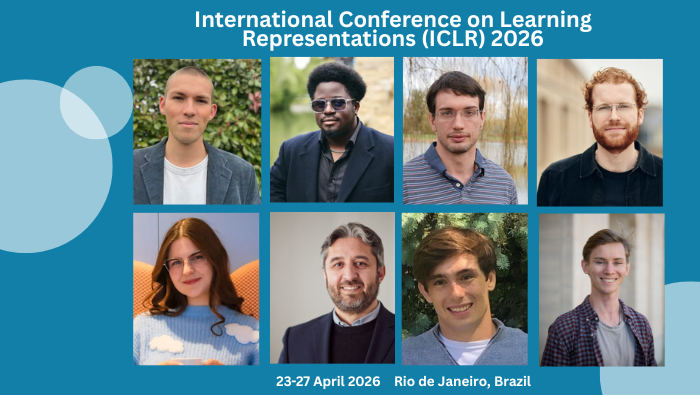
Oxford Internet Institute researchers head to Rio for ICLR 2026
OII researchers and DPhil students will attend the 14th International Conference on Learning Representations in Rio de Janeiro from 23–27 April 2026.
AI/ML news, top picks, and generated innovation digests.
31071 matching items
OII researchers and DPhil students will attend the 14th International Conference on Learning Representations in Rio de Janeiro from 23–27 April 2026.
For the past 10 years, Ai2 has built open, real-time tools that help people protect wildlife, oceans, and ecosystems around the world.
AI added new ways to search code, but not all of them apply to every problem. Here’s how to choose between Code Search, Deep Search, and MCP.
AI added new ways to search code, but not all of them apply to every problem. Here’s how to choose between Code Search, Deep Search, and MCP.
Leveraging commuting patterns and workplace charging to advance equitable EV charger access robyn.cherinka… Tue, 04/21/2026 - 13:24 This study introduces a framework for improving accessibility to and quantifying social equity priorities in electric vehicle charging infrastructure through strategic workplace charger placement. We develop a customizable equity evaluation model that quantifies access disparities across demographic groups. This model is used to construct an optimization framework that informs charging infrastructure deployment decisions. Leveraging commuting patterns, we demonstrate in the case study of Oakland, California that strategically placing workplace charging can achieve, on average, a 1.8-fold reduction in accessible charging resource disparities compared to benchmark scenarios. Our analysis reveals that targeted workplace charger deployment in high-commuter zones can disproportionately improve citywide equity. The framework provides policymakers with quantifiable metrics to evaluate trade-offs between sometimes divergent equity considerations (e.g., income, housing type) and offers practical insights for achieving more equitable charging infrastructure distribution. Image Nov 15, 2025 Human-Centered AI Read More 1 Minute Read
Short-Range Order and LixTM4−x Probability Maps for Disordered Rocksalt Cathodes robyn.cherinka… Tue, 04/21/2026 - 13:16 Short-range order (SRO) in the cation-disordered state is a controlling factor influencing the probability of finding tetrahedron clusters in disordered rocksalt (DRX) cathode materials. However, the prevalent probability below the random limit across reported DRX compositions has not been systematically investigated, active strategies to surpass the random limit of probability are lacking, and the fundamental ordering behavior on the face-centered cubic (FCC) lattice remains insufficiently explored. This research quantitatively examines pair SRO parameters and probabilities via exhaustive Monte Carlo mapping across a simplified subset of the parameter space. The results indicate that, in the disordered state, the probability is governed by the nearest neighbor (NN) pairwise SRO parameter, and that these quantities do not necessarily represent a simple attenuation of their corresponding low-temperature long-range order, particularly for the important cases of Layered and Spinel-like orderings. Strategies are proposed to mitigate or even reverse the lithium and transition metals mixing tendency of NN pair SRO to achieve probabilities that exceed the random limit. This study advances the fundamental thermodynamic understanding of ordering behaviors, which can be generalized to any FCC system. Image Mar 11, 2026 Energy & Materials Read More 1 Minute Read
Date: 2 April 2026 Venue: Darlin Sofola Cinnamon Centre Partnership School: Surulere Girls Senior Secondary School The AI Literacy outreach […]
Billion-dollar tech platforms are aggressively pushing for deregulation of the “Uber for nursing” industry in an effort to expand gig work in the healthcare sector, according to a report published on Tuesday. The post ‘Uber for nurses’: gig-work apps lobby to deregulate healthcare, report finds appeared first on AI Now Institute .
One of the biggest challenges when it comes to agent development is quality. It’s getting easier every day to spin up an MVP or demo of an agent that accomplishes complex tasks through an array of tool calls, context retrieval steps, and system prompts. But it’s still hard to know whether that agent will perform […] The post Introducing Opik Test Suites: Straightforward Unit & Regression Testing for AI Agents appeared first on Comet .
Watch this "Ethics Empowered" event, in which an expert panel grapples with the challenges of AI agents in multilateral and diplomatic spaces.
As AI assistants and privacy proxies challenge the capabilities of traditional bot detection, the Web needs new models for accountability. We believe that control should remain with the client, and that an open ecosystem of anonymous credentials is key to preserving user privacy while protecting origins from abuse.
[…] Explained: Registration Of Online Games Under Draft Online Gaming Rules, 2025 […]
I. Introduction We want to measure and understand how much AI agents can accelerate AI R&D and how this is changing over time. There are various sources of evidence we can look to here, including anecdotes about autonomous contributions ( AlphaEvolve and TTT-Discover speeding up a GPU kernels, autoresearch yielding speedups in nanochat), progress on benchmarks, and uplift measurement (see our recent post for a longer discussion). One interesting source of evidence is cumulative progress on publicly tracked challenges like the NanoGPT speedrun, where we can compare agent contributions to human progress over time. Such challenges and leaderboards of cumulative progress on a task are especially useful when: The task maps to real AI R&D (e.g., pretraining a language model) Many contributors have built up a rich history of progress, giving a rough sense of how much human effort went into it (a cost curve) Agents can compete under comparable conditions and potentially make new contributions Let’s look at one such leaderboard: the nanogpt speedrun . The goal is to train a language model to a target validation loss on FineWeb using 8×H100 GPUs as fast as possible . It’s a small-scale version of LLM pretraining with a public history of contributions, with four recent ones credited to AI agents as of April 2026. The optimization activities map to pretraining research such as architecture changes, writing kernels, and improving optimizers. Contributions, such as the Muon optimizer , ha…
[…] Claude Opus 4 and 4.1 Can Now End Harmful Conversations With Users Unilaterally […]
A deep dive into Engram, our managed memory service for agents which is simple to get started but adaptable to any use case.
We audited what it would take to build a Sourcegraph equivalent internally, mapped the platform to 90 engineering requirements across 10 categories, and modeled 3-year costs for different environment sizes.
We audited what it would take to build a Sourcegraph equivalent internally, mapped the platform to 90 engineering requirements across 10 categories, and modeled 3-year costs for different environment sizes.
The post Pairing geotechnical data with AI helps New Zealand build better appeared first on Source .
Why AI safety benchmarks degrade over time - and the infrastructure MLCommons is building to keep AILuminate reliable as frontier models advance. The post Fresh Benchmarks, Reliable Scores: Introducing Continuous Prompt Stewardship for AI Risk Evaluation appeared first on MLCommons .
The complex factors that determine the single evaluation number so many focus on. Plus, how this changes in the future.
Google's once-forgotten Cloud division is making a run on the strength of Gemini. Here's what it needs to continue its ascent.
A seismic shift is rocking the healthcare industry. Uber’s business model—the “gigification” of labor—and lobbying practices have made their way to healthcare staffing. The post Uber For Nursing Part II appeared first on AI Now Institute .
In May 2026, the Research ICT Africa team travels to Lusaka, Zambia, to participate in one of the world’s leading summits on human rights in the digital age. RightsCon boasts […] The post RIA at RightsCon 2026 appeared first on Research ICT Africa .
Learn about how we built a CI-native AI code reviewer using OpenCode that helps our engineers ship better, safer code.
We built our internal AI engineering stack on the same products we ship. That means 20 million requests routed through AI Gateway, 241 billion tokens processed, and inference running on Workers AI, serving more than 3,683 internal users. Here's how we did it.
Agents Week 2026 is a wrap. Let’s take a look at everything we announced, from compute and security to the agent toolbox, platform tools, and the emerging agentic web. Everything we shipped for the agentic cloud.

At what point do the financial markets price in the singularity?
GRASP is a new gradient-based planner for learned dynamics (a “world model”) that makes long-horizon planning practical by (1) lifting the trajectory into virtual states so optimization is parallel across time, (2) adding stochasticity directly to the state iterates for exploration, and (3) reshaping gradients so actions get clean signals while we avoid brittle “state-input” gradients through high-dimensional vision models. Large, learned world models are becoming increasingly capable. They can predict long sequences of future observations in high-dimensional visual spaces and generalize across tasks in ways that were difficult to imagine a few years ago. As these models scale, they start to look less like task-specific predictors and more like general-purpose simulators. But having a powerful predictive model is not the same as being able to use it effectively for control/learning/planning. In practice, long-horizon planning with modern world models remains fragile: optimization becomes ill-conditioned, non-greedy structure creates bad local minima, and high-dimensional latent spaces introduce subtle failure modes. In this blog post, I describe the problems that motivated this project and our approach to address them: why planning with modern world models can be surprisingly fragile, why long horizons are the real stress test, and what we changed to make gradient-based planning much more robust. This blog post discusses work done with Mike Rabbat, Aditi Krishnapriyan, Yann…
BAR is a recipe for post-training language models one capability at a time—train domain experts independently, merge them into a single mixture-of-experts model, and upgrade any expert without impacting the others.
[…] Reliance Posts 10% Revenue Growth In Q3FY26 As Jio Crosses 500 Million Subscribers […]
[…] asset management business, operated through the Jio-BlackRock joint venture, reported assets under management of Rs 15,218 crore across 10 funds, with a retail […]
A learning-oriented workflow for understanding new open-weight model releases

I'm modeling the effect of a treatment on a population of flies. For each fly, I have the following covariates: Treatment (control or treated) Sex Cage in which the fly was reared. I have 3 cages of treated flies and 3 cages of control flies. 96-well plate on which the fly was sequenced. Each plate is entirely treatment or entirely control flies, from a mix of the 3 cages of that treatment. (i.e., plate is nested within treatment, and cage is nested within treatment, but plate and cage are not nested in each other). and I also have my response variable, which is continuous and determined by the sequencing. I'd think to model this using a mixed-effects model, treating treatment and sex as fixed effects and cage and plate as random: Response ~ treatment + sex + 1|cage + 1|plate I have no issues with this so far, but I'm interested in applying a permutation test to this data and am not sure how best to do so. I want to build a null distribution of test statistics for the treatment fixed effect. As I understand it, I could just shuffle treatment labels to get a null distribution: Response ~ treatment_permuted + sex + 1|cage + 1|plate However, I'm concerned that the random effects here will be based on the variance associated with the true treatment, and will not be truly permuted. Alternatively, I could use the permuted treatment labels in making new cage:treatment and plate:treatment groups for the random effects, but then I'd have more of these groups than in my true case, sin…
Join us at RightsCon 2026 for a timely and critical conversation on the future of digital public infrastructure (DPI) in the Global South. Across the Global South, digital public infrastructure […] The post RightsCon 2026: South-South Digital Public Infrastructure Approaches: Challenges and Opportunities appeared first on Research ICT Africa .
The Agent Readiness score can help site owners understand how well their websites support AI agents. Here we explore new standards, share Radar data, and detail how we made Cloudflare’s docs the most agent-friendly on the web.
Today, we’re excited to give you a sneak peek of our support for shared compression dictionaries, show you how it improves page load times, and reveal when you’ll be able to try the beta yourself.
Cloudflare Agent Memory is a managed service that gives AI agents persistent memory, allowing them to recall what matters, forget what doesn't, and get smarter over time.
Running LLMs across Cloudflare’s network requires us to be smarter and more efficient about GPU memory bandwidth. That’s why we developed Unweight, a lossless inference-time compression system that achieves up to a 22% model footprint reduction, so that we can deliver faster and cheaper inference than ever before.
Soft directives don’t stop crawlers from ingesting deprecated content. Redirects for AI Training allows anybody on Cloudflare to redirect verified crawlers to canonical pages with one toggle and no origin changes.
In the first quarter of 2026, four African countries have advanced significant AI governance instruments. South Africa’s Cabinet approved a Draft National AI Policy for public comment on 2 April. […] The post Rapid Response Webinar Series: AI Governance in Africa appeared first on Research ICT Africa .
[…] Why the IRDAI Is Not Allowing Insurance Manufacturing Licenses for VC-Backed Fintechs […]
The EU Commission’s policy on data centers keeps information on the energy and water use of individual centers under wraps. Research by Corporate and Europe Observatory and AlgorithmWatch, published by Investigate Europe, reveals the Commission copied and pasted an amendment suggested by Microsoft and the lobby group Digital Europe. The aim: To prevent NGOs from obtaining information on energy-hungry data centers in the face of growing resistance.
When their key product was faced with unfavorable scientific evidence and the risk of regulation, most businesses in the 20th century defended themselves by sowing doubt on an industrial scale. Big AI is doing something radically different: it floods the zone with potential future risks.
In this episode, Rashmi Shetty, senior director of enterprise generative AI platform at Capital One, joins us to explore how the company is designing, deploying, and scaling multi-agent systems in a highly regulated environment. Rashmi walks us through Chat Concierge, a multi-agent chat experience for auto dealerships that handles intent disambiguation, tool invocation, and human handoffs to deliver safer, more personalized customer journeys. We discuss Capital One’s platform-centric approach to AI agents and how it separates design from runtime governance, embedding policies, guardrails, and cyber controls across agent threat boundaries. Rashmi shares how the team approaches the developer experience for agent builders, observability, and evals for stochastic, multi-agent workflows; and strategies for model specialization, including fine-tuning and distillation. We also cover standards and abstraction, closed-loop learning from production telemetry, and key lessons for enterprises building agentic systems. The complete show notes for this episode can be found at https://twimlai.com/go/765.
Introducing CRUX, a new project for evaluating AI on long, messy tasks
Learn how Github uses eBPF to detect and prevent circular dependencies in its deployment tooling. The post How GitHub uses eBPF to improve deployment safety appeared first on The GitHub Blog .
Aarathi Krishnan, CEO of Raksha Intelligence Futures, discusses the political, economic, and technological dynamics shaping this moment of uncertainty and transition in the global system.
President Trump said during an interview aired yesterday by Fox Business that “there should be” when asked if AI needs […]
Autonomous driving is not just a big tech or closed-source game, it's becoming accessible through open innovation and real-world deployment. Dan and Chris sit down with Harald Schäfer, CTO at Comma AI, to explore how OpenPilot is bringing self-driving to everyday vehicles using open source AI. We dive into the intersection of machine learning, robotics, and simulation, including how world models are enabling training at scale and shaping the future of autonomy. Featuring: Harald Schäfer – LinkedIn Chris Benson – Website , LinkedIn , Bluesky , GitHub , X Daniel Whitenack – Website , GitHub , X Links: Comma Upcoming Events: Register for upcoming webinars here !
Organizations face growing pressure to adopt artificial intelligence, but often lack practical guidance on how to do so effectively. This report bridges the gap between high-level principles and real-world implementation, offering actionable steps across the AI adoption life cycle. Drawing on over 1,200 resources, this reference guide provides practitioners with the knowledge required to operationalize AI safety, security, and governance practices within their organizations. The post Operationalizing AI Guidance: A Reference Guide for Translating High-Level Goals into Practical Implementation appeared first on Center for Security and Emerging Technology .